
Aari Embroidery: The Ancient Hook Technique Behind Luxury Indian Fashion
If you've ever run your fingers over the surface of a finely embroidered Indian outfit and felt those raised, intricate florals — chances are you were touching aari work. Aari embroidery, also called ari or hook embroidery, is one of the oldest and most refined needlework traditions in India, and it remains the backbone of luxury Indian fashion today.
What Is Aari Embroidery?
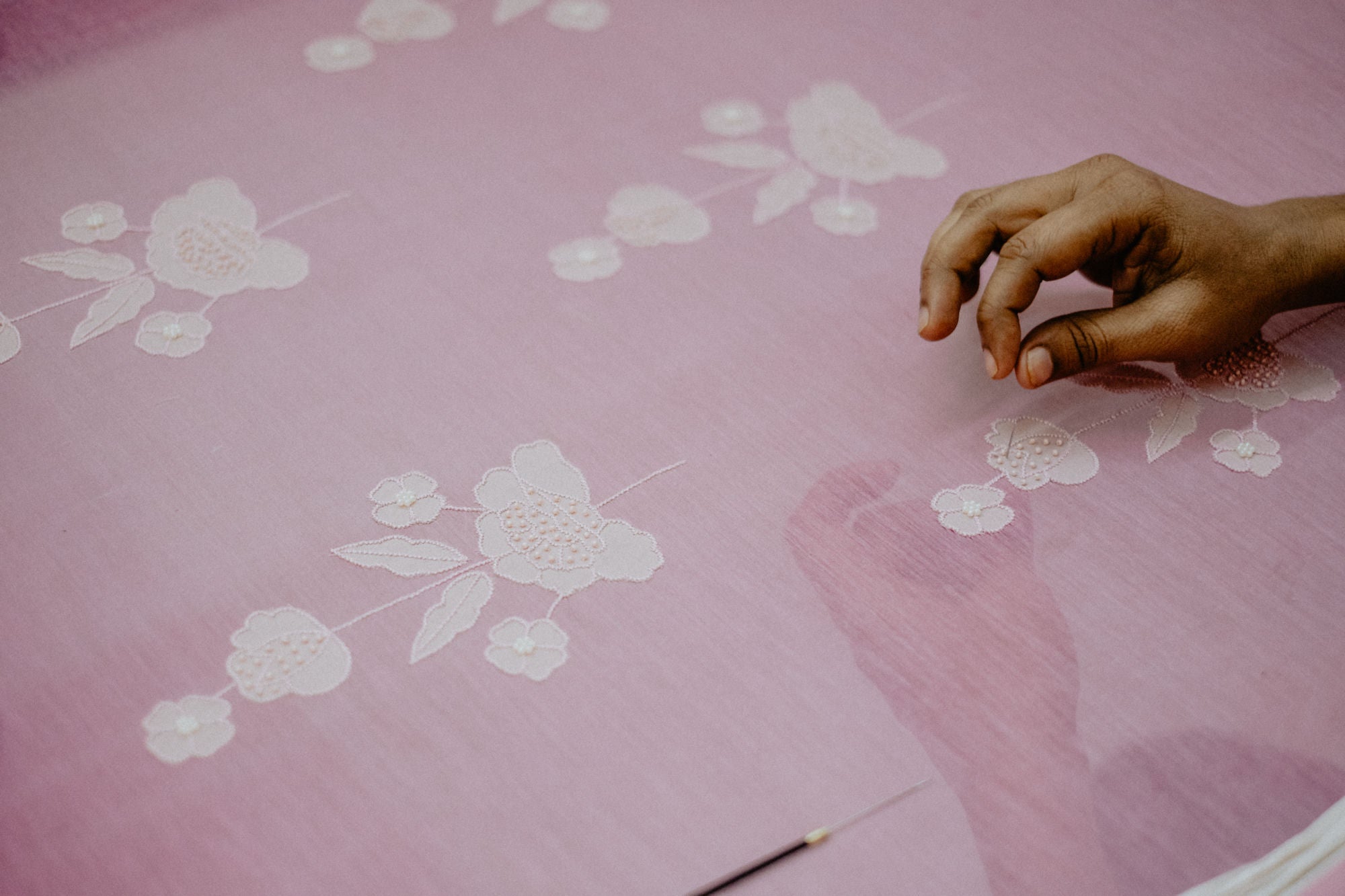
Aari embroidery takes its name from the tool used to create it — the aari needle, a long, sharp hook resembling a crochet needle. Unlike regular hand embroidery done with a standard needle and thread, aari work uses this hooked needle to pull thread from below the fabric, creating a continuous chain stitch on the surface.
The technique originated in the royal courts of Mughal India and was traditionally used to embellish garments for royalty. The artisan stretches the fabric on a wooden frame called an adda, then uses the aari hook to create flowing, unbroken lines of chain stitch — building up elaborate patterns of flowers, paisleys, vines, and geometric motifs.
What makes aari distinct from other embroidery forms is its speed and precision. A skilled karigar can work faster with the aari hook than with a regular needle, while achieving incredibly fine, uniform stitches. This makes it ideal for covering large areas with dense, detailed embroidery — which is why you'll see it on everything from lehenga borders to full-coverage kurtas.
How Aari Differs from Other Indian Embroidery
Indian fashion has a rich vocabulary of embroidery techniques, and each has its own character:
Aari vs. Zardozi: While both are used in luxury fashion, zardozi uses heavy metallic threads (gold and silver wire) and is typically bolder and more raised. Aari is finer, uses silk or metallic thread, and creates a flatter, more intricate surface. Many pieces combine both — zardozi for bold accents, aari for detailed fills.
Aari vs. Chikankari: Chikankari is a white-on-white (or tonal) embroidery from Lucknow, done entirely by hand with a regular needle. Aari uses a hook and typically features more colour and metallic elements.
Aari vs. Machine Embroidery: The chain stitch of aari can be mimicked by machine, but the difference is visible up close. Hand-done aari has slight natural variations in tension and spacing that give it life. Machine embroidery is perfectly uniform — and flat in comparison.
Aari Work in Modern Indian Fashion
Today, aari embroidery is central to Indian occasion wear. You'll find it on bridal lehengas, festive kurtas, designer sarees, and evening blouses. It's often combined with other techniques — sequins, beadwork, cutdana, and gota patti — to create multi-textured surfaces.
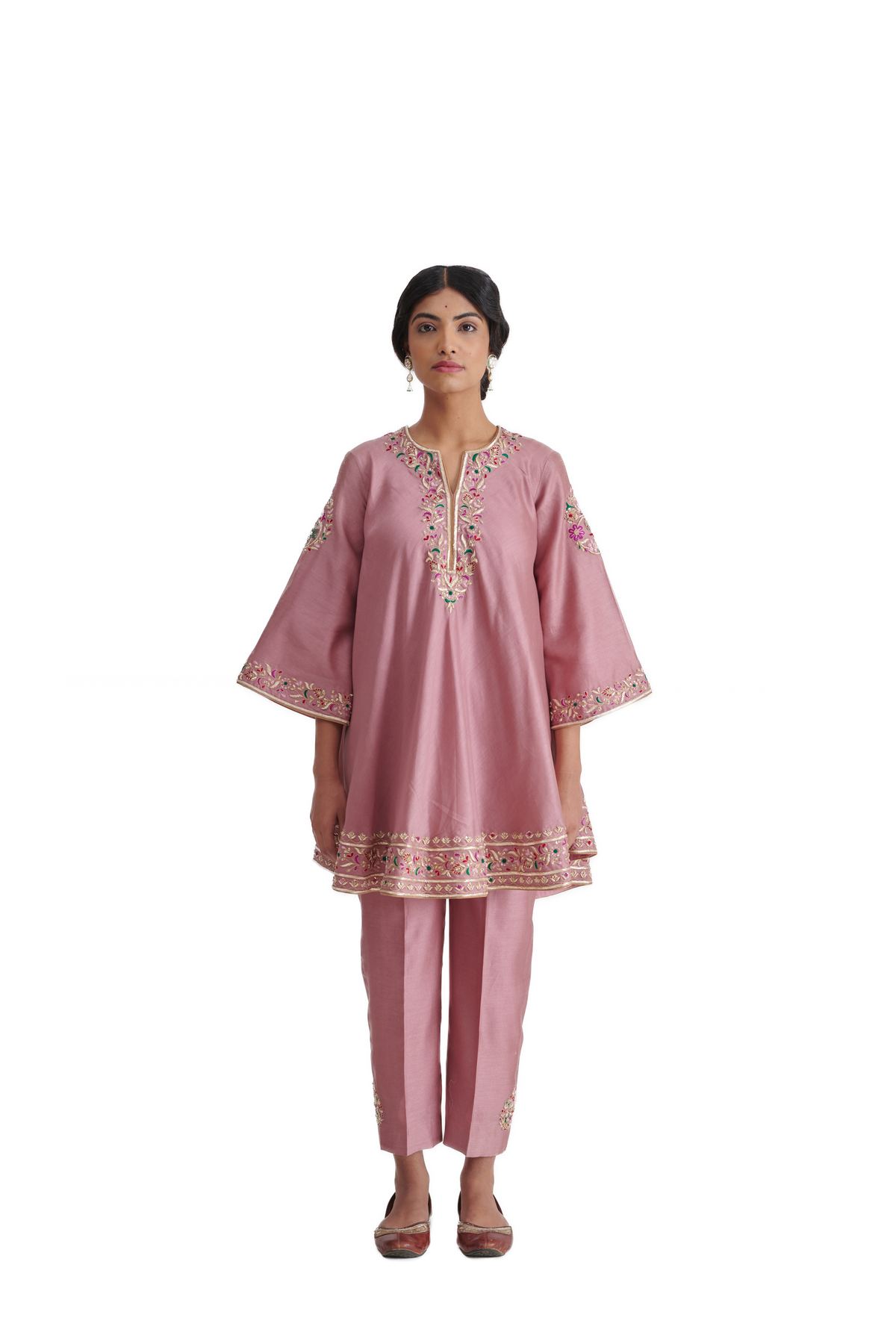
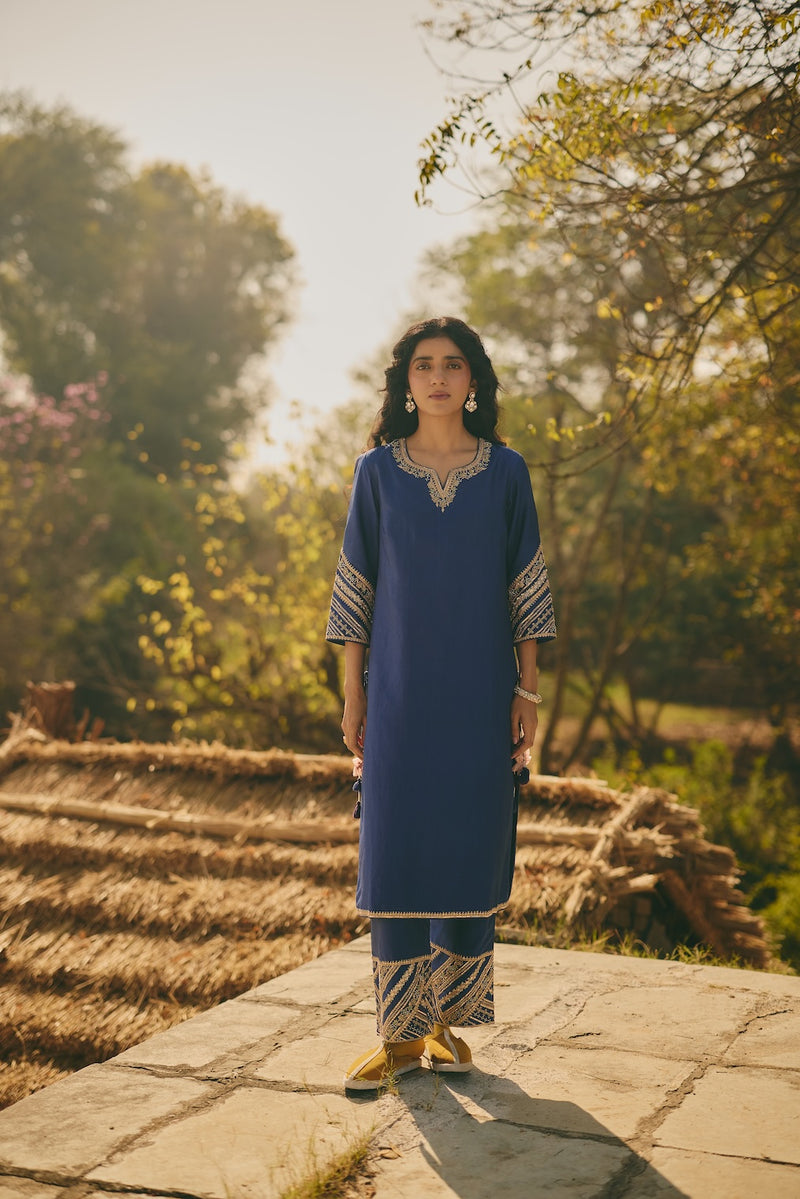
The Naveli & Ruhi set is a beautiful example. This dusty rose chanderi kurta features intricate floral embroidery combining aari, zardozi, sequin, and thread work around the neckline, sleeves, back, and hem.

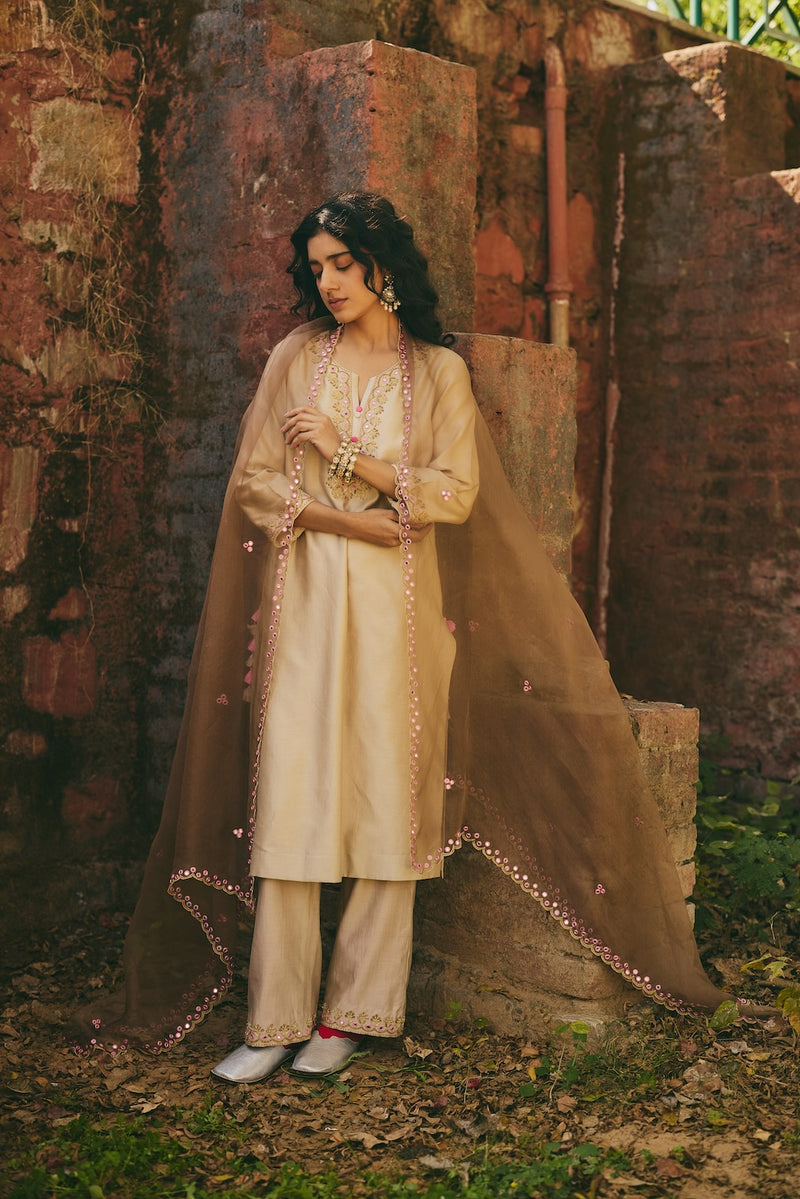
Another striking piece is the Ira & Hoor — a silk cotton zari checks cape shirt with hand-embroidered motifs along the collar and cuffs. The embroidery combines zardozi and aari techniques, using gold and silver threads to create exquisite floral patterns.

Aari in Shirts and Everyday Luxury
One of the most interesting developments in Indian fashion is how aari work has moved beyond bridal and festive wear into more wearable formats. Designer shirts, cape tops, and structured blouses now feature aari detailing — making handcrafted embroidery accessible for occasions beyond weddings.


The Iraaday & Raya shirt features zardozi and aari embroidery in gold and silver threads, paired with silk cotton zari stripe pants. The Noori & Nagma shirt uses aari and zardozi to create delicate scattered florals on silk moonga checks.
Aari on Statement Pieces
For occasions that call for drama, aari embroidery scales beautifully. The Roop blouse is crafted in deep black silk with floral aari embroidery in pastel pinks and ivory running along the sleeves, neckline, and back — a quiet elegance against a bold silhouette.
Free Download
Get Our Measurement Guide
Step-by-step instructions with photos for perfect custom fit.
Download Free Guide
And for a full ensemble, the Rumi, Akira & Vihana brings together a rani pink dupion silk blouse, an orange ombre cheniya bandhani brocade skirt, and an organza cape — all featuring aari embellishments alongside sequins and beadwork.
How to Identify Quality Aari Work
When shopping for aari-embroidered pieces, here's what to look for:
Turn it over. On genuine hand-done aari work, the reverse side shows a continuous thread line mirroring the chain stitch pattern on the front. Machine embroidery typically has a different pattern on the back.
Check the uniformity. Hand-done aari will have subtle natural variations — not perfectly identical stitches. This is a sign of authenticity, not imperfection.
Feel the weight. Dense aari embroidery adds noticeable weight to the fabric. A heavily embroidered piece should feel substantial.
Look at the edges. Quality aari work has clean, well-finished thread ends. No loose loops or fraying thread tails.
Caring for Aari-Embroidered Garments
Dry clean only — water and agitation can loosen the chain stitches and damage metallic threads.
Store flat or padded — avoid hanging heavy aari pieces for long periods, as the weight of the embroidery can stretch the fabric.
Keep away from rough surfaces — the raised embroidery can snag. Use a muslin or cotton cloth bag for storage.
Iron on reverse — if needed, iron on the reverse side with a pressing cloth between the iron and fabric.
Frequently Asked Questions
How long does aari embroidery take?
It depends on the density and size of the design. A single blouse with moderate aari work can take 2-4 days. A fully embroidered lehenga panel can take weeks of continuous work by skilled karigars.
Is aari embroidery expensive?
Yes, because it's entirely done by hand and requires significant skill. The cost reflects the hours of work and the expertise of the craftsperson. Pieces with dense, all-over aari work will naturally be priced higher than those with accent aari detailing.
Where is aari embroidery traditionally done?
Aari work has strong roots in Rajasthan, Kashmir, and parts of Uttar Pradesh. Jaipur is one of the most important centres for aari embroidery in contemporary fashion.
Can aari work be done on any fabric?
Aari works best on fabrics that can be stretched taut on a frame — silk, organza, chanderi, velvet, and cotton are all commonly used. Very loosely woven or extremely stretchy fabrics are less suitable.
Ready to Order Custom?
WhatsApp us at +91 70423 11214 with what you're looking for. We'll guide you through measurements, customizations, and timeline.
Most pieces ready in 4-5 weeks. Bridal in 6-8 weeks.
Made to order in 4–5 weeks
Have an event date? We’ll tell you exactly when to order by.
We take a limited number of orders each month — secure your slot early.
Not sure where to start?
Tell us what you're dressing for and we'll help you choose — fabric, fit, colour, and timeline — over WhatsApp.
Your Cart
Pieces from this story
All pieces →
Keep reading
The journal →
Caring for Kids' Hand-Embroidered Clothes (and Handing Them Down)
Handmade by karigars Made to your measurements Fit guarantee Ships worldwide As seen in GraziaElle Graduat...
31 July 2026
Twinning Kids: Coordinating Outfits for Siblings & Cousins
Handmade by karigars Made to your measurements Fit guarantee Ships worldwide As seen in GraziaElle Graduat...
31 July 2026
Kids' First Birthday Outfit Ideas: Ethnic Looks for the Big Day
Handmade by karigars Made to your measurements Fit guarantee Ships worldwide As seen in GraziaElle Graduat...
31 July 2026