
Bandhani: The Ancient Tie-and-Dye Art of India
Over 5,000 years ago, in the sun-drenched landscapes of western India, artisans developed a textile art so precise and so beautiful that it has endured across millennia. Bandhani — derived from the Hindi word bandhan, meaning 'to tie' — is India's oldest form of tie-and-dye, and it remains one of the most instantly recognisable textile traditions in the world.
Tracing the Origins of Bandhani
The earliest evidence of Bandhani dates back to the Indus Valley Civilisation, where terracotta figurines discovered at archaeological sites appear to be wearing garments with dotted patterns consistent with tie-dye techniques. Literary references appear in texts from the 6th century, and the craft finds mention in Alexander the Great's accounts of his encounters with Indian textiles.
Bandhani flourished primarily in two regions: Rajasthan and Gujarat. In Rajasthan, the craft centred around Jaipur, Jodhpur, Udaipur, and Bikaner, where it became integral to the cultural identity of the Rajput communities. In Gujarat, the Kutch region — particularly the town of Mandvi and the Khatri community — developed their own distinctive styles of Bandhani, often incorporating mirrors and embroidery.
Historically, Bandhani carried deep social significance. A bride's odhni (veil) in Bandhani was considered auspicious, and specific patterns were reserved for different occasions and communities. The red Bandhani chunari (a large scarf or veil) remains an essential element of Rajasthani bridal trousseau to this day.
How Bandhani Is Created
The Bandhani process is a masterwork of patience and precision, carried out almost entirely by hand.
First, the fabric — typically cotton, silk, or a blend — is washed and prepared. The artisan then marks the design on the fabric using a wooden block dipped in a fugitive colour (one that washes away). Next comes the most critical and time-consuming step: tying.
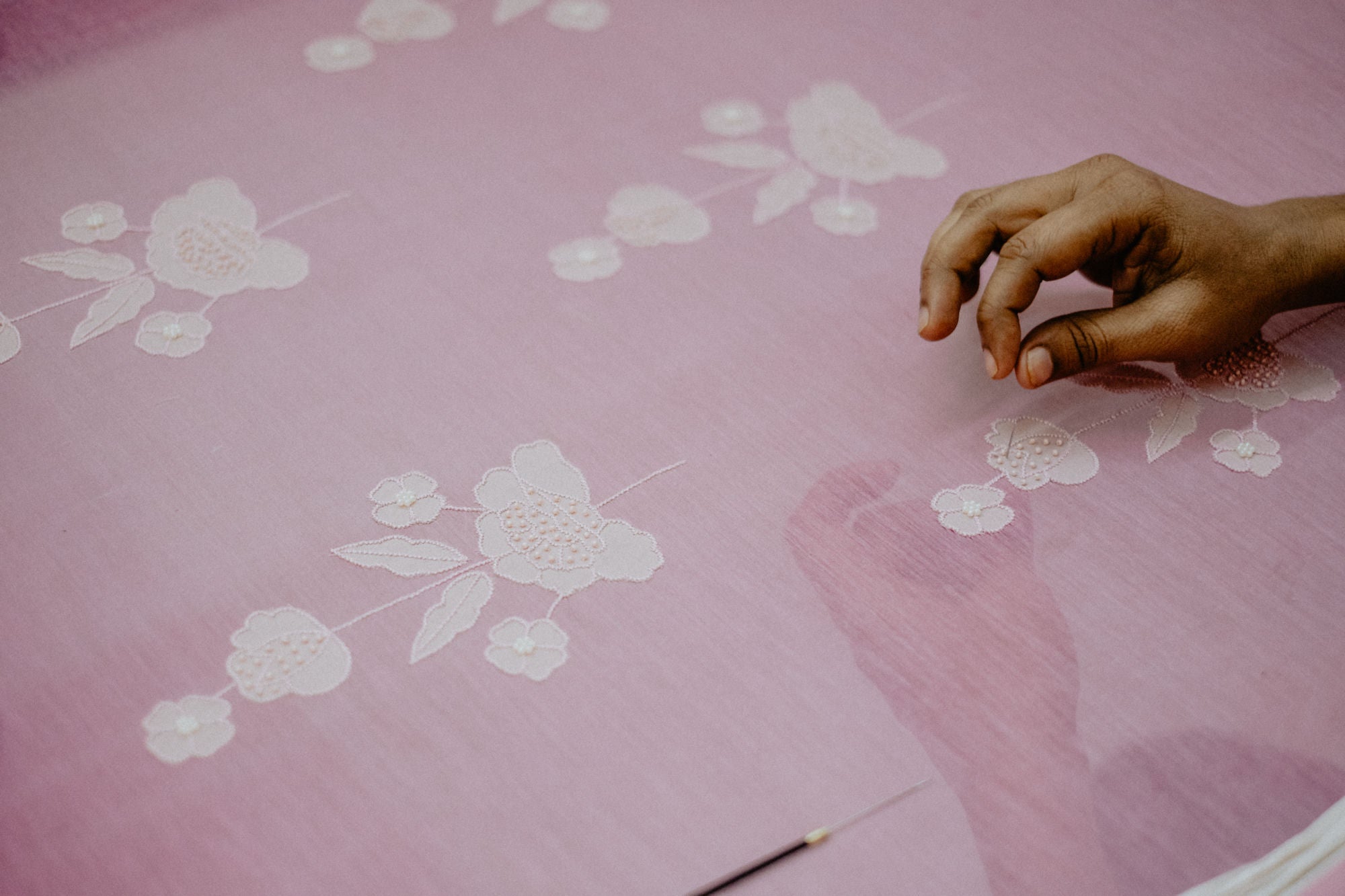
Using their fingernails — often protected by a small metal tool called a nakhuna — artisans pinch tiny points of fabric and bind them tightly with thread. Each tied point, no bigger than a pinhead, will resist the dye and create the characteristic dotted pattern. A single saree may contain anywhere from 12,000 to over 100,000 individual knots, each tied by hand.
After tying, the fabric is immersed in dye baths, starting with the lightest colour and progressing to the darkest. Between each dye bath, specific points are untied to reveal the previous colour, while new points are tied to preserve the current one. This multi-stage dyeing process creates the rich, layered colour palette that distinguishes fine Bandhani.


The Symbolism of Colours in Bandhani
In Bandhani, colour is never arbitrary — it carries meaning:
- Red: Marriage, good fortune, and celebration. The most auspicious colour in Indian culture.
- Yellow: Spring, joy, and new beginnings. Worn during the spring festival of Basant Panchami.
- Saffron: Spirituality, renunciation, and devotion.
- Green: Fertility, prosperity, and the monsoon season.
- Black: Mourning and loss. Traditionally avoided for celebratory occasions.
These colour traditions continue to influence how Bandhani is designed and worn today, though contemporary interpretations have expanded the palette to include pastels, deep jewel tones, and unexpected colour combinations.
Bandhani Patterns and Their Names
The patterns created through Bandhani tying have evocative names that reflect their visual character:
Free Download
Get Our Measurement Guide
Step-by-step instructions with photos for perfect custom fit.
Download Free Guide- Ekdali: Single dot — the simplest and most fundamental pattern.
- Trikunti: Three dots arranged in a triangle.
- Chaubundi: Four dots forming a square.
- Shikari: A pattern depicting a hunting scene, with intricate figurative elements.
- Jaaldar: A net-like all-over pattern of fine dots.
- Beldaar: A wave or vine-like flowing pattern.
Bandhani in Modern Indian Fashion
While the ancient technique remains unchanged, contemporary designers are reimagining Bandhani for modern wardrobes. The craft has moved beyond the traditional odhni and chunari to appear on sarees, dupattas, lehengas, kurtas, and even Western silhouettes.

At Rashika Mittal, our collections draw inspiration from these rich textile traditions. The GULNAAZ Dupatta, crafted in bandhani silk with zardozi, sequins and cutdana detailing in bold paisley motifs, is a direct celebration of this ancient craft. The SUROOR Anarkali, in Bandhej Banarasi silk, merges bandhani resist-dye texture with Banarasi woven gold bootis.
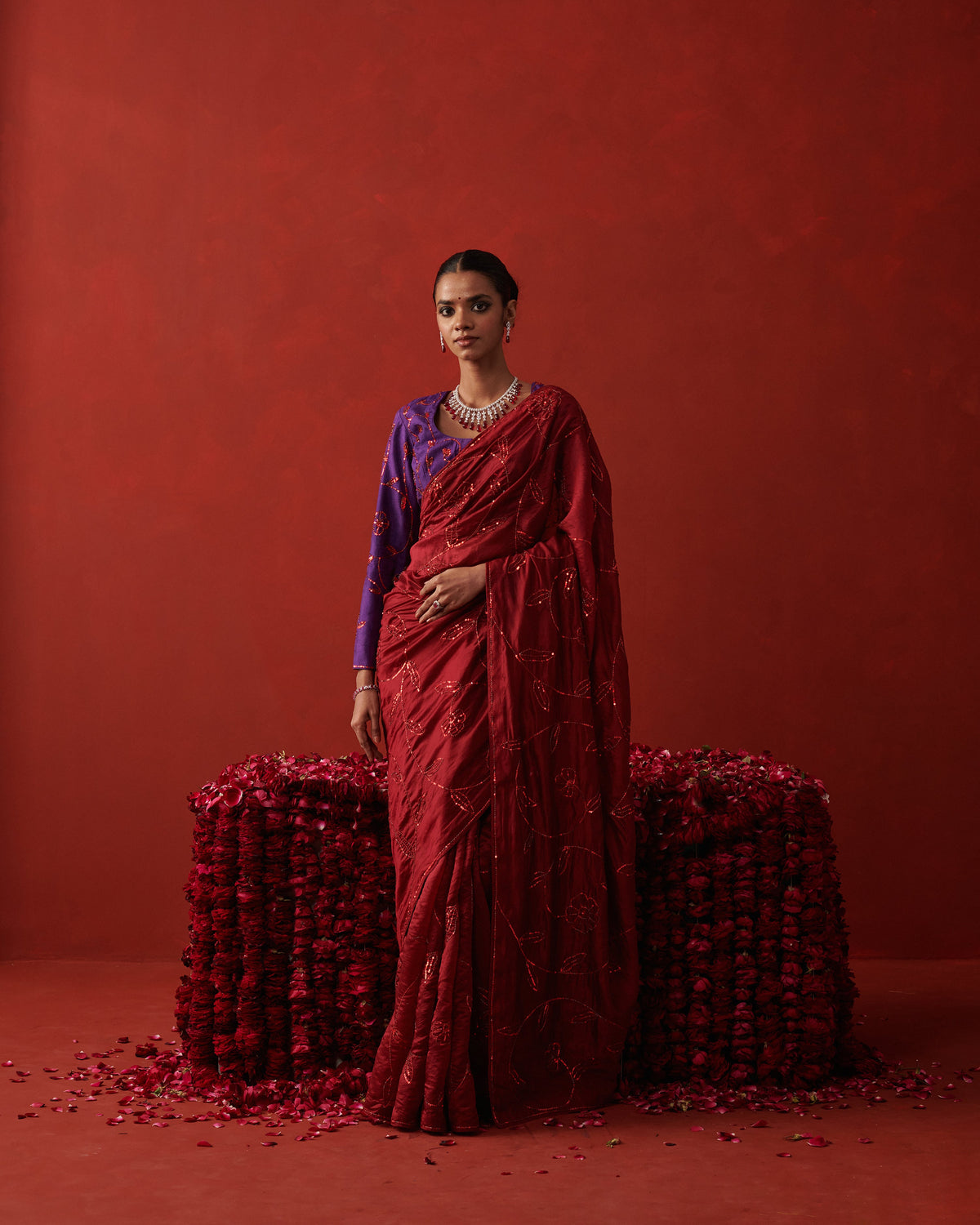
The vibrant colour palette of Bandhani is reflected across our collection — from the LAAL ISHQ Saree, in deep vermillion organza silk with sequin vines and abstract florals inspired by vintage Rajput aesthetics, to the RANGREZ Saree (whose very name means 'dyer'), a deep red chiffon saree with hand-embroidered floral bootis in ivory, saffron, plum and rose.
Our kurta sets and co-ord sets also draw from the vibrant spirit of western Indian textile traditions, offering modern silhouettes rooted in heritage craftsmanship.


Frequently Asked Questions
Is Bandhani the same as tie-dye?
Bandhani is a specific, highly refined form of tie-and-dye native to India. Unlike the free-form tie-dye popular in Western counterculture, Bandhani involves precisely placed, individually tied knots that create specific geometric and figurative patterns. Each dot is intentional, making it far more intricate than most tie-dye techniques.
Can I wash Bandhani at home?
Hand wash in cold water with a mild detergent. Do not wring — gently squeeze out excess water and dry in shade. The first wash may release some excess dye; this is normal. Never bleach or machine wash Bandhani, as it can damage both the colour and the texture of the tied patterns.
How do I know if Bandhani is handmade?
Turn the fabric over — hand-tied Bandhani will show raised bumps (the remnants of the tied knots) on the reverse. Machine-printed Bandhani imitations will be flat on both sides. The dots in handmade Bandhani will also show slight, natural variations in size and spacing, unlike the perfect uniformity of printed versions.
Ready to Order Custom?
WhatsApp us at +91 70423 11214 with what you're looking for. We'll guide you through measurements, customizations, and timeline.
Most pieces ready in 4-5 weeks. Bridal in 6-8 weeks.
Made to order in 4–5 weeks
Have an event date? We’ll tell you exactly when to order by.
We take a limited number of orders each month — secure your slot early.
WhatsApp me my order-by date + a shortlistNot sure where to start?
Tell us what you're dressing for and we'll help you choose — fabric, fit, colour, and timeline — over WhatsApp or on a video call.
Your Cart
Pieces from this story
All pieces →Not sure which piece, or need it by a date? Book a video consultation Ask us on WhatsApp


Keep reading
The journal →
Garba Abroad: What to Wear to Navratri in the US, UK, Canada & Australia
What to wear to garba abroad — community-hall and university garbas, sports-hall floors, cold car parks and nine nigh...
20 September 2026
What to Wear to a Palace Wedding in Udaipur or Jaipur
What to wear to a palace wedding in Udaipur or Jaipur — courtyards, boat transfers, marble stairs and a dress code th...
12 September 2026
Gangaur Outfit Ideas: What to Wear for Rajasthan's Festival of Gauri
What to wear for Gangaur — bandhani, leheriya and gota patti outfit ideas for the eighteen-day Rajasthani festival an...
22 August 2026