
Mukesh Work: The Shimmering Embroidery Craft of Lucknow
Hold a mukesh-embroidered fabric under the light and you will see it — a fine, stippled shimmer that moves across the surface like sunlight on water. Not the bold flash of sequins or the structured gleam of zardozi, but something quieter, more refined. This is mukesh work — one of Lucknow's most delicate and least understood embroidery traditions.
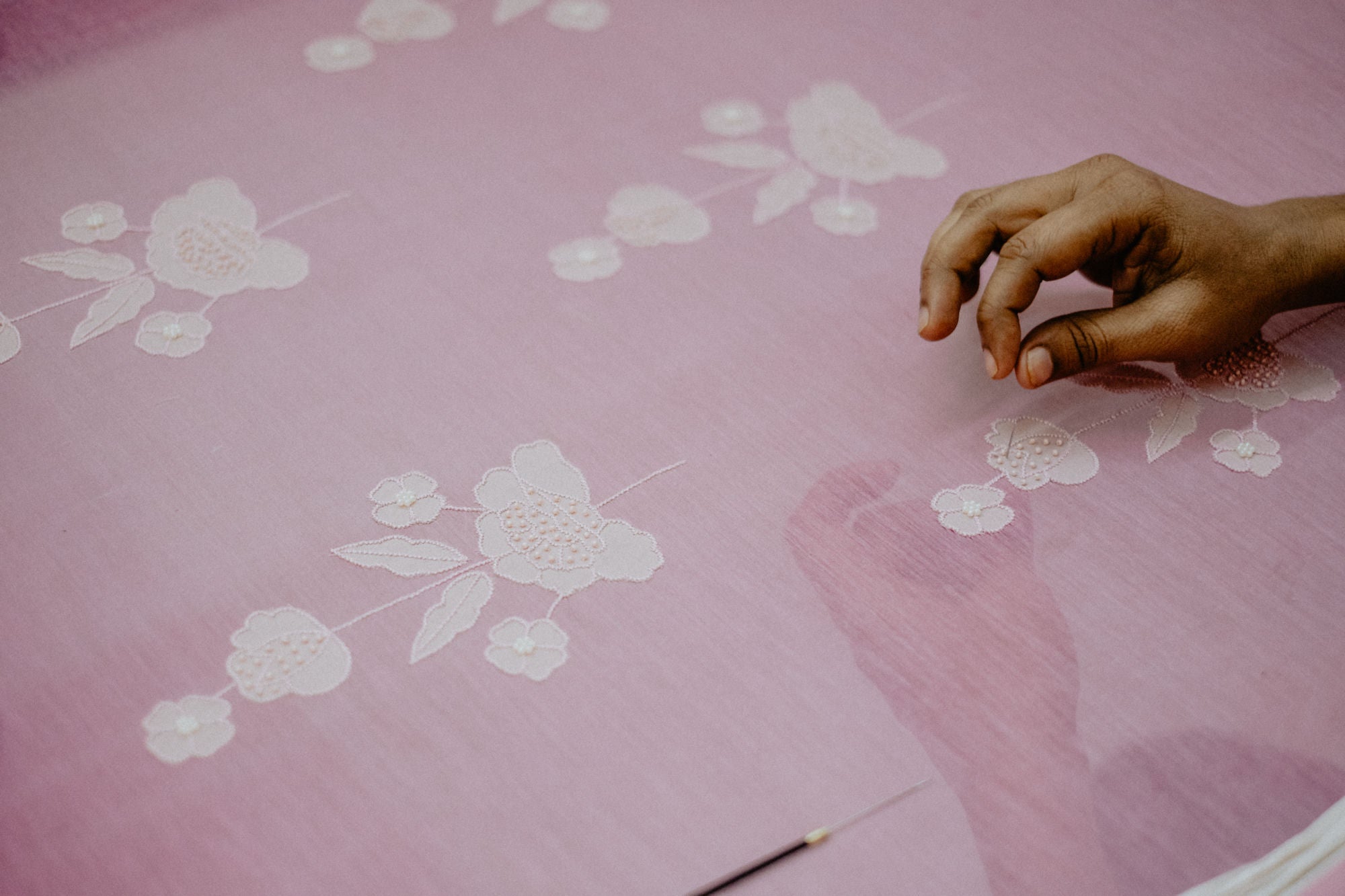
Also spelled mukaish (and sometimes called badla work), this technique involves attaching tiny flattened pieces of metallic wire to fabric using a needle, creating a fine, shimmering texture that catches light from every angle. It is one of the most labour-intensive embroidery forms in Indian craft — and one of the most beautiful.
What Is Mukesh Work?
Mukesh work (also written as mukaish) is a traditional embroidery technique from Lucknow, Uttar Pradesh, where tiny pieces of flattened metallic wire — usually gold or silver — are pulled through fabric using a fine needle. Each metallic piece is individually placed and secured, creating a shimmering, textured surface.
The technique has three primary forms:
Badla: The most common form, where flat metallic strips are woven into the fabric surface, creating a fine shimmer. This is sometimes called "badla work" and is the foundation of mukesh embroidery.
Salma: Coiled metallic wire (like a tiny spring) stitched onto fabric, creating slightly raised, spiralled motifs. Often combined with badla for contrast.
Sitara: Small, flat metallic discs (like tiny sequins) attached to the fabric. Combined with badla and salma, it adds points of brighter light within the overall shimmer.
What makes mukesh work distinctive is its subtlety. Unlike zardozi, which creates bold, raised surfaces, or sequin work, which creates distinct points of light, mukesh produces a continuous, fine-grained shimmer — almost like the fabric itself is glowing from within.

History of Mukesh Work
Mukesh work traces its origins to the Mughal courts of Lucknow, where it was developed as a complement to the city's famous chikankari embroidery. While chikankari created delicate white-on-white patterns through pulled thread work, mukesh added metallic shimmer to the same garments — the two techniques were designed to work together.
During the height of Nawabi culture in Lucknow, mukesh-embellished garments were symbols of refinement and status. The technique required enormous patience and skill — a single garment could take weeks to complete — making it a luxury reserved for the aristocracy.
Over the centuries, mukesh work evolved from purely court wear to become a staple of Lucknowi festive and formal attire. Today, it remains one of the defining crafts of the region, though the number of karigars who practice traditional mukesh work has declined significantly.
The Mukaish Anarkali: A Classic Silhouette
The anarkali — named after the legendary Mughal court dancer — is perhaps the most natural canvas for mukesh work. The flowing, floor-length silhouette allows the shimmer to move and catch light with every step, while the gathering at the waist creates depth that makes the embroidery appear to shift and change.
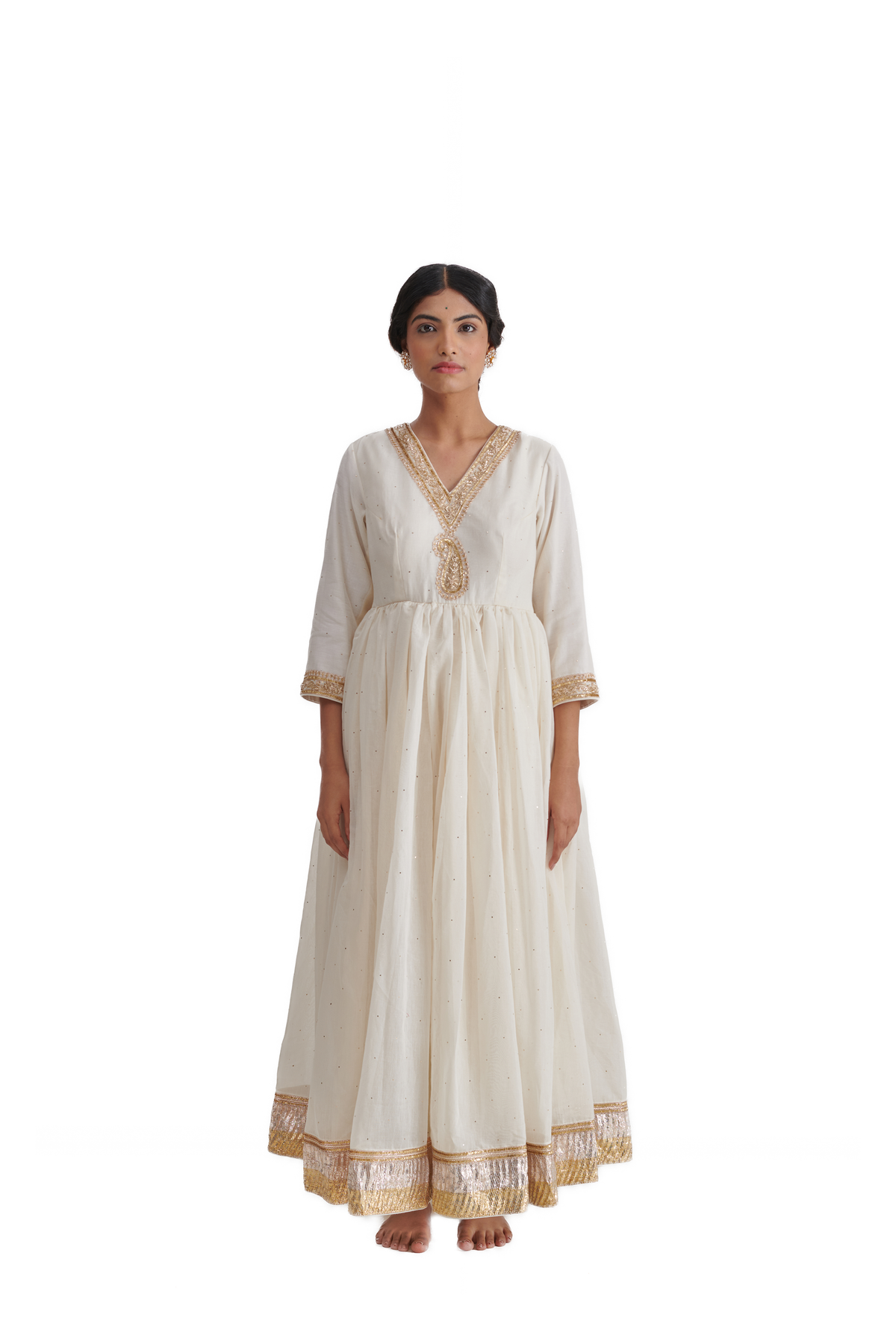
The BHAYLI & AHANA is an ivory woven anarkali featuring exquisite mukesh work with gold hand-embroidered motifs along the V-neckline and cuffs. Delicate sequin detailing throughout adds complementary sparkle, and the hem is highlighted with a rich gold and silver border. Paired with churidar pants.
The NOOR & AHANA takes a similar approach — an ivory woven anarkali with mukesh work and intricate hand-embroidered floral motifs. The bodice and sleeves showcase floral embroidery that enhances the traditional appeal with a contemporary touch. Also paired with churidar pants.

What makes these pieces work is the pairing of mukesh with woven fabric. The ivory base allows the metallic work to be the focus, while the woven texture gives the anarkali structure and body. The overall effect is luminous without being loud — exactly the quality that makes mukesh work so prized.
How to Style a Mukesh Anarkali
For weddings and formal events: Pair with statement jhumkas and a potli bag. The mukesh shimmer provides enough sparkle that heavy jewellery is unnecessary — choose one statement piece (earrings or a maang tikka) and keep the rest minimal.
Free Download
Get Our Measurement Guide
Step-by-step instructions with photos for perfect custom fit.
Download Free GuideFor festive occasions: Mukesh anarkalis work beautifully for Diwali, Eid, and other celebrations. Add a contrast dupatta — a rich organza or tissue silk in a complementary colour — to elevate the look without competing with the embroidery.
For intimate gatherings: The understated shimmer of mukesh makes it ideal for smaller celebrations where you want to look polished without being overdressed. Style with simple gold hoops and flat embroidered juttis for an effortlessly elegant look.
Mukesh Work vs Other Embroidery Techniques
Mukesh vs Zardozi: Zardozi creates bold, raised, sculptural surfaces using thick metallic threads and heavy embellishments. Mukesh is flat and fine — the shimmer is in the fabric surface rather than on top of it. Zardozi commands attention; mukesh rewards a closer look.
Mukesh vs Sequin work: Sequins create distinct, individual points of light. Mukesh creates a continuous shimmer — more like fabric woven with light than fabric decorated with light.
Mukesh vs Chikankari: These two Lucknowi techniques are natural companions. Chikankari creates delicate white-on-white patterns through thread work; mukesh adds metallic shimmer to the same garments. Many traditional Lucknowi outfits combine both techniques.
Caring for Mukesh Embroidery
Mukesh work is delicate and requires careful handling:
Storage: Always store flat or hang on padded hangers. Never fold mukesh-embroidered sections — the metallic pieces can bend or detach at fold lines.
Cleaning: Dry clean only. Water and detergents can tarnish the metallic elements and damage the attachment points.
Ironing: Never iron directly on mukesh work. Use a pressing cloth and low heat on the reverse side only.
Wearing: Be mindful of jewellery that might snag the metallic pieces — rings and bracelets with sharp settings can catch on the embroidery.
Frequently Asked Questions
What is the difference between mukesh and mukaish work?
They are the same technique — just different spellings. Mukesh and mukaish both refer to the Lucknowi embroidery technique using tiny flattened metallic wire pieces attached to fabric. "Badla work" is another name for the same craft.
Is mukesh work done by hand?
Traditional mukesh work is entirely hand-done. Each tiny metallic piece is individually placed and secured using a fine needle. Machine versions exist but lack the irregularity and depth of hand-done mukesh.
Can mukesh work be done on any fabric?
Mukesh work is best suited to woven fabrics — cotton, silk, and blended weaves that provide a stable base for the metallic pieces. Very sheer or stretchy fabrics are not ideal as they do not hold the metallic elements securely.
How do I know if mukesh work is genuine?
Genuine hand-done mukesh has slight variations in the placement and size of metallic pieces — the hallmark of hand work. Machine-made versions are perfectly uniform. Also check the reverse side — hand-done mukesh shows the thread pulls on the back, while machine work is cleaner on both sides.
Ready to Order Custom?
WhatsApp us at +91 70423 11214 with what you're looking for. We'll guide you through measurements, customizations, and timeline.
Most pieces ready in 4-5 weeks. Bridal in 6-8 weeks.
Made to order in 4–5 weeks
Have an event date? We’ll tell you exactly when to order by.
We take a limited number of orders each month — secure your slot early.
WhatsApp me my order-by date + a shortlistNot sure where to start?
Tell us what you're dressing for and we'll help you choose — fabric, fit, colour, and timeline — over WhatsApp or on a video call.
Your Cart
Pieces from this story
All pieces →Not sure which piece, or need it by a date? Book a video consultation Ask us on WhatsApp


Keep reading
The journal →
Wedding Guest Outfits Under ₹50,000: Lehengas, Sarees, Shararas & Anarkalis by Function
The best wedding guest outfits under ₹50,000: lehengas, sarees, shararas, anarkalis and kurta sets by budget and by f...
7 October 2026
Dabka, Nakshi, Cutdana: A Glossary of Hand Embroidery Materials
What dabka, nakshi, cutdana, resham, marodi, gota and moti actually are — a plain-English glossary of the materials b...
22 August 2026
Buta & Booti: The Small Motifs That Carry Indian Embroidery
What buta and booti mean in Indian textiles, how they differ from jaal, how they're woven or hand-embroidered, and ho...
14 August 2026