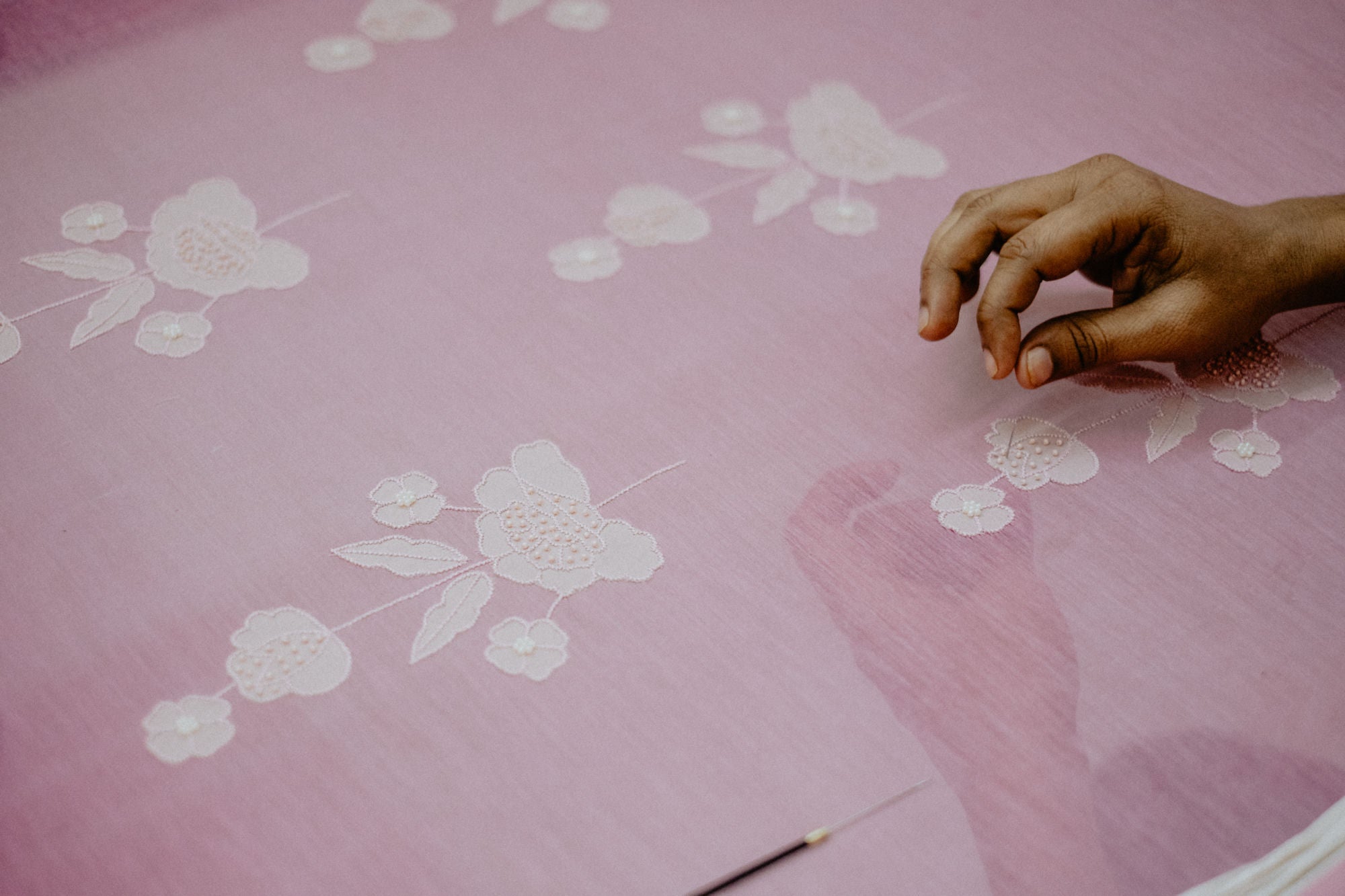
India's hand-embroidery traditions span thousands of years, passed down through generations of karigars (master artisans) who transform plain fabric into wearable art. Each region developed its own techniques — Rajasthan's gota patti, Lucknow's zardozi, Kashmir's aari work — each with distinctive materials, tools, and visual signatures.
This guide covers eight of the most celebrated embroidery and surface-ornamentation techniques used in Indian occasion wear today, with examples from our handcrafted collection. Every piece shown is made to order by skilled karigars in Jaipur, using the exact techniques described here.
Origin: Rajasthan
Gota patti is a Rajasthani applique technique in which narrow ribbons of gold or silver metallic fabric (called gota) are cut into small shapes — petals, diamonds, leaves, rhombuses — and hand-stitched onto the base fabric. Unlike embroidery that uses thread, gota patti builds dimension through layered metallic ribbon, creating a raised, sculpted surface that catches light from every angle.
The artisan cuts strips of zari ribbon into precise geometric or floral shapes, folds the edges under, and stitches each piece flat onto the fabric using fine thread. Dense compositions may involve hundreds of individual pieces on a single garment. The technique is time-intensive — a heavily embellished kurta can take several weeks of handwork.
See this technique

Purple silk kurta with dense hand-done gota applique, each metallic ribbon folded and stitched into rhombus and floral shapes
Origin: Persia, refined in Lucknow and Delhi
Zardozi (from the Persian "zar" meaning gold and "dozi" meaning embroidery) is one of the most opulent forms of Indian embroidery. It uses heavy metallic threads — gold and silver bullion wire, coiled springs (dabka), sequins, and sometimes semi-precious stones — couched onto fabric to create raised, sculptural motifs. Historically reserved for royalty, zardozi remains the hallmark of bridal and ceremonial garments.
The artisan stretches the fabric on a wooden frame (adda) and works from the underside, pushing a needle through to catch the metallic wire on the surface. Each motif — typically floral vines, paisleys, or Mughal-inspired patterns — is built by couching lengths of bullion wire and filling areas with sequins and cut beads. The weight and density of the metalwork gives zardozi its signature grandeur.
See this technique

Ivory silk kurta with floral and vine motifs in gold and pink zardozi and aari embroidery
Origin: Kashmir, widely practised across India
Aari work is a chain-stitch embroidery technique done with a specialised hooked needle called an aari (similar to a crochet hook but finer). The artisan holds the needle above the stretched fabric and loops thread from below, creating continuous chain stitches that flow into intricate floral, paisley, and vine patterns. The technique allows for both fine detail and broad coverage, making it one of the most versatile forms of Indian embroidery.
The fabric is stretched taut on a frame. The artisan pushes the hooked aari needle down through the fabric, catches the thread held underneath, and pulls it up as a loop. The next stitch catches through that loop, forming a chain. Skilled karigars can produce remarkably even stitches at speed, covering large areas with flowing designs. Aari work is often combined with beads, sequins, and cutdana for added texture.
See this technique

Coral pink silk kurta with marodi, resham, and sequins, with aari-inspired patchwork on cuffs
Origin: Lucknow, Uttar Pradesh
Mukesh work (also called badla work) uses tiny pieces of flattened metallic wire — called badla — that are individually stitched onto the fabric surface. Each piece of wire is hammered flat, cut to size, and attached with precise stitches, creating an all-over shimmering effect that resembles liquid metal. The technique is distinct from sequin work because the metallic pieces are wire-based rather than stamped discs, producing a softer, more organic shimmer.
The artisan draws fine metallic wire through a plate to flatten it, then cuts it into small uniform pieces. Each piece is placed on the fabric and secured with stitches from the reverse side. The repetitive placement of hundreds of tiny metallic strips across the surface creates a luminous, mirror-like texture. Mukesh work is often combined with chikankari or other embroidery to add shimmer to an otherwise matte surface.
See this technique

Ivory woven anarkali with Mukesh work and gold hand-embroidered motifs along v-neckline and cuffs

Ivory woven anarkali with Mukesh work and intricate hand-embroidered floral motifs with sequin detailing
Origin: Rajasthan and Gujarat
Marodi work is a hooked-needle embroidery technique closely related to aari work, but traditionally associated with Rajasthani and Gujarati artisan communities. The word "marodi" comes from the Hindi for "twisted" — referring to the twisted chain stitches that form the embroidery. Marodi work is characterised by its use of metallic threads (gold and silver) to create festive, celebratory patterns, making it a staple of bridal and wedding-guest attire.
Using a fine hooked needle, the artisan creates chain stitches from the front of the fabric, twisting metallic or silk thread into looped chains. The technique allows rapid coverage of large areas while maintaining stitch consistency. Marodi work is frequently combined with gota patti, resham thread, and bead work to create richly layered surfaces.
See this technique
Origin: Rajasthan and Gujarat
Bandhani (also called bandhej) is one of India's oldest textile arts — a resist-dyeing technique rather than embroidery in the strict sense, but so integral to Indian occasion wear that no guide is complete without it. The fabric is pinched into tiny points, tied tightly with thread to resist the dye, and then submerged in colour baths. When the threads are removed, the tied areas remain undyed, creating intricate patterns of dots, circles, waves, and diamonds across the cloth.
Artisans use their fingernails (often protected with metal thimbles) to pinch the fabric into points as small as a grain of rice, then wrap each point tightly with thread. A single saree or lehenga may require thousands of individual ties. After tying, the fabric is dipped in successive dye baths — lighter colours first, then darker — to build up multi-coloured patterns. The characteristic slightly puckered texture of bandhani fabric is a hallmark of authenticity.
See this technique

Emerald cheniya bandhani jacquard silk set with gold and silver thread motifs
Practised across India, prominent in Lucknow and Jaipur
Cutdana work uses small tubes of cut glass or metal (the word literally means "cut grain") that are hand-stitched onto fabric, catching and refracting light to create a glittering surface. When combined with sequins — flat metallic or iridescent discs — the result is a garment that shimmers with movement. While machine-applied sequins are common in mass-produced fashion, hand-applied cutdana and sequin work is distinguished by its precision, pattern intentionality, and the slight irregularity that marks genuine handcraft.
Each cutdana tube and sequin is individually threaded onto a needle and stitched to the fabric. The artisan follows a traced pattern, placing each element to build up motifs — vertical lines, floral sprays, borders, or all-over shimmer. The angle of each cutdana is deliberately controlled to maximise light refraction. A single saree with all-over cutdana work can require thousands of individual hand-placed elements.
See this technique
Origin: Rajasthan, Gujarat, and Sindh
Mirror work — known as shisha or abhla bharat — involves attaching small mirrors (traditionally made from blown glass, now often mica or acrylic) to fabric using a framework of embroidery stitches. The mirrors are held in place by a lattice of thread worked around their edges, creating a secure setting that also forms a decorative border around each mirror. The technique transforms garments into light-catching, kinetic surfaces — every movement sends reflections across the fabric.
The artisan places a mirror on the fabric and creates a grid of foundation stitches across its surface to hold it in place. Then, decorative stitches (typically buttonhole or herringbone) are worked around the perimeter, locking the mirror securely while creating an ornamental frame. Mirror work is frequently combined with other embroidery techniques — gota patti, zardozi, dabka — for layered, multi-textured surfaces.
See this technique
Every piece in our collection is handcrafted using these traditional techniques. Browse by category to find garments featuring the embroidery styles you love.
Zardozi is generally the most expensive Indian embroidery technique. It uses real gold and silver bullion wire, requires highly skilled artisans, and is extremely time-intensive — a single zardozi panel can take weeks to complete. The cost of materials (metallic wire, semi-precious stones, sequins) combined with the labour hours involved makes heavily embroidered zardozi garments the most valuable. Dense gota patti work ranks second, as it also requires significant handwork and metallic materials. The price of any hand-embroidered garment ultimately depends on the density of the work, the materials used, and the hours invested by the karigar.
The time varies dramatically by technique and density. A kurta with light aari or marodi work on the yoke and cuffs might take 3-5 days of embroidery. A lehenga with dense all-over gota patti can take 3-4 weeks of continuous work. Heavy zardozi pieces — particularly bridal garments — can require 4-6 weeks or more. At Rashika Mittal, our made-to-order production time of 4-5 weeks accounts for fabric preparation, embroidery, tailoring, and finishing.
There are several reliable indicators. First, turn the garment inside out: hand embroidery shows thread trails, knots, and slight irregularities on the reverse side, while machine embroidery has a uniform, mechanical pattern on the back. Second, examine the stitches closely — hand embroidery has subtle variations in stitch length and spacing that give it an organic quality. Machine stitches are perfectly identical. Third, check the feel: hand-embroidered surfaces have a natural texture with slight dimensional variation, while machine work feels flat and uniform. Finally, hand-applied sequins and cutdana will have individual thread attachments, whereas machine-applied embellishments are often held by continuous thread lines.
For bridal outfits, zardozi and heavy gota patti are the traditional choices — their metallic grandeur matches the significance of the occasion. Bridal lehengas and sarees often combine multiple techniques (zardozi borders with aari filling, gota patti panels with mirror work) for maximum richness. For wedding guests, the best technique depends on the function: lighter aari work and marodi embroidery suit daytime events like mehendi and haldi, while sequin and cutdana work creates the evening shimmer appropriate for sangeet and reception. Bandhani combined with embroidery works beautifully for festive celebrations like garba and sangeet nights.
Hand-embroidered garments require careful handling to preserve the artisan's work. Dry cleaning is always the safest option, particularly for pieces with zardozi, Mukesh work, cutdana, or mirror work — water can tarnish metallic elements and loosen adhesives. For lighter embroidery (aari, marodi, resham thread work), gentle hand washing in cold water with mild detergent is possible, but the garment should be laid flat to dry and never wrung or twisted. Never machine wash hand-embroidered garments. Store them flat or loosely folded with acid-free tissue paper between layers to prevent the embroidery from pressing into adjacent fabric and leaving impressions.
Continue exploring Indian fashion, fabric, and styling.