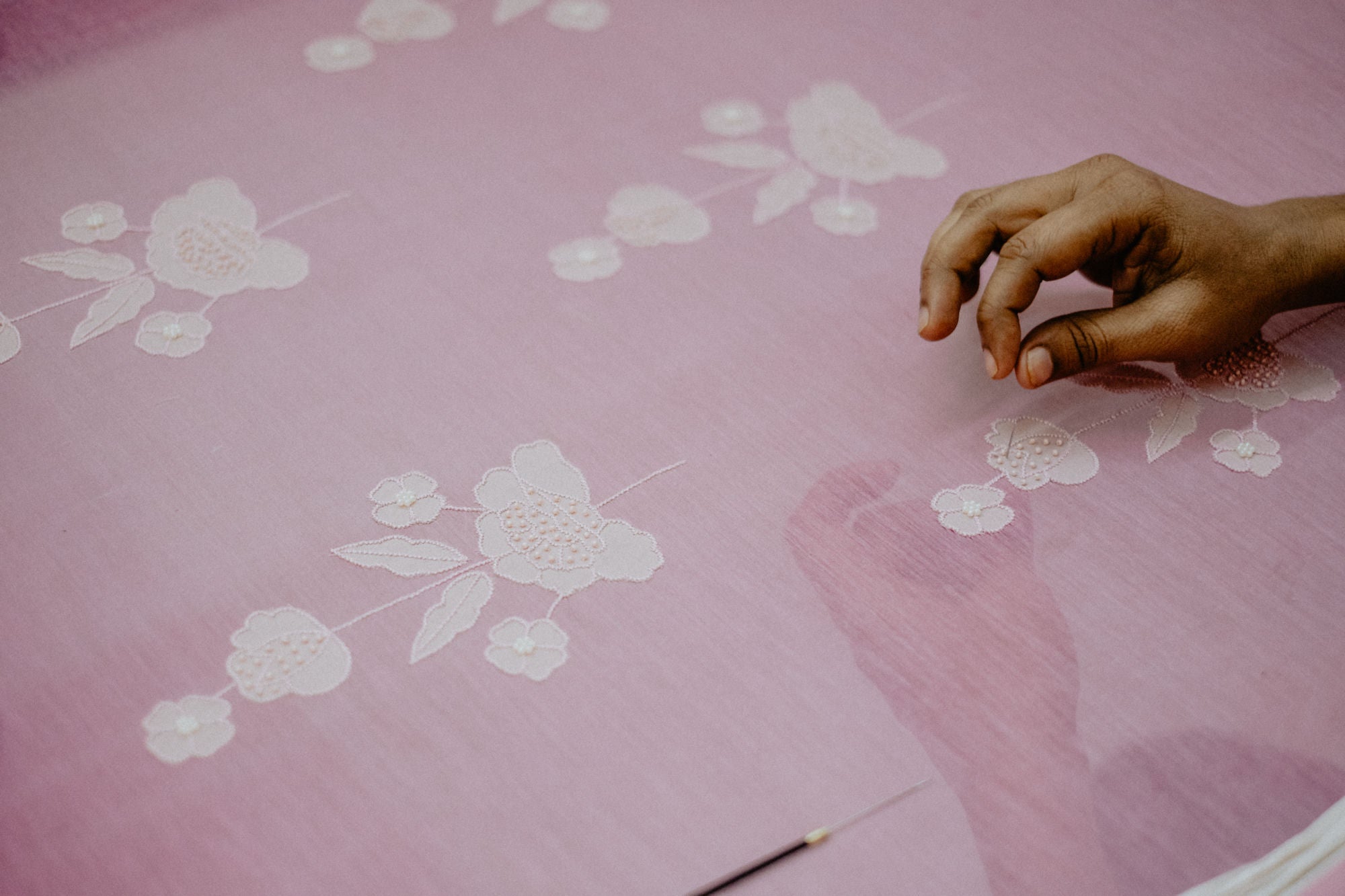
Indian fashion carries centuries of textile heritage in every thread. From the intricate zardozi embroidery of Mughal courts to the delicate bandhani tie-dye of Rajasthan, each technique represents generations of artisan knowledge passed down through families of master craftspeople, known as karigars.
Whether you are shopping for your first lehenga, trying to understand the difference between Banarasi silk and chanderi, or simply curious about the embroidery on your favourite kurta, this glossary covers over 50 essential Indian fashion terms. We have organized them alphabetically so you can quickly find what you are looking for.
Aari is a form of chain-stitch embroidery worked with a hooked needle called an aari needle. Originating in Central Asia and refined in the Indian subcontinent, it creates flowing, continuous lines of stitching that are ideal for filling large floral and paisley motifs. Aari work is widely used across Rajasthan and Kashmir to embellish everything from sarees to dupattas. Learn more about this and other techniques in our embroidery guide.
An anarkali is a long, flared dress-style garment that cinches at the waist and flows to the floor, creating a graceful A-line or umbrella silhouette. Named after Anarkali, a legendary court dancer of the Mughal era, this garment is a staple for festive occasions, weddings, and formal gatherings. The silhouette is universally flattering and can range from simple cotton versions for everyday wear to heavily embroidered pieces in silk and organza. See our anarkali collection.
The angrakha is one of the oldest known Indian garment forms, featuring a wrap-front closure where one panel of fabric crosses over the other and is tied at the side. Historically worn by both men and women across Mughal and Rajput courts, the angrakha has seen a strong revival in contemporary Indian fashion. Its asymmetric neckline and overlapping panels give it a distinctive, regal look.
Banarasi refers to textiles woven in Varanasi (Banaras), one of the oldest centres of silk weaving in the world. True Banarasi fabric is characterized by its heavy, opulent gold and silver zari work woven directly into the silk, creating intricate patterns of florals, paisleys, and jaal (net) designs. A Banarasi saree is often considered the most prized garment in an Indian bride's trousseau, taking anywhere from two weeks to six months to weave by hand depending on complexity.
Bandhani, also called bandhej, is a tie-and-dye technique practiced primarily in Rajasthan and Gujarat. Artisans pluck tiny pinches of fabric and bind them tightly with thread before submerging the cloth in dye, creating distinctive dotted patterns. The tied areas resist the dye, forming circles, waves, or elaborate geometric designs. The craft requires extraordinary patience, as a single dupatta can contain thousands of individually tied points.
A bindi is a decorative dot or ornament worn on the centre of the forehead, between the eyebrows. Traditionally made from vermilion or sandalwood paste, modern bindis come in an array of felt, crystal, and jewelled varieties. While it carries cultural and spiritual significance in Hinduism, the bindi has also become a fashion accessory embraced across South Asian dressing.
Booti (also spelled buta or buti) refers to a small, repeating motif that is either woven into or embroidered onto fabric. These tiny floral or paisley designs are scattered evenly across the surface of a textile, creating an understated all-over pattern. Booti work is commonly found on Banarasi silks, chiffons, and organza fabrics used for sarees, lehengas, and dupattas.
Brocade is a richly decorative woven fabric where supplementary weft threads create raised patterns on the surface. In Indian textiles, brocade typically features gold or silver metallic threads forming elaborate motifs against a silk base. The fabric has a pronounced weight and luxurious texture, making it a popular choice for structured garments like lehenga blouses, sherwanis, and festive jackets. For tips on maintaining brocade and other fine textiles, see our fabric care guide.
Chanderi is a lightweight, handwoven fabric originating from the town of Chanderi in Madhya Pradesh. It is traditionally made using a combination of silk and cotton (or pure silk), and is recognized by its sheer texture and subtle sheen. Chanderi fabrics often feature zari or brocade motifs and are prized for their ability to drape beautifully in sarees, dupattas, and kurtas.
Chiffon is a sheer, lightweight fabric with a slightly rough texture created by alternating S-twist and Z-twist yarn in both warp and weft. It drapes exceptionally well and has an elegant, flowing quality that makes it ideal for sarees, dupattas, and layered garments. Chiffon can be made from silk, nylon, or polyester, with silk chiffon being the most luxurious and breathable. For guidance on handling delicate fabrics, visit our fabric care guide.
Chikankari is a delicate form of hand embroidery originating from Lucknow, Uttar Pradesh. Often described as shadow work, it involves white-on-white threadwork on fine muslin or cotton, creating subtle, tone-on-tone floral and paisley patterns. There are over 30 different stitches used in traditional chikankari, and a single garment can take weeks to complete. Modern interpretations also use coloured threads and fabrics. Explore this and other hand-embroidery traditions in our embroidery guide.
Churidars are tightly fitted trousers that are cut longer than the leg, causing the excess fabric to gather in folds (churis) around the ankles. They are commonly paired with kurtas or kameez and are a staple of both everyday and formal Indian dressing. The snug fit from knee to ankle gives a streamlined silhouette, distinguishing churidars from the looser-fitting salwar.
Cutdana refers to small, cylindrical pieces of cut glass or metal tubes used as embellishments in embroidery. When stitched onto fabric, cutdana catches and refracts light, creating a faceted, sparkling effect that differs from the flat shimmer of sequins. It is a key material in bridal and occasion wear, often combined with zardozi, dabka, and sequin work for richly textured surfaces.
Dabka (also spelled dabke) is a type of embroidery that uses tightly coiled metallic wire, resembling a tiny spring. The wire is couched onto fabric in loops and curves to create raised, three-dimensional motifs. Dabka work is a hallmark of Indian bridal wear, often used alongside zardozi and cutdana to build ornate floral, paisley, and scrollwork patterns. Read more about embroidery techniques in our embroidery guide.
A dupatta is a long, flowing scarf or shawl that is draped over the shoulders, across the chest, or over the head as part of a traditional Indian outfit. It is an essential companion to kurta sets, lehengas, anarkalis, and shararas, serving both as a modesty garment and as a decorative element. Dupattas can be plain or heavily embellished, and come in every conceivable fabric from cotton and chiffon to organza and tissue. Discover our dupatta collection.
Embroidery is the art of decorating fabric using needle and thread, beads, sequins, or other materials. India has one of the richest embroidery traditions in the world, with distinct regional styles including chikankari from Lucknow, phulkari from Punjab, aari work from Rajasthan and Kashmir, zardozi from the Mughal courts, and gota patti from Rajasthan. Each technique carries its own history, stitches, and aesthetic. Explore these traditions in depth in our embroidery guide.
Farshi literally translates to "floor-sweeping" in Urdu. In fashion, the term most commonly refers to farshi palazzo or farshi gharara, which are extra-wide, voluminous pants designed to pool elegantly at the feet. The generous width creates a dramatic, regal silhouette that was favoured in Mughal-era courts and continues to be a striking choice for weddings and formal occasions.
Georgette is a lightweight, slightly crinkled fabric with a matte, crepe-like texture. It is made from highly twisted yarns, which give it its characteristic subtle roughness and excellent drape. Georgette is widely used for sarees, dupattas, and layered garments because it flows gracefully without clinging. It can be made from silk (the most traditional form) or synthetic fibres.
A gharara consists of a pair of wide-legged pants that are ruched and gathered at the knee, creating a dramatic flare from the knee downward. Paired with a short kurti and a dupatta, the gharara is a traditional outfit with roots in Awadhi (Lucknow) culture. The wide, flowing silhouette makes it a popular choice for nikah ceremonies and festive celebrations.
Gota patti is a traditional Rajasthani embellishment technique in which small pieces of gold or silver ribbon (gota) are cut into shapes such as leaves, flowers, and petals, then appliqued onto fabric. The result is a bright, reflective surface that catches light beautifully. Gota patti is a signature of Rajasthani bridal and festive wear, and is central to many of the handcrafted pieces created by artisans in Jaipur. Learn about this technique in our embroidery guide.
Gotta (also spelled gota) refers to metallic lace or ribbon, typically in gold or silver, used as a border or trim on Indian garments. Gotta can be applied as a straight border along hems and dupattas, or cut and shaped into motifs for gota patti work. It adds a bright, festive finish and is ubiquitous in Rajasthani clothing.
Handloom refers to fabric that is woven on a hand-operated loom, without the use of electricity or automated machinery. India has one of the largest handloom sectors in the world, with millions of weavers producing textiles ranging from simple cotton khadi to intricate Banarasi silk. Handloom fabrics are valued for their unique texture, slight irregularities that attest to human craftsmanship, and the cultural heritage they carry. Natural variations in weave and colour are a hallmark of genuine handloom textiles.
Ikat is a resist-dyeing technique in which yarn is tied and dyed in patterns before being woven into fabric. Because the design is created in the yarn itself rather than printed or embroidered after weaving, ikat produces a characteristic soft, feathered edge to its motifs. In India, ikat traditions include Patola from Gujarat, Pochampally from Telangana, and Sambalpuri from Odisha, each with its own distinct style and colour palette.
Jaal refers to a net-like pattern of embroidery or weaving that covers the entire surface of a fabric in an interconnected, lattice-like design. Unlike booti work, which features isolated, scattered motifs, jaal creates a continuous, flowing pattern. Jaal work is commonly seen on Banarasi sarees and Kashmiri shawls, where it produces an effect of dense, all-over ornamentation.
Jacquard is a type of fabric in which the pattern is woven directly into the textile using a jacquard loom, rather than being printed, dyed, or embroidered. The result is a textured, often reversible fabric with raised motifs. In Indian fashion, jacquard weaving is used to create complex floral, paisley, and geometric patterns on silks and brocades, and the technique is central to Banarasi weaving traditions.
A jhumka is a bell-shaped or dome-shaped earring that is iconic to Indian jewellery. Traditionally crafted in gold or silver, jhumkas often feature filigree work, enamel (meenakari), or gemstone embellishments, with small dangling beads or pearls along the lower edge. They are a quintessential accessory for festive and bridal outfits across all regions of India.
A kaftan is a loose, flowing garment with wide sleeves, often falling to ankle length. While the kaftan has roots across the Middle East and Central Asia, it has been enthusiastically adopted in Indian fashion as a comfortable yet elegant option for resort wear, festive gatherings, and casual luxury. Indian kaftans are often embellished with embroidery, prints, or metallic borders.
A kali is a triangular or trapezoidal panel of fabric inserted into a garment to add volume and flare. The number of kalis in a lehenga or anarkali determines its fullness; for example, a heavily flared lehenga may contain 12 or more kalis to create a sweeping, circular silhouette. The term comes from the Hindi word for a flower bud, evoking the way the fabric opens outward.
Karigar is the Hindi and Urdu word for a skilled craftsperson or artisan. In the context of Indian fashion, karigars are the master embroiderers, weavers, dyers, and tailors who bring a designer's vision to life through their hands. Many karigar families have practised the same craft for generations, preserving techniques that might otherwise be lost. Supporting karigar livelihoods is central to sustaining India's textile heritage.
Kiran is a metallic fringe or lace trim, typically in gold, used to finish the edges of dupattas, sarees, and lehengas. It adds a refined, shimmering border that catches light with movement. Kiran work is a hallmark of Rajasthani and North Indian festive garments, providing a clean, ornamental finish to raw edges.
The kurta is a long tunic that serves as the foundation of much of Indian dressing. It can be collarless or have a mandarin/band collar, and is typically paired with churidars, salwars, palazzos, or worn as a standalone dress. Kurtas range from simple, everyday cotton to heavily embroidered silk and organza versions for weddings and celebrations. The versatility of the kurta makes it one of the most universally worn garments in the subcontinent. Shop kurta sets.
A lehenga (also called a lehenga choli) is a three-piece outfit comprising a flared skirt (lehenga), a fitted blouse (choli), and a dupatta. It is the quintessential garment for Indian weddings and celebrations, and the amount of handwork on a bridal lehenga can take months to complete. Lehengas come in a vast range of silhouettes, from A-line and mermaid to circular and panelled, and are crafted in fabrics including silk, velvet, organza, and net. Explore handcrafted lehengas.
Lappa is a broad metallic border or lace, wider than kiran, used along the hemlines and borders of garments. It provides a substantial, weighty finish to the edges of lehengas, sarees, and dupattas. Lappa borders often feature woven or embossed patterns and are a common element in North Indian festive and bridal wear.
Marodi is a hook-needle embroidery technique that creates a twisted chain stitch, producing a rope-like texture on the fabric surface. It is closely related to aari work but uses a specific hooking motion that gives the stitch a distinctive twisted appearance. Marodi work is widely practised in Rajasthan and is often combined with other techniques like gota patti and zari to create layered, textured embellishments.
Mukesh work, also known as badla, involves flattened metallic wire that is woven or stitched through fine fabric to create a glinting, mirror-like surface. Each small piece of metal is individually pulled through the weave of the fabric using a needle, making it a painstaking and time-intensive craft. When light hits mukesh work, it produces a soft, liquid shimmer quite different from the sparkle of sequins. The technique is particularly associated with Lucknow and is often combined with chikankari embroidery.
Mukaish is an alternate spelling and pronunciation of mukesh (see above). Both terms refer to the same metallic wire embroidery technique originating from Lucknow, where flattened wire is pulled through fabric to create a subtle, reflective surface.
Nakshi refers to decorative needlework patterns, often involving intricate surface embroidery. The term is used across multiple Indian textile traditions to describe fine, detailed ornamental stitching. Nakshi kantha, for example, is a Bengali tradition of running-stitch embroidery on layered cotton, used to create quilts and wraps with elaborate narrative and floral designs.
Organza is a sheer, crisp fabric with a slight stiffness that allows it to hold shape while remaining translucent. Made from silk, polyester, or nylon, it is prized in Indian fashion for layering, dupattas, and creating voluminous silhouettes. Silk organza, in particular, is favoured for hand-embroidered pieces because the sheer base allows the embroidery to appear as though it is floating. For care instructions on organza and other delicate fabrics, see our fabric care guide.
An odhani (also spelled odhni) is a traditional head covering or draping cloth from Rajasthan and Gujarat. Functionally similar to a dupatta, the odhani is typically a large rectangular cloth that is draped over the head and across the shoulders. It is often heavily decorated with bandhani, mirror work, or embroidery, and is a central element of traditional Rajasthani women's attire.
Palazzos are wide-legged pants with a relaxed, flowing drape from waist to ankle. While not originally Indian in origin, palazzo pants have become a modern staple in Indian fashion, paired with kurtas, short kurtis, and crop tops. Their comfort and ease of movement make them a popular alternative to traditional churidars and salwars, especially for semi-formal and fusion looks.
The peshwaz is a long, empire-waist dress that is considered a precursor to the modern anarkali. It features a fitted bodice with a high waist and a long, flowing skirt. Originating in the Mughal era, the peshwaz was worn by women of the court and is notable for its elegant, elongating proportions. The style has been revived in contemporary Indian fashion as a refined alternative to the anarkali.
Phulkari, meaning "flower work" in Punjabi, is a vibrant embroidery tradition from Punjab. It is characterized by bold, geometric floral patterns stitched with untwisted silk thread (pat) on handwoven cotton fabric. The embroidery is worked from the reverse side of the fabric, with long, straight stitches that create a dense, saturated surface of colour on the front. Bagh phulkari covers the entire surface of the cloth, while regular phulkari leaves some of the base fabric visible.
Resham is the Hindi word for silk thread, particularly the type used in hand embroidery. Resham threads are untwisted or loosely twisted, giving them a soft, lustrous finish that catches light beautifully. Resham embroidery can range from delicate floral work to bold, saturated patterns, and it forms the base of many Indian embroidery traditions including phulkari and Kashmiri needlework.
The saree is an unstitched length of fabric, typically five to nine yards, that is draped around the body in various styles. It is one of the oldest and most iconic garments in the world, with evidence of draping traditions dating back thousands of years on the Indian subcontinent. Sarees are made in virtually every textile tradition India offers, from Banarasi silk and Kanjeevaram to lightweight chiffon and georgette. The way a saree is woven, printed, or embroidered often identifies its region of origin. Browse our saree collection.
A sequin is a small, flat, reflective disc sewn onto fabric for decorative effect. In Indian fashion, sequins are used extensively in embroidery to add sparkle and dimension, often combined with thread work, zari, and beading. Sequins can be round, square, or shaped, and may be made from metal, plastic, or gelatin. Machine-applied sequins create uniform glitter, while hand-applied sequins allow artisans to create nuanced patterns and textures.
A sharara consists of wide-legged pants that flare from the hip or upper thigh, creating a dramatic, flowing silhouette. Unlike a gharara, which gathers at the knee, a sharara flares continuously from higher up, producing even more volume. Shararas are paired with a short kurti and dupatta, and are a popular choice for mehendi ceremonies, engagement parties, and festive events.
Silk is a natural protein fibre produced by silkworms and is one of the most prized textiles in Indian fashion. India produces several distinct varieties, including mulberry silk (the most common), tussar silk (wild, with a textured finish), muga silk (golden, exclusive to Assam), and eri silk (also from the Northeast). Each variety has its own weight, texture, and lustre, making silk versatile enough for everything from crisp Banarasi weaves to fluid chiffon sarees. For tips on maintaining silk garments, see our fabric care guide.
Tissue fabric is a lightweight textile woven with metallic weft threads, typically gold or silver, that give it a distinctive all-over shimmer. Unlike fabrics where metallic thread is used only in the border or motif, tissue has metallic yarn running through the entire weave, creating a luminous, translucent quality. Tissue is widely used for dupattas, sarees, and overlays in Indian festive and bridal wear.
Tilla refers to metallic thread, typically gold or silver, used in embroidery. Tilla work is particularly associated with Kashmiri craft traditions, where it is used to create elaborate patterns on shawls, phirans, and other garments. The metallic thread is couched onto the fabric surface in tight, precise rows, producing a rich, reflective finish.
In the context of Indian textiles, uncut typically refers to the raw, unfinished selvedge edge of a handwoven fabric. A selvedge, or self-edge, is the tightly woven border created during the weaving process that prevents the fabric from fraying. Leaving the selvedge uncut and visible is sometimes a deliberate design choice in handloom garments, showcasing the authenticity and handmade quality of the textile.
Zardozi is a form of heavy, opulent metallic embroidery that originated in Persia and was refined to an art form in the Mughal courts of India. The technique involves couching thick gold and silver metallic threads, along with materials like dabka, cutdana, sequins, and semi-precious stones, onto a base of velvet, silk, or other heavy fabrics. Zardozi was historically used to embellish royal garments, elephant saddles, and court furnishings, and today it remains the pinnacle of Indian bridal embroidery. The term comes from the Persian words "zar" (gold) and "dozi" (embroidery). Learn more in our embroidery guide.
Zari is metallic yarn, traditionally made from fine gold or silver wire wound around a silk or cotton core. It is one of the most fundamental materials in Indian textiles, used both in weaving (as in Banarasi brocades) and in embroidery. Real zari uses precious metal and is extremely costly, while tested zari and imitation zari use copper, brass, or synthetic metallic coatings. The shimmer of zari work is unmistakable and has defined the aesthetic of Indian festive clothing for centuries.
A lehenga is a flared skirt, usually A-line or circular in cut, that sits at the waist and falls to the floor. A gharara, on the other hand, is a pair of wide-legged pants that are fitted to the knee and then flare out dramatically from the knee downward in a gathered, ruffled manner. Lehengas are typically paired with a fitted blouse (choli) and dupatta, while ghararas are worn with a short kurti and dupatta. Both are popular for weddings and celebrations, but the silhouettes are quite different -- the lehenga creates a smooth, flowing line while the gharara has a distinctive gathered volume below the knee.
Zari is a material -- it is metallic yarn or thread (gold or silver) that can be used in both weaving and embroidery. Zardozi is a specific embroidery technique that uses zari thread along with other heavy materials like dabka (coiled wire), cutdana (glass tubes), and sequins to create raised, three-dimensional patterns on fabric. In simple terms, zari is the thread, and zardozi is the craft of embroidering with that thread and other metallic embellishments.
A karigar is a skilled artisan or master craftsperson in the Indian textile and fashion tradition. Karigars are the hands behind the embroidery, weaving, dyeing, block printing, and tailoring that define Indian fashion. Many karigar families have practised the same craft for generations, preserving centuries-old techniques. When you purchase a handcrafted Indian garment, it is karigar hands that have brought it to life, often spending weeks or months on a single piece.
The most popular fabrics for Indian wedding wear include silk (especially Banarasi silk and raw silk for their richness and structure), velvet (for winter weddings and heavily embroidered pieces), organza (for its sheer, romantic quality and ability to showcase embroidery), tissue (for its all-over metallic shimmer), and georgette and chiffon (for their beautiful drape in lighter, layered garments). The choice often depends on the ceremony, the season, and the level of embellishment desired. Bridal outfits tend to favour heavier fabrics like silk and velvet that can support the weight of zardozi and zari work.
Banarasi silk is not a different type of silk fibre; rather, it refers to silk fabric that is handwoven in Varanasi (Banaras), India, using traditional techniques that have been practised for centuries. What distinguishes Banarasi silk from regular silk is the weaving: Banarasi fabric features elaborate gold and silver zari motifs woven directly into the silk, creating rich brocade patterns of florals, paisleys, and jaal designs. A genuine Banarasi saree is heavier and more ornate than a plain silk saree, and can take weeks to months to weave on a handloom. The GI (Geographical Indication) tag protects authentic Banarasi textiles, ensuring they are actually produced in the Varanasi region.
Understanding these terms is the first step toward appreciating the extraordinary depth of Indian textile heritage. Every handcrafted garment carries the skill of karigars, the legacy of centuries-old techniques, and a story woven into its very fabric.
Explore the Collection