
Jaipur Handcraft Heritage: The Art Behind Handmade Indian Fashion
Jaipur is not just a tourist destination. It is one of the most significant living centres of handcraft in India — a city where thousands of karigars (artisans) practise embroidery, dyeing, and textile techniques that are centuries old. When you wear a garment made in Jaipur, you're wearing the output of a supply chain that runs through narrow lanes in the old city, through family workshops where skills pass from one generation to the next, and through a design ecosystem that still prioritises the human hand over the machine.
This article looks at Jaipur handcraft as it relates to fashion — the key techniques, the karigars who execute them, the time each piece demands, and why this matters when you're choosing between handmade and mass-produced. If you've ever wondered what makes handmade Indian fashion genuinely different, Jaipur is the right place to start.
Jaipur as India's Handcraft Capital
Several Indian cities are known for specific textile traditions — Varanasi for brocade, Lucknow for Chikankari, Kolkata for Kantha. Jaipur is unusual because it is a hub for multiple craft forms simultaneously. Within the city and its surrounding areas, you'll find master craftspeople working in Gota Patti, Aari, Zardozi, Bandhani, block printing, leheriya dyeing, and various forms of zari and sequin work — all operating as parallel, interconnected ecosystems.
This concentration isn't accidental. Jaipur was founded in 1727 by Maharaja Sawai Jai Singh II, who actively invited and patronised artisan communities. The city's layout — its grid of bazaars and mohallas (neighbourhoods) — was designed in part to house these communities. Johari Bazaar for gem cutters, Tripolia Bazaar for lac bangles and metalwork, Kishanpol for textile artisans. The royal court's demand for decorated textiles, from turbans and sarees to wall hangings and tent fabrics, sustained these craft clusters for centuries.
That patronage system ended, but the infrastructure remained. Today, Jaipur's handcraft economy serves a different market — fashion designers, boutiques, and labels who source directly from karigar workshops. The city has become the production backbone for a significant portion of India's designer fashion industry, including luxury labels that sell nationally and internationally.

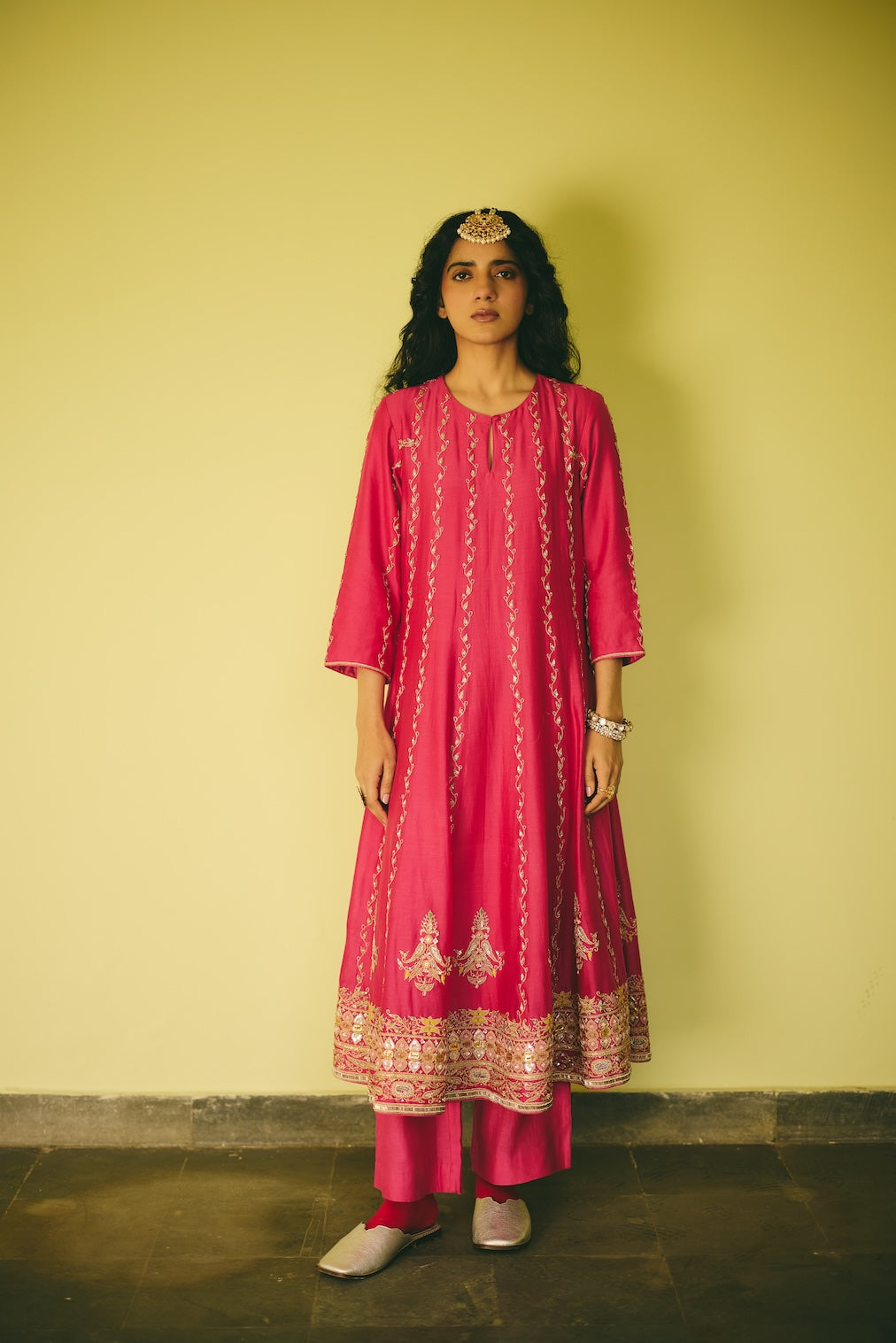
The Ferozaan & Gulraaz is a vivid example of what Jaipur's craft ecosystem produces. This jewel-toned fuchsia Chanderi silk anarkali features Aari and Marodi vine patterns running vertically across the body, with a hemline meticulously hand-embroidered with Gota appliqué, Nakshi, and sequins forming intricate floral medallions. A row of moti (pearls) traces the neckline and sleeve edges. Multiple techniques — Aari, Gota, Marodi, sequin work — converge in a single garment, which is only possible in a city where all of these specialists work in proximity.
Key Jaipur Embroidery Techniques
Understanding the specific techniques behind Jaipur embroidery helps you appreciate what you're looking at — and what you're paying for. Each technique has its own tools, its own specialist artisans, and its own visual vocabulary.
Gota Patti
Gota Patti is perhaps the most distinctly Rajasthani embroidery technique. It involves appliquéing small pieces of gold or silver ribbon (gota) onto fabric, then folding, stitching, and layering them into geometric or floral patterns. The ribbon is cut into shapes — petals, diamonds, circles — and each piece is individually sewn down by hand. The result is a textured, light-catching surface that has defined Rajasthani fashion for centuries.
Gota Patti was traditionally associated with bridal wear — Rajasthani brides wore (and still wear) lehengas covered in dense Gota work. The technique is labour-intensive: a heavily embellished lehenga can take weeks of a karigar's time. For a complete breakdown, read our Gota Patti embroidery guide.
Aari Work
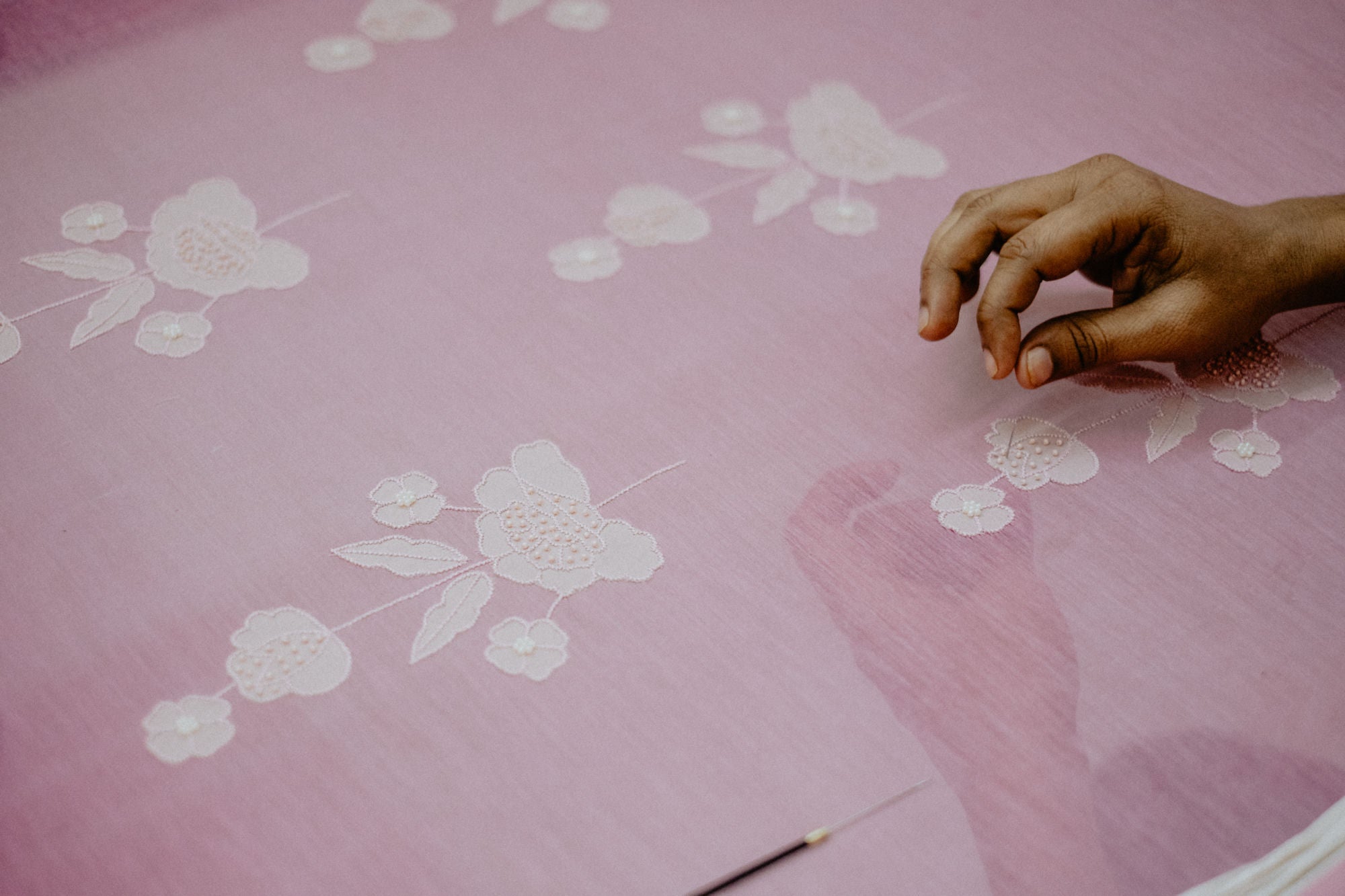
Aari work uses a specialised hooked needle (the aari) to create chain-stitch embroidery on fabric stretched across a frame. The karigar sits at the frame, feeding thread from below while pulling loops through with the hook from above, producing fine, continuous chain-stitch lines that can form anything from delicate vine patterns to dense floral fills.
Aari is one of the most versatile Jaipur artisan techniques. It's used to create outlines, fills, and textures that serve as the foundation for further embellishment — sequins, beads, and cutdana are often attached using the same aari hook. The speed and precision of an experienced Aari karigar is remarkable; they work by feel as much as by sight, maintaining perfectly even stitches across metres of fabric. See our Aari embroidery guide for a deeper look at the technique.
Zardozi
Zardozi is the heavyweight of Indian embroidery — literally. It involves stitching metallic threads, wires, and bullion (coiled metal springs) onto fabric to create dense, raised, sculptural patterns. Historically a court embroidery patronised by Mughal emperors, Zardozi work uses materials like dabka (coiled wire), salma (flat metallic strip), sitara (metal sequins), and nakshi (punched metal shapes).
Zardozi karigars in Jaipur work on wooden frames called adda, stretching the fabric taut and embroidering with both hands — one above, one below the frame. The weight and complexity of Zardozi make it the most expensive hand-embroidery technique; a Zardozi-heavy bridal piece can represent hundreds of hours of work. Our Zardozi embroidery guide covers the history, materials, and process in detail.
Bandhani
Bandhani (tie-dye) is not embroidery but a dyeing technique deeply rooted in Rajasthan. Artisans pinch tiny points of fabric and tie them with thread before immersion dyeing, creating patterns of undyed dots against a coloured ground. The fineness of Bandhani depends on how small and how numerous the ties are — premium Bandhani work involves thousands of individual ties on a single garment, each pinched and knotted by hand.
Jaipur and the broader Rajasthan-Gujarat region are the primary centres for Bandhani, producing everything from casual dupattas to elaborate bridal odhnis with tens of thousands of ties in complex mandala patterns.
Mukesh Work
Mukesh work (badla work) involves flattening fine metallic wire and stitching it through the fabric to create shimmering, geometric patterns. Unlike Zardozi, which sits on top of the fabric surface, Mukesh work is woven through the cloth, producing a flatter, more delicate metallic effect. It catches light subtly rather than projecting it boldly, making it ideal for garments that need shimmer without heaviness. For technique details, see our Mukesh work guide.

The Noor & Ahana demonstrates Mukesh work in context. This ivory woven anarkali features exquisite Mukesh work with intricate hand-embroidered floral motifs and delicate sequin detailing. The bodice and sleeves showcase floral embroidery that blends traditional craft with a contemporary silhouette — a piece that required multiple karigar specialisations to produce.
The Karigars: Skilled Craftspeople Behind Every Stitch
The word karigar translates roughly as "craftsperson" or "maker," but it carries a deeper cultural weight. Karigars are not factory workers following a blueprint. They are skilled specialists — many of whom have spent decades refining a single technique — who bring interpretive judgment to every piece they create.
A Gota Patti karigar knows, from years of practice, exactly how much tension to apply when folding a ribbon petal so it sits at the correct angle. A Zardozi karigar can gauge the weight of metallic thread needed for a particular motif by feel, adjusting for fabric density and the client's design intent. An Aari specialist maintains stitch consistency across thousands of repetitions without a guide line.
These are not unskilled labourers performing repetitive tasks. They are artisans whose expertise takes years to develop and cannot be replicated by machines. The relationship between a fashion label and its karigars is collaborative — the designer provides the vision, but the karigar's technical knowledge determines what's actually possible and how to achieve it.
In Jaipur, karigar families often specialise. One family might be known for their Gota Patti, another for Zardozi, another for Aari fill work. When a complex garment requires multiple techniques, it may pass through two or three different workshops, each contributing their specialisation. The final piece is a collaboration among several sets of hands, coordinated by the designer or production manager.


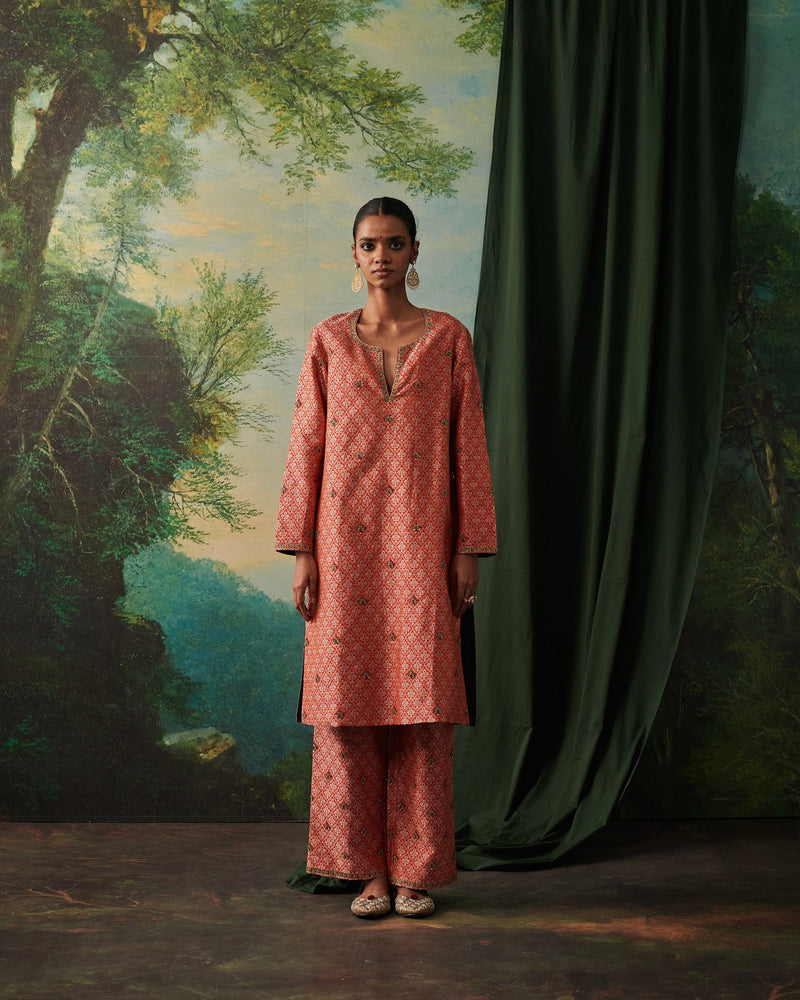
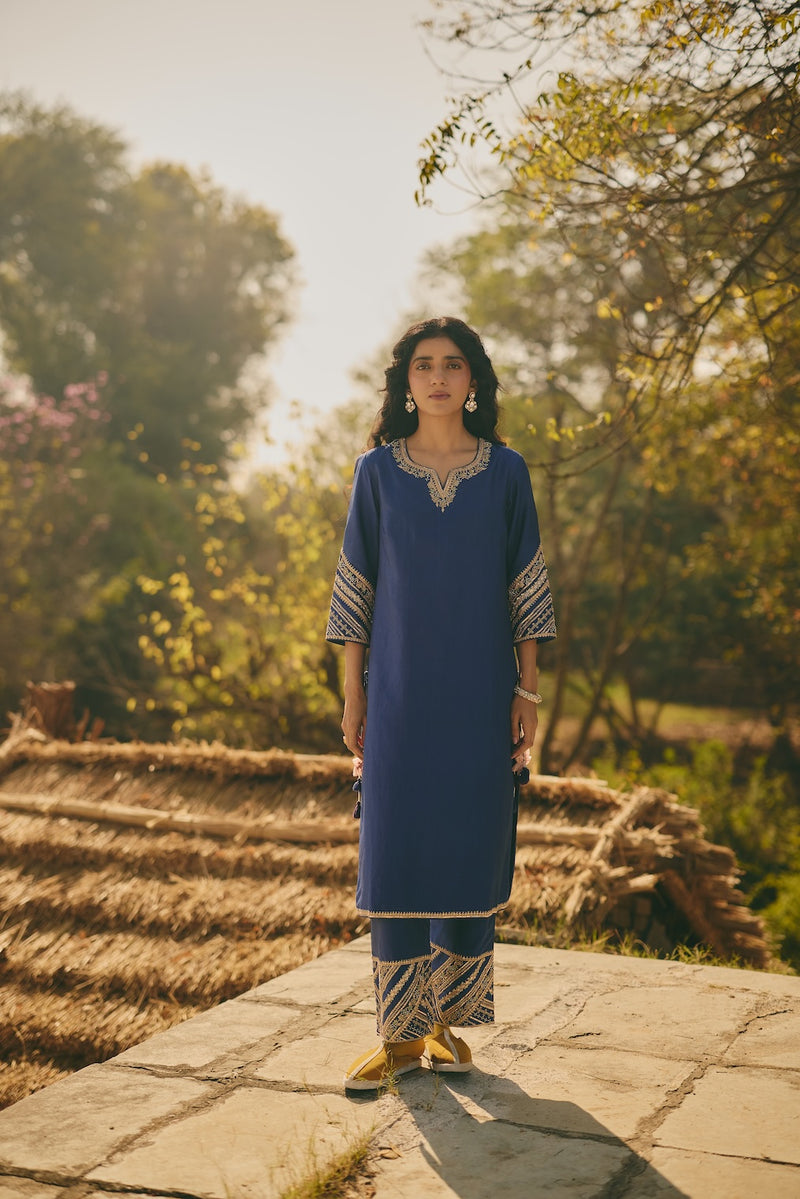
The Eila & Riya and Mirza & Raina illustrate this collaborative process. The Eila kurta is crafted in silk cotton jacquard with gold hand-embroidery — floral and vine motifs meticulously executed by artisan hands, with a square neckline and sleeves highlighted with matching embroidered borders. The Mirza kurta takes a similar vocabulary of floral and vine motifs but renders them in Zardozi technique with gold threads and zari work on ivory silk, accented with pink embroidery. Same design language, different karigar specialisations, distinctly different results.
How a Handmade Garment Is Produced in Jaipur
Understanding the production timeline helps explain why handmade Indian fashion is priced the way it is — and why it's worth the wait.
Free Download
Get Our Measurement Guide
Step-by-step instructions with photos for perfect custom fit.
Download Free GuideDesign and sampling (1-2 weeks): The process starts with a design sketch or reference. The designer works with the master karigar to determine which techniques will be used, what materials are needed, and how the embroidery will be laid out across the garment. A sample may be stitched on a test piece of fabric to confirm colours, scale, and density before committing to the final piece.
Fabric preparation (2-5 days): The base fabric is cut and prepared. For embroidery work, the fabric is often stretched on a wooden frame. Patterns are traced onto the fabric using stencils, pouncing (transferring a design through perforated paper), or freehand drawing by the karigar.
Hand-embroidery (1-4 weeks): This is the bulk of the production time. Depending on the technique and density of the work, a single garment can occupy one karigar for one to four weeks of full-time work. A heavily embroidered bridal lehenga might take multiple karigars working in parallel. Every stitch is placed by hand. There are no shortcuts.
Finishing and assembly (3-5 days): Once the embroidery is complete, the garment is assembled — panels are stitched together, linings are added, and the piece is finished with closures, piping, and hem details. Final quality checks catch any inconsistencies in embroidery tension, thread colour, or alignment.
From start to finish, a made-to-order garment typically takes 4-5 weeks of production time. That timeline represents real human labour — not warehouse storage or shipping delays, but weeks of a skilled person's focused attention on a single piece.

The Sakhi saree is a clear example of this process in action. This deep sindoori red organza saree is hand-embroidered with sequin, cutdana, and gota work — floral butis scattered across the body with a bold scalloped border that echoes traditional bridal motifs. Each buti, each sequin, each length of gota in that scalloped border was placed by a karigar's hands. The result is a piece with a texture and character that machine embroidery simply cannot replicate.
Why Handmade Matters: Beyond the Label
The phrase "handmade" has become a marketing term, used loosely by brands that want to signal authenticity without necessarily delivering it. Here's what genuine handcraft means in practical terms.
Uniqueness: Every handmade piece is slightly different. The karigar's hand pressure, the way thread tension varies across a session, the micro-decisions about stitch placement — these create subtle variations that make each garment one of a kind. Two garments made from the same design will share the same pattern but differ in the details. This is not a defect; it's a signature of hand production.
Quality of surface: Hand-embroidery has a dimensionality that machine embroidery lacks. Stitches sit at varied angles, catching light differently. Zardozi done by hand has a sculptural quality — the metallic threads are manipulated into shapes that machines can approximate but not truly replicate. Gota Patti done by hand has a softness in the folds that laser-cut machine Gota doesn't achieve.
Durability: Hand-stitched embroidery, when done well, is more durable than machine embroidery. The karigar adjusts tension for each stitch, securing the thread more firmly in areas that receive wear. Machine embroidery applies uniform tension regardless of the garment's stress points, which can lead to earlier unravelling.
Economic impact: Purchasing handmade directly supports karigar livelihoods. Jaipur's handcraft economy employs tens of thousands of artisan families. When you buy a handmade garment, a significant portion of the cost represents skilled human labour rather than factory overhead or machinery depreciation.

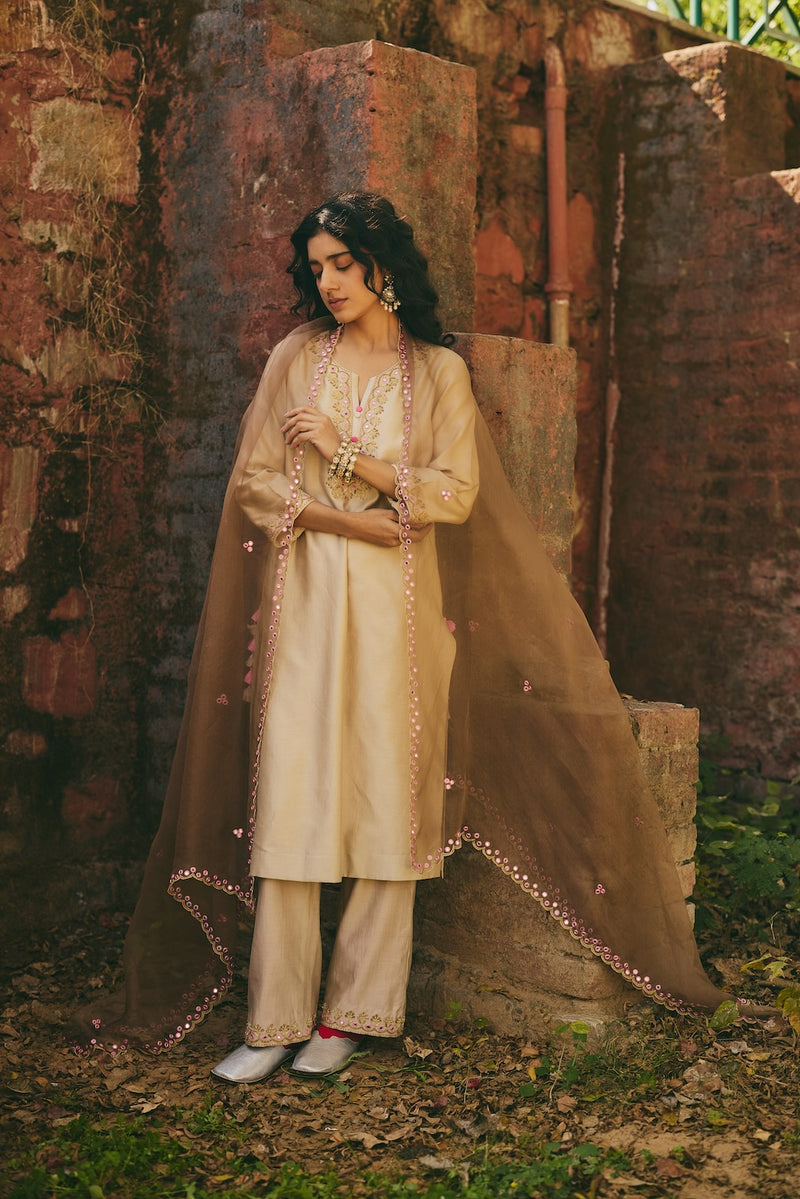
Even a single dupatta reflects this reality. The Lila is a pink and green shaded organza dupatta with intricate gold hand-embroidery and delicate floral motifs, finished with gold lace along the edges and sequin hand-embroidered detail. A dupatta this delicate, with embroidery this fine on sheer organza, requires a karigar with a particularly light touch — too much tension and the organza tears; too little and the stitches don't hold. That expertise is what you're investing in.
Rashika Mittal's Connection to Jaipur's Artisan Community
Rashika Mittal grew up in Tinsukia, a small town in Upper Assam — far from the fashion industry's established centres. After graduating from design college, she moved to Jaipur and began building direct relationships with karigar workshops across the city.
Working directly with karigars — rather than through middlemen or production houses — allows for a level of design specificity and quality control that intermediated production doesn't. When the designer can sit with the karigar, discuss a motif's scale, adjust a colour in real time, and see a technique's possibilities demonstrated on fabric, the creative process is fundamentally different from sending a tech pack to a factory.
Every garment in the Rashika Mittal collection — whether it's a kurta set, an anarkali, a saree, or a dupatta — is fully handmade. There is no machine embroidery in the production process. Each piece is made to order, with a standard production time of 4-5 weeks, because that's how long genuine handcraft takes.
This is not a supply chain optimised for speed. It's one optimised for craft. And for Rashika, being based in Jaipur — surrounded by these artisan communities, speaking the same creative language, understanding the seasonal rhythms of karigar workshops — is not incidental to the brand. It is foundational.
Frequently Asked Questions
What makes Jaipur a centre for handcraft?
Jaipur has been a handcraft hub since its founding in 1727, when Maharaja Sawai Jai Singh II invited and patronised artisan communities. The city uniquely concentrates multiple craft forms — Gota Patti, Aari, Zardozi, Bandhani, block printing, and more — in close proximity, creating an ecosystem where different specialists can collaborate on a single garment.
What is the difference between handmade and machine-made embroidery?
Hand-embroidery is executed by a karigar using needles, hooks, or frames, with each stitch placed individually. It produces dimensional, slightly varied textures and adapts to the fabric in real time. Machine embroidery is programmed and executed mechanically, producing uniform results that lack the depth and subtle irregularity of handwork. Hand-embroidery is more time-intensive and expensive, but more durable and visually complex.
What is a karigar?
A karigar is a skilled craftsperson or artisan, typically specialising in a particular technique such as Aari embroidery, Zardozi, Gota Patti, or Bandhani. Many karigars learn their craft within their families, though the skill requires years of independent practice to master. They are the craftspeople who execute the hand-embroidery on luxury Indian garments.
Why does handmade fashion take 4-5 weeks?
The production timeline reflects the real labour involved. After design, fabric preparation, and pattern transfer, the hand-embroidery alone can take one to four weeks depending on the technique and density. Every stitch, every sequin, every piece of Gota ribbon is placed by hand. Finishing and quality checks add additional days. The timeline is not arbitrary — it represents weeks of skilled human work.
Which Jaipur embroidery techniques are used in Rashika Mittal garments?
Rashika Mittal garments feature multiple Jaipur embroidery traditions including Aari work (chain-stitch embroidery), Gota Patti (gold ribbon appliqué), Zardozi (metallic thread embroidery), Mukesh work (flattened metallic wire), Marodi (twisted chain stitch), and embellishments with sequins, cutdana, moti, and nakshi. Many pieces combine several techniques in a single garment.
How can I tell if embroidery is handmade?
Look at the reverse of the fabric — hand-embroidery shows visible, slightly irregular thread paths on the back, while machine embroidery is uniform and often has a backing sheet. Examine the stitches closely: handwork has subtle variations in size and angle, while machine stitches are mechanically identical. Hand-embroidered pieces also feel different — the stitches have a slight raised texture that flat machine embroidery doesn't achieve.
Is handmade embroidery more durable?
When executed by skilled karigars, hand-embroidery tends to be more durable than machine alternatives. The artisan adjusts thread tension for each stitch, securing work more firmly in stress areas. With proper care — dry cleaning, careful storage, avoiding direct heat — hand-embroidered garments can last for generations.
Ready to Order Custom?
WhatsApp us at +91 70423 11214 with what you're looking for. We'll guide you through measurements, customizations, and timeline.
Most pieces ready in 4-5 weeks. Bridal in 6-8 weeks.
Made to order in 4–5 weeks
Have an event date? We’ll tell you exactly when to order by.
We take a limited number of orders each month — secure your slot early.
Not sure where to start?
Tell us what you're dressing for and we'll help you choose — fabric, fit, colour, and timeline — over WhatsApp.
Your Cart
Pieces from this story
All pieces →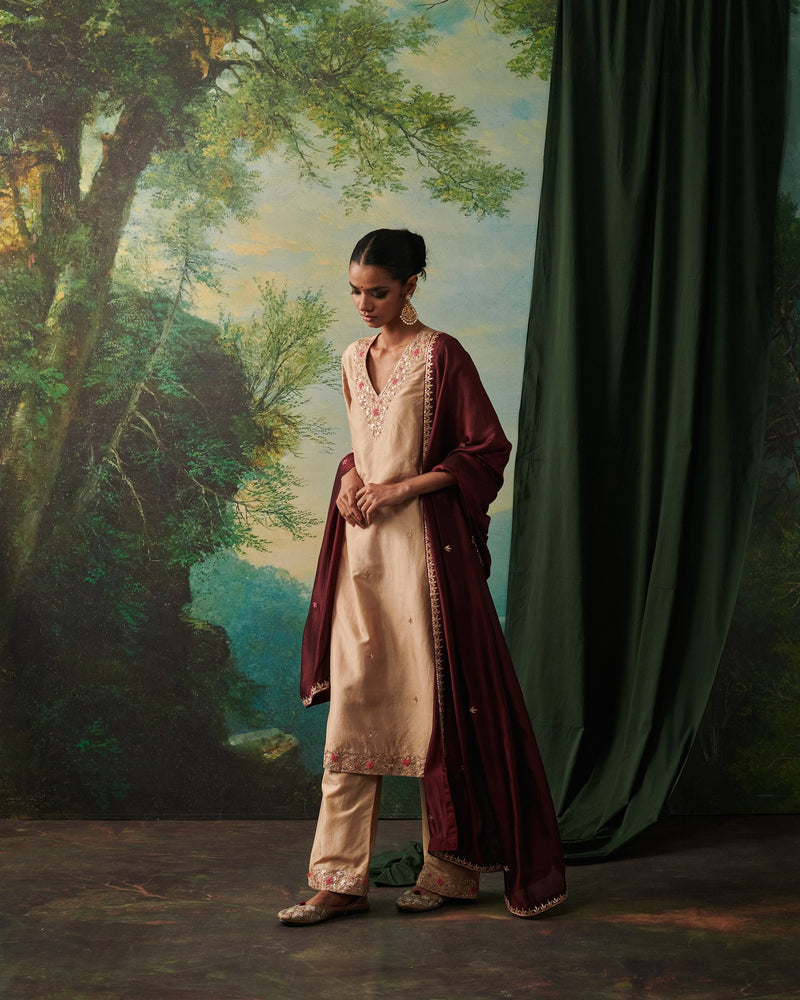
Keep reading
The journal →
Best Plus-Size Ethnic Wear Brands in India 2026: Where to Actually Find Your Size
Handmade by karigars Made to your measurements Fit guarantee Ships worldwide As seen in GraziaElle Graduat...
17 September 2026
Kurta Sets for Girls: A Parent's Buying Guide to Kids' Kurta Sets
Handmade by karigars Made to your measurements Fit guarantee Ships worldwide As seen in GraziaElle Graduat...
17 September 2026
Gifts for Your Mother-in-Law: Indian Outfits That Don't Feel Like a Formality
Handmade by karigars Made to your measurements Fit guarantee Ships worldwide As seen in GraziaElle Graduat...
17 September 2026