
How to Style Banarasi Silk: A Guide to Wearing India's Most Iconic Weave
Banarasi silk is more than a fabric — it is a heritage, a ceremony, an inheritance. Woven in the holy city of Varanasi, often using gold and silver zari, a Banarasi piece carries centuries of craft in every thread. But for all its grandeur, Banarasi can feel daunting to wear. How do you style something so storied without looking overdone? Here is a guide to wearing Banarasi silk beautifully.
What Makes Banarasi Special
Banarasi silk is defined by its density, its lustre and its intricate weave. Traditional motifs — jaal (net patterns), florals, paisleys, architectural forms — are woven into the fabric, often in gold or silver zari, giving Banarasi its unmistakable opulence. A true Banarasi is heavy, but it drapes beautifully, and once owned, it is often kept for generations.

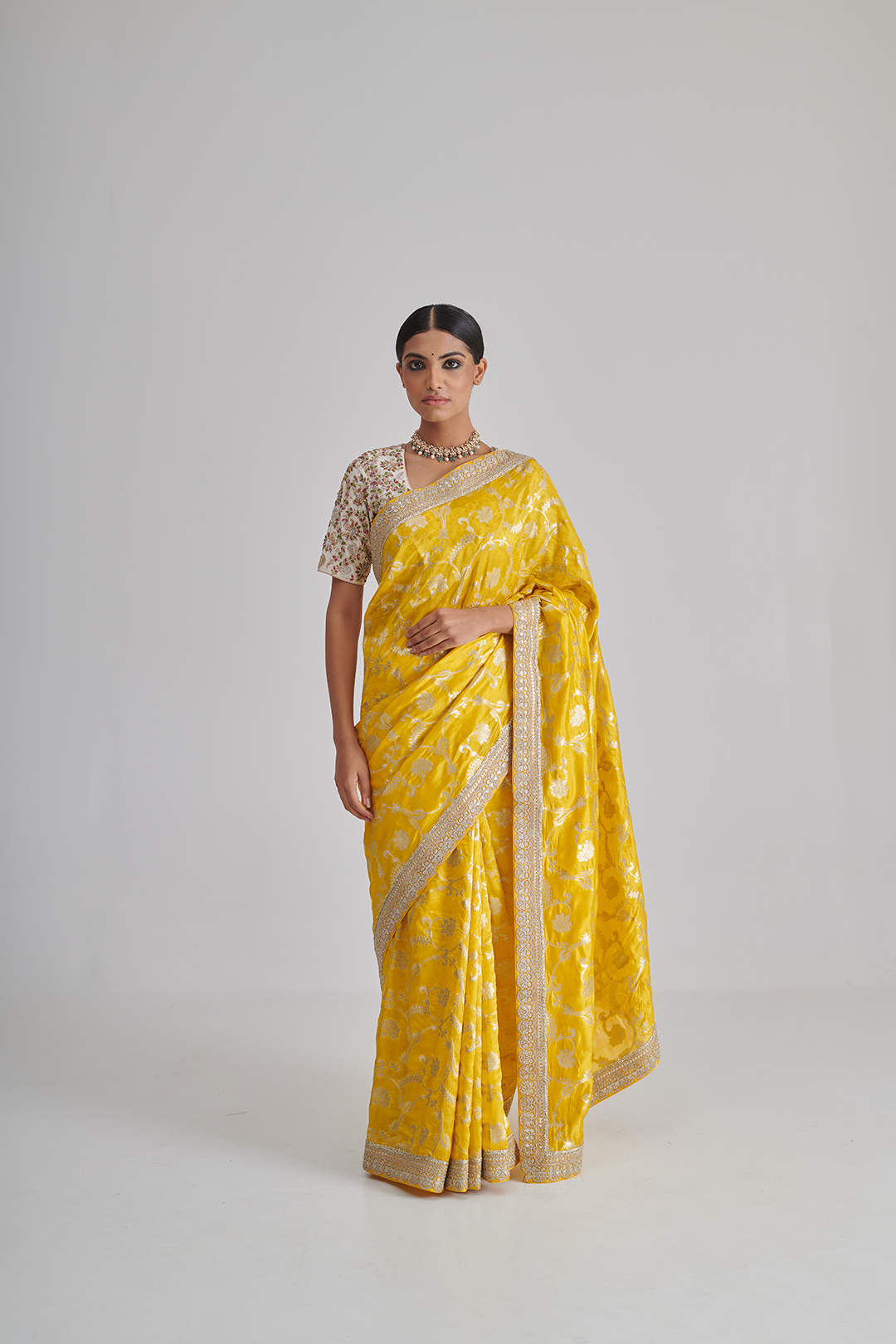
The Phalgun–Myra Saree is Banarasi at its most radiant — a yellow Banarasi silk with intricate floral motifs woven in silver thread, framed by a rich lace border, paired with an ivory blouse worked in floral embroidery and sequins.
Beyond the Saree: Banarasi in Modern Silhouettes
Banarasi is no longer sarees-only. The same rich brocade weave works beautifully in lehengas, blazers and structured sets. The Rehmat–Vasl–Inaayat Lehenga is a rich red Varanasi silk brocade lehenga and choli with all-over gold zari work — floral motifs drawn from Mughal architecture — finished with a broad gold border at the hem.


For a contemporary twist, the Raat Rani–Vani–Kiyara Ensemble reworks Varanasi silk brocade into a fitted black blazer with a hand-embroidered collar and wide-leg pants — a striking, modern-formal Banarasi look.
Want help choosing a Banarasi for your event? WhatsApp us →
How to Style Banarasi Without Overdoing It
The fabric already carries weight and drama, so the styling trick is to let it lead:
- Keep the blouse or base simple. A contrasting solid blouse or an understated embroidered piece lets the weave shine.
- Go minimal on jewellery. A pair of statement earrings or a single choker is enough — too much competes with the zari.
- Let the silhouette breathe. Banarasi's structure holds its own; avoid over-accessorising with belts or heavy dupattas.
- Balance old and new. A heritage weave with a contemporary cut — a blazer, a cropped blouse, wide-leg pants — keeps it fresh.
A Lighter Banarasi for Warmer Days
Not all Banarasi is heavy. The Zariya Saree is a soft mint-green Banarasi base with diagonal bands of sequins and gota in antique gold — light, fluid and easier to wear through long, warm celebrations.

Drawn to a Banarasi piece?
Each is made to order and tailored to you — message us to begin. WhatsApp us at +91 70423 11214
Standard production time is 4–5 weeks.
Frequently Asked Questions
Is Banarasi silk heavy to wear?
Traditional Banarasi with dense zari work is heavier than other silks, but the weight is part of its drape. Lighter versions — like Banarasi georgette or sequin-finished Banarasi — are easier for long, warm events.
Can you wear Banarasi to a daytime wedding?
Yes — choose a lighter weave and a softer colour palette. A mint or yellow Banarasi saree reads festive without being overwhelming.
How do you care for Banarasi silk?
Dry-clean only to protect the zari and silk. Store wrapped in breathable muslin, re-fold occasionally to avoid crease lines, and keep away from direct sunlight and damp.
Browse our hand-embroidered Banarasi and heritage sarees.
Browse SareesMade to order in 4–5 weeks
Have an event date? We’ll tell you exactly when to order by.
We take a limited number of orders each month — secure your slot early.
Not sure where to start?
Tell us what you're dressing for and we'll help you choose — fabric, fit, colour, and timeline — over WhatsApp.
Your Cart
Pieces from this story
All pieces →
Keep reading
The journal →
Dholki Night Outfit Ideas: What to Wear to the Ladies' Dhol
Handmade by karigars Made to your measurements Fit guarantee Ships worldwide As seen in GraziaElle Graduat...
27 July 2026
Mayra & Bhaat Outfit Ideas: Dressing for the Maternal Gift Ceremony
Handmade by karigars Made to your measurements Fit guarantee Ships worldwide As seen in GraziaElle Graduat...
27 July 2026
Pag Phera Outfit Ideas: What to Wear for the Bride's Homecoming
Handmade by karigars Made to your measurements Fit guarantee Ships worldwide As seen in GraziaElle Graduat...
27 July 2026