रशिका मित्तल
The cloth

Ten fabrics, and how each one behaves.

Cloth decides more than colour does — how a piece falls, how much embroidery it can carry, whether it holds its shape or moves with you. These are the ten we work in, and what to expect from each.

Silk रेशमSilk

The one that holds weight.

Woven
Bengaluru, Kanchipuram, Murshidabad
In the hand
Dense, cool, faintly heavy

Silk takes embroidery better than anything else we work with — it can carry dense zardozi or gota without puckering, and it falls in weighted folds rather than floating. Most of our heavier festive pieces are silk for exactly that reason.

99 pieces in Silk
Organza ऑर्गेंज़ाOrganza

Sheer, and holds its shape.

Woven
Woven from tightly twisted silk yarn
In the hand
Crisp, papery, weightless

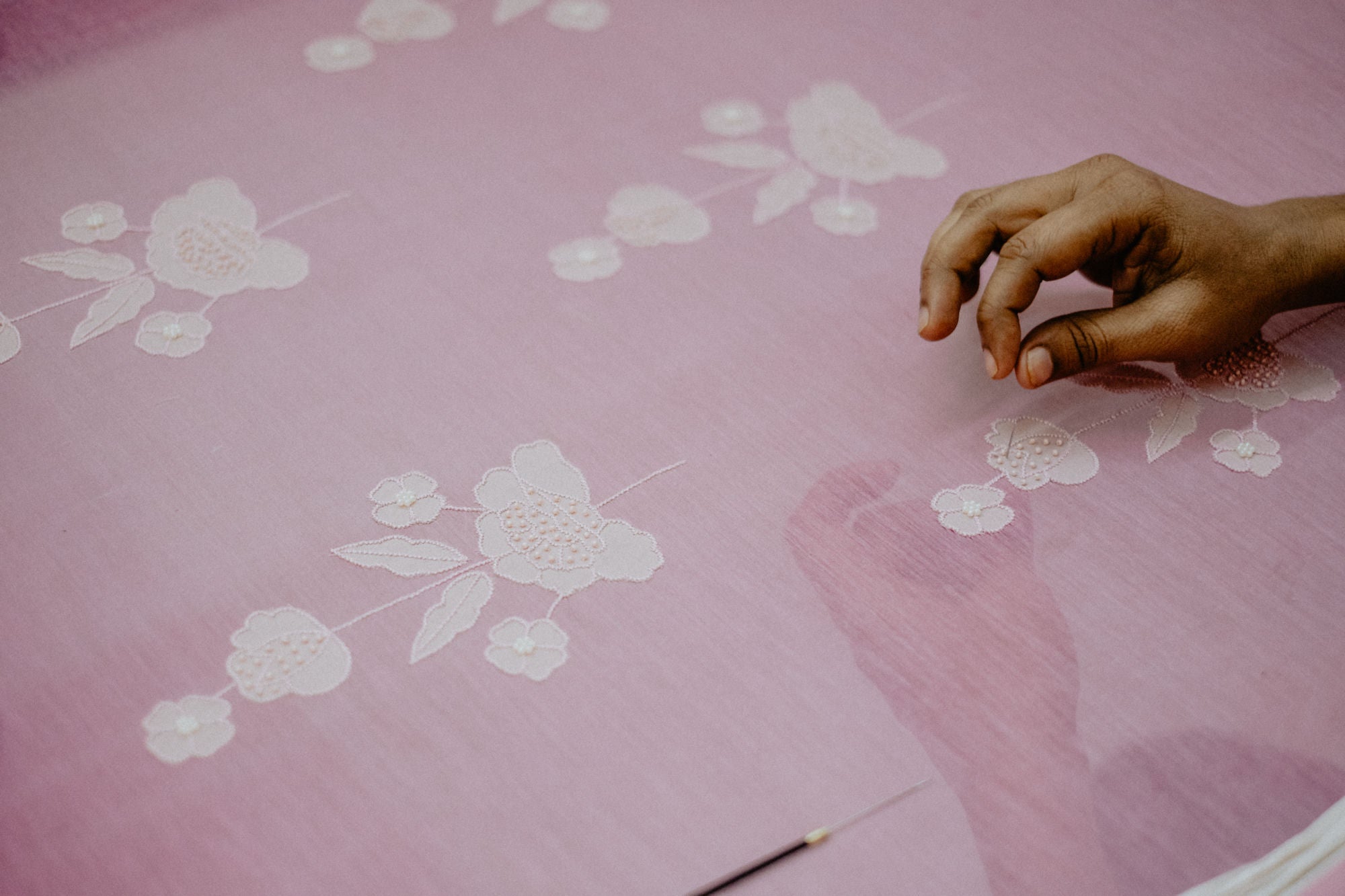
The stiffness is in the twist of the yarn, not in any finish, so it survives washing and keeps standing away from the body. Sleeves and dupattas in organza hold their volume all evening; embroidery on it appears to float, because you can see through the ground.

35 pieces in Organza
Chanderi चंदेरीChanderi

Glass-clear, and very light.

Woven
Chanderi, Madhya Pradesh
In the hand
Fine, airy, faintly glossy

Woven from unbleached, undegummed yarn, which is what gives Chanderi its particular transparency — the sheen sits in the fibre rather than on the surface. It is light enough for summer and formal enough for a wedding, which is a rare pair.

24 pieces in Chanderi
Tissue टिशूTissue

Metal in the weave.

Woven
Varanasi and Chanderi
In the hand
Papery, cool, reflective

Fine metallic thread is woven into the ground itself, so the shine belongs to the cloth rather than to anything added on top. It changes completely under different light — daylight reads it as pale, lamplight makes it burn. Photographs rarely do it justice.

18 pieces in Tissue
Georgette जॉर्जेटGeorgette

Falls, never holds.

Woven
Woven from crêpe-twist yarn
In the hand
Grainy, matte, fluid

The crêpe twist gives a slightly pebbled surface and almost no structure, so georgette drapes close to the body and moves constantly. It is the most forgiving cloth we cut — it skims rather than clings, and it does not crease.

4 pieces in Georgette
Chiffon शिफ़ॉनChiffon

Barely there.

Woven
Fine plain-weave silk
In the hand
Whisper-light, slightly rough

Lighter and sheerer than georgette, with the same fluid fall. It takes hand embroidery only where the work is light — sequin, cutdana, fine resham — because anything heavier drags the ground out of shape.

9 pieces in Chiffon
Banarasi बनारसीBanarasi

Woven, not printed.

Woven
Varanasi
In the hand
Substantial, ridged on the reverse

A brocade in which the motif is built on the loom in zari as the cloth is made, not applied afterwards. Turn a Banarasi over and you can read the whole pattern in floats of thread on the back — the surest way to tell it from a print.

6 pieces in Banarasi
Velvet मख़मलVelvet

Colour with depth in it.

Woven
A Mughal-court cloth, now woven across India
In the hand
Dense, warm, directional

The pile catches light differently depending on which way you brush it, which is why velvet colour looks deeper than flat cloth. It is a winter fabric and a heavy one, so we keep the embroidery on it deliberate rather than all-over.

Satin साटनSatin

Smooth face, matte back.

Woven
A weave, not a fibre
In the hand
Cool, slippery, weighty

Satin is a way of weaving — long floats on the surface that reflect light evenly — rather than a material. It gives the cleanest shine of anything here, and shows every stitch, so the work on it has to be exact.

6 pieces in Satin
Cotton सूतीCotton

For the days in between.

Woven
Woven across India
In the hand
Dry, breathable, soft with wear

The everyday cloth, and the one that improves with washing. We use it where a piece is meant to be worn often rather than kept for occasions — the embroidery on it is usually resham and gota rather than anything metallic.

6 pieces in Cotton

The work on top

Our craft
Gota Pattiगोटा पट्टीZardoziज़रदोज़ीAariआरीMarodiमरोड़ीReshamरेशमZariज़रीNakshiनक़्शीCutdanaकटदाना