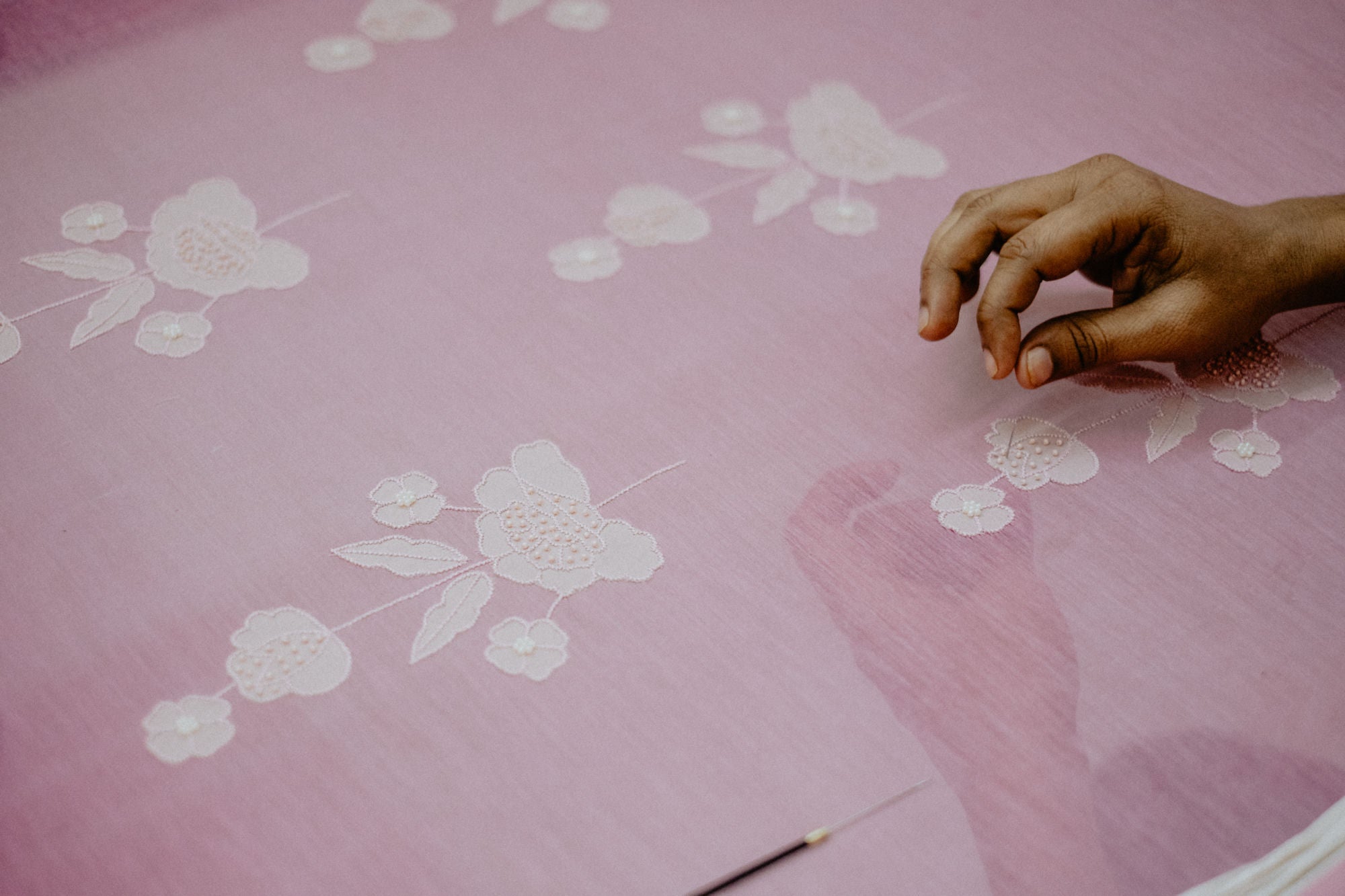
Every piece we make is embroidered by karigars in our Jaipur atelier, in techniques carried between generations — some Rajasthani, some brought by the Mughal court, some older than either. This is what the words on each product page mean, and what your piece is made of.
Narrow ribbon of flattened metallic tissue is folded, pleated and cut into leaves, florets and lattices, then stitched down along its edges so the shape lies flat against the cloth. Because the gota is applied rather than embroidered through, the surface stays light — a heavily worked odhani still moves.
Persia, then the Mughal courts — Lucknow, Bhopal, Delhi
Metal-wound thread is couched onto cloth stretched drum-tight across a wooden adda. The karigar works from above with a needle, or from below with an ari hook, laying dabka, salma and nakshi coils in dense raised patterns. It is the slowest work we do; a single heavily worked panel can take weeks.
A fine hooked needle — the ari, named for a cobbler's awl — is pushed through cloth stretched on a frame and pulls thread up from underneath in a continuous chain stitch. The karigar works blind to the face of the cloth, following a chalked outline he can only feel. It is much faster than a needle, which is why long vines and dense fills are almost always aari.
A twisted metallic cord is laid along a drawn line and stitched down at intervals with a fine matching thread, so the cord itself never passes through the cloth. The result is a raised, continuous outline — the vines and stems that carry most of our floral work are marodi.
Worked wherever silk is spun; Bengal, Karnataka, Kashmir
Untwisted silk floss, worked in satin and long-and-short stitch. Because the filament is untwisted it lies flat and reflects along its whole length, so a petal shaded in resham reads as colour rather than as stitch. It is the only work here that adds no metal and no weight.
Fine metallic thread — a flat strip wound around a silk core — carried through the cloth as an ordinary thread rather than couched on top. It sits with the weave instead of above it, so zari gives a low even shine that reads as light in the fabric rather than as ornament laid onto it.
A tightly wound metal coil with a faceted outer face, cut into short lengths and threaded like a bead. Because each face is flat, nakshi catches light from a different angle than the smooth dabka beside it — the two are almost always used together for exactly that contrast.
Small glass beads, each cut with flat faces, stitched individually along a drawn line or scattered across a ground. Used to break up a surface and hold light in points rather than in lines — the sparkle in most of our evening pieces is cutdana, not sequin.
Hyderabad, and wherever pearl came through the ports
Pearls stitched one at a time, usually to finish an edge — a neckline, a sleeve hem, the scalloped border of a dupatta. Moti is the last work done on a piece and the most tactile: it is the part you feel when you put the garment on.
A small mirror is trapped against the cloth by a ring of interlaced stitches worked around its rim — no glue, no metal setting, nothing behind it. The thread ring is both the fixing and the ornament, and if it is worked well the mirror will outlast the garment.
Kutch and Jamnagar, Gujarat; Jaipur and Sikar, Rajasthan
The cloth is pinched into thousands of tiny points and each is bound tightly with thread before dyeing. The bound points resist the dye; when the ties are opened the pattern appears in reverse, as small undyed circles. A fine bandhani odhani can hold over a hundred thousand ties.
Shapes are cut from one fabric and laid onto a second, their raw edges turned under and stitched down. It gives flat blocks of colour and a slightly raised edge that embroidery cannot — the graphic borders and large florals in our work are appliqué, often outlined afterwards in marodi.