
How to Accessorize Indian Outfits: The Complete Guide for Every Occasion
The outfit is only half the story. The right accessories transform a simple kurta set into a festive look, a plain saree into a cocktail statement, and a cotton dress into weekend brunch perfection. But over-accessorizing is just as common as under-accessorizing — the key is knowing which pieces to add and when to stop.
The Golden Rule: One Hero Piece
Every look should have one hero accessory — the piece your eye goes to first. Everything else should support it, not compete with it.
- If your outfit is heavily embroidered → keep accessories minimal (studs, thin chain)
- If your outfit is simple → one statement accessory changes everything (big jhumkas, layered necklace)
- If you're wearing a dupatta → that counts as an accessory. Don't pile on more
Accessorizing Kurta Sets
Kurta sets are the most versatile canvas for accessories because the silhouette is clean and doesn't compete with jewellery.
Casual / Everyday Kurta Set
Add: Oxidised silver jhumkas or hoops, a thin bangle stack, kolhapuris or flat sandals, a crossbody bag or tote
Skip: Heavy necklaces, multiple statement pieces, heels


A set like the Pardesi & Amaya in cotton needs nothing more than silver jhumkas and kolhapuris. The Banni & Aayat set in Chanderi goes from casual to lunch-appropriate with gold studs and pointed flats.
Festive / Wedding Kurta Set
Add: Kundan or polki earrings, a statement ring, embroidered juttis or heeled sandals, an embroidered potli or clutch, and — the most important — a dupatta
Skip: Casual bags, sneakers, minimal jewellery


A set like the Jazabah & Saiyan in deep red silk calls for kundan jhumkas, a gold potli bag, and embroidered heels. The Raabiya & Zareen with its rich marodi embroidery needs only statement earrings — the outfit does the rest.
Accessorizing Sarees
A saree's accessories depend almost entirely on the blouse. The blouse is the frame; the jewellery works with it.
With a Simple Blouse
Add: Statement necklace or choker, bold earrings, a bangle stack, bindi, waist belt (optional), embellished clutch
When the blouse is simple, accessories carry the look.
With an Embroidered / Statement Blouse
Add: Stud or small drop earrings, a single bracelet or watch, sleek clutch
When the blouse is the star, everything else steps back.


The Roop in black silk with floral aari embroidery and cutout back is a statement — add studs and a thin bracelet only. The Haseena in ivory silk halter is minimal — this is where a statement choker or layered necklace transforms the look.
The Dupatta as an Accessory
A dupatta is the most versatile accessory in Indian fashion. The right dupatta can change a simple outfit's entire personality.


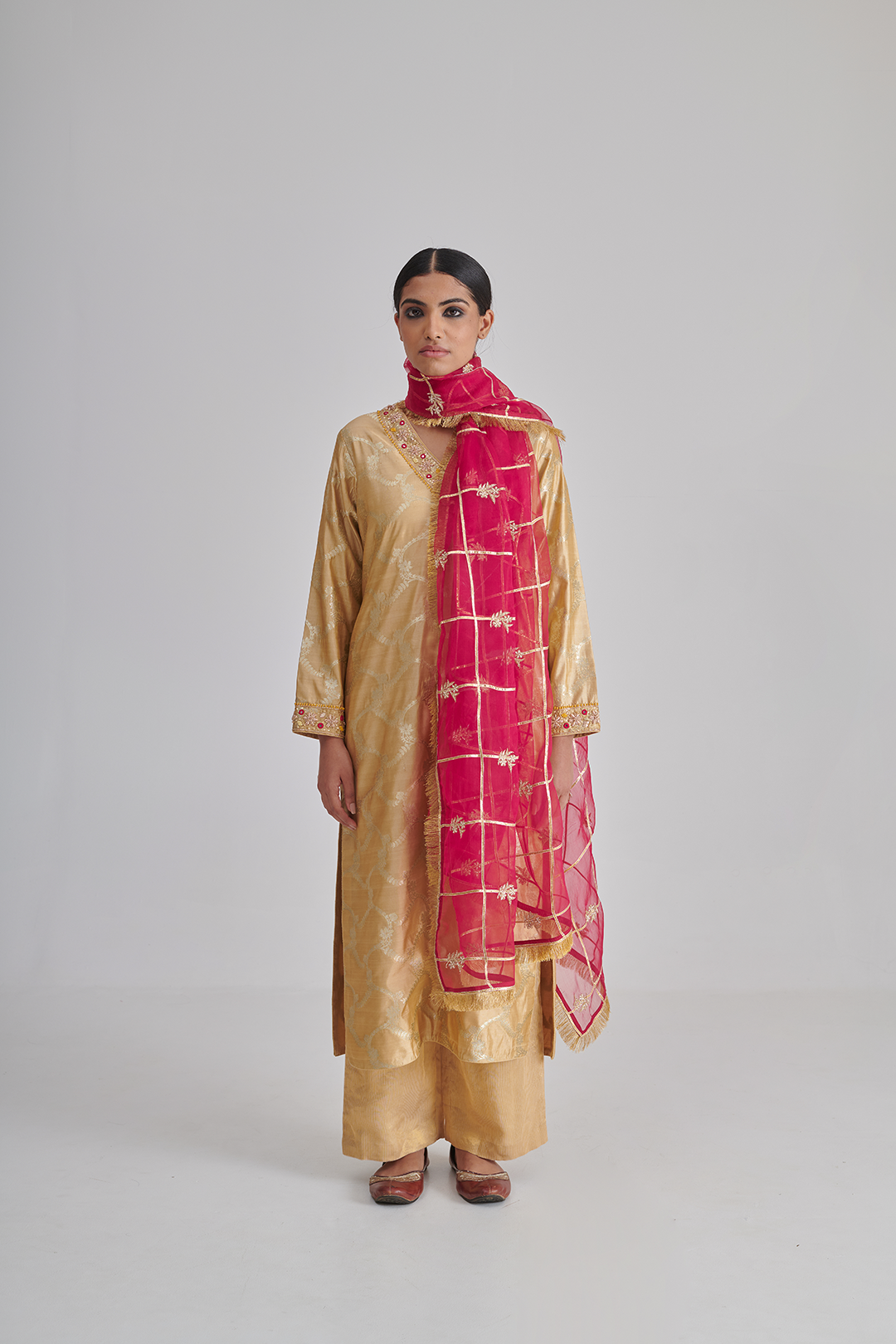
Draped on one shoulder — the classic. Works with kurta sets for a festive touch. The Aadya red organza with gold zari adds instant ceremony-level drama to a plain kurta.
As a head covering — for religious ceremonies, nikah, temple visits. The Naisha in peach organza with scalloped borders is perfect — light enough to drape comfortably.
As a wrap/stole — draped loosely around both arms for evening events. The Lila with its pink-to-green gradient creates movement and colour when worn as a wrap.
Footwear Guide
Kolhapuris: The all-rounder. Work with kurta sets, cotton dresses, casual sarees. Choose leather for everyday, embellished for festive.
Free Download
Get Our Measurement Guide
Step-by-step instructions with photos for perfect custom fit.
Download Free GuideJuttis: Embroidered juttis are the Indian equivalent of statement heels. They add festive energy to any outfit without the discomfort of heels.
Block heels: The practical choice for weddings where you'll be standing and dancing. Gold or nude block heels work with almost everything.
Stilettos: For cocktail and reception only. Unless the event is entirely on flat ground, skip them — Indian venues rarely have stiletto-friendly surfaces.
Flat sandals: For mehendi, haldi, and casual events. Keep them sleek (not sporty) and you'll look intentional.
Bags for Indian Outfits
Potli bags: The classic Indian occasion bag. Embroidered, beaded, or metallic — they're small enough to carry essentials and festive enough to be part of the outfit.
Box clutches: More modern, more structured. Work for both Indian and indo-western looks. Choose metallic (gold, silver) for maximum versatility.
Crossbody bags: For casual events only — mehendi, shopping trips, brunch. Choose a small, structured crossbody over a slouchy one.
Accessorizing by Occasion: Quick Cheat Sheet
Office / everyday: Studs or small hoops + thin bangle + kolhapuris or pointed flats + structured tote
Festive lunch / puja: Jhumkas + bangle stack + juttis + dupatta on one shoulder + potli or clutch
Wedding ceremony: Kundan/polki set + statement earrings + embroidered heels + potli + dupatta + bindi
Cocktail / reception: Statement earrings (drop or chandelier) + single bracelet or cuff + stilettos or block heels + box clutch
Mehendi / haldi: Oxidised silver jhumkas + floral bangles + flat sandals or kolhapuris + crossbody bag
Common Accessorizing Mistakes
- Matching everything: Your earrings, necklace, bangles, and bag don't need to match. Coordinated is better than identical.
- Heavy jewellery with heavy embroidery: If the outfit is doing the work, let it. Statement embroidery + statement jewellery = visual noise.
- Wrong metal tone: Gold jewellery pairs best with warm colours (red, yellow, orange, pink). Silver works with cool colours (blue, green, black, white). Rose gold bridges both.
- Ignoring the dupatta: An organza dupatta is the single most transformative accessory. It takes a 5-minute outfit and makes it wedding-ready.
Frequently Asked Questions
Gold or silver jewellery with Indian outfits?
Traditional rule: gold for festive, silver for casual. Modern reality: wear what suits your skin tone. Warm undertones look best in gold. Cool undertones look best in silver. If unsure, gold is always safe with Indian outfits. Read our jewellery pairing guide for detailed combinations.
How many accessories is too many?
The rule of three works: earrings + one wrist piece + one additional (necklace OR ring OR hair accessory). For weddings, you can push to four or five. For everyday, two is enough.
Can I wear Western accessories with Indian outfits?
Yes — selectively. A structured leather bag with a cotton kurta looks chic. Hoop earrings with a silk set look modern. But avoid very Western statement pieces (chunky chain necklaces, oversized sunglasses) with traditional silhouettes — the mix reads as confused rather than intentional.
Explore: dupattas · kurta sets · sarees · blouses · shop all
Ready to Order Custom?
WhatsApp us at +91 70423 11214 with what you're looking for. We'll guide you through measurements, customizations, and timeline.
Most pieces ready in 4-5 weeks. Bridal in 6-8 weeks.
Made to order in 4–5 weeks
Have an event date? We’ll tell you exactly when to order by.
We take a limited number of orders each month — secure your slot early.
WhatsApp me my order-by date + a shortlistNot sure where to start?
Tell us what you're dressing for and we'll help you choose — fabric, fit, colour, and timeline — over WhatsApp or on a video call.
Your Cart
Pieces from this story
All pieces →Not sure which piece, or need it by a date? Book a video consultation Ask us on WhatsApp




Keep reading
The journal →
The Complete Guide to Pairing Jewellery with Indian Outfits
The complete guide to pairing jewellery with lehengas, sarees, anarkalis, and kurta sets. What to wear, what to skip,...
13 March 2026
Vidaai Outfit Ideas: What the Bride and Her Family Should Wear
Vidaai outfit ideas for the bride and her family — elegant, comfortable pieces in soft silk, blush, and fuchsia for t...
23 July 2026
Payal & Anklet Styling Guide: The Prettiest Detail You're Forgetting
A guide to payals and anklets in Indian fashion — silver vs gold traditions, types from delicate chains to ghungroo p...
2 July 2026