
Makar Sankranti 2027 Colours: Why Maharashtra Wears Black, and What the Rest of India Wears
Makar Sankranti 2027 falls on Friday 15 January in most Indian panchangs. The one colour with a real custom behind it is black, and it is a Maharashtrian custom. Women there wear black sarees, and a new bride wears black with white sugar jewellery for her first Sankranti. Outside Maharashtra there is no official Sankranti colour. The table below shows which colours are customs and which are simply our picks.
When Is Makar Sankranti in 2027?
Drik Panchang (New Delhi) puts the Sankranti moment at 9:14 PM on Thursday 14 January 2027. That is after sunset, so it lists Makar Sankranti on Friday 15 January, with the Punya Kaal from about 7:15 AM to 5:46 PM. Some calendars and holiday sites still print 14 January, because they go by the date of the transit itself. For the bath, the daan and the puja, follow your local panchang. For planning outfits, think of 14 and 15 January as one long festival.
The festivals around it shift too. Drik Panchang lists Lohri and Maghi on Thursday 14 January, though a few sites say Wednesday 13 January, so check with your gurdwara or family. It lists Magh Bihu on Friday 15 January, with Uruka the night before. Tamil Nadu's 2027 holiday list, as reported, puts Thai Pongal on Friday 15 January.
Makar Sankranti Colours by State: The Quick Answer
| Where & what it's called | Colour | Custom or our pick? | How to wear it |
|---|---|---|---|
| Maharashtra, Makar Sankrant (15 Jan) | Black | Regional custom | Black saree for haldi-kumkum; newlyweds in black with white halwyache dagine |
| Gujarat, Uttarayan (14 Jan, Vasi Uttarayan next day) | Bright yellows, oranges | Our pick (no set colour) | A kurta set you can climb stairs and fly kites in |
| Punjab, Lohri (14 Jan night) & Maghi | Deep red | Our pick (no set colour) | Chanderi kurta set and a warm shawl; keep sheer fabrics away from the fire |
| Assam, Uruka (14 Jan) & Magh Bihu (15 Jan) | Golden, cream | The natural colours of muga and pat silk, not a festival rule | Mekhela sador for the meji; beige-and-gold for gatherings outside Assam |
| Karnataka, Sankranti / Suggi | Any new clothes | Custom is new clothes, not a colour | Something fresh for ellu birodhu visits |
| Andhra & Telangana, Bhogi to Mukkanuma | Yellow and silver | Our pick (no set colour) | Silk sari for the Sankranti day, lighter cotton for drawing muggulu |
| Tamil Nadu, Pongal (Thai Pongal 15 Jan) | See our Pongal guide | New clothes are the custom | Day by day in the Pongal colour guide |
| Bihar & UP, Khichdi | Saffron, yellow | Astrological association with the sun | A warm-toned set for the temple visit and dahi-chura lunch |
Dates per Drik Panchang (New Delhi) and reported state holiday lists. Local panchangs can differ by a day. Updated 2 November 2026.
Why Maharashtra Wears Black on Sankranti
Across most of Hindu India, black stays in the cupboard on puja days. Sankranti in Maharashtra is the well-known exception, which Wikipedia calls "a unique regional custom".
No documented origin exists. Three explanations are given most often:
- Warmth. Sankranti falls in the coldest weeks of the year, and black absorbs the sun's heat. This is the most common explanation, and the simplest.
- Shani. Makar rashi is ruled by Shani (Saturn), and black is Shani's colour. Hindi outlets such as Navbharat Live describe wearing black as a way to please Shani on the day the sun enters his sign. This is an astrological belief, not a scriptural rule.
- A new beginning. Some writers read it as darkness giving way to light as the days lengthen.
Whatever the reason, the custom shows up in three places:
Haldi-kumkum. Married women invite each other home, apply haldi and kumkum, exchange small gifts and hand round tilgul with the greeting "tilgul ghya, god god bola": take this sesame-jaggery sweet and speak sweetly. Gulf News describes the women of the house and the neighbouring homes gathering in black nine-yard sarees. For what to wear as a host or a guest, see our haldi-kumkum outfit guide.
The newlywed's first Sankranti. In the first year of marriage, the bride wears a black saree and halwyache dagine: necklace, earrings, bangles, armbands and waistbands made from sugar crystallised around sesame seeds. Atlas Obscura reports that the groom often wears a black kurta or suit too. The white sugar against black silk is the whole look.
Bornahan. Many families also hold a bornahan ("bor bath") for young children, often up to the age of five. The child is dressed in black, given sugar jewellery, and showered with ber, puffed rice, sugarcane pieces and sweets.
How to wear black for Sankranti
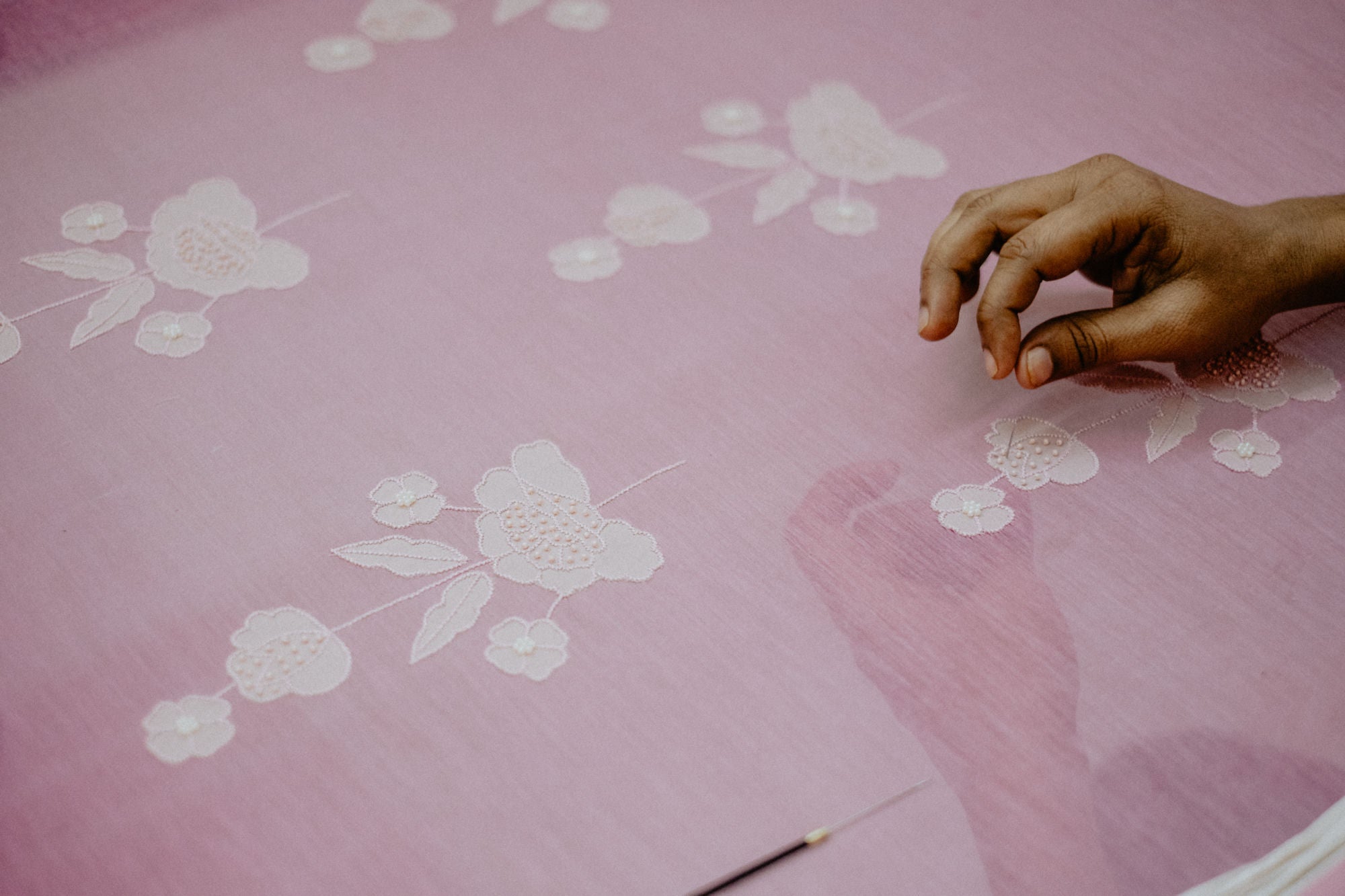
The traditional choice is a black nine-yard nauvari or a six-yard Maharashtrian silk. We don't make nauvari, and we don't weave our own silks: we buy handwoven cloth and embroider it in our Jaipur atelier. What we offer is black with handwork, for a haldi-kumkum, a Sankranti lunch or a first Sankranti away from Maharashtra.
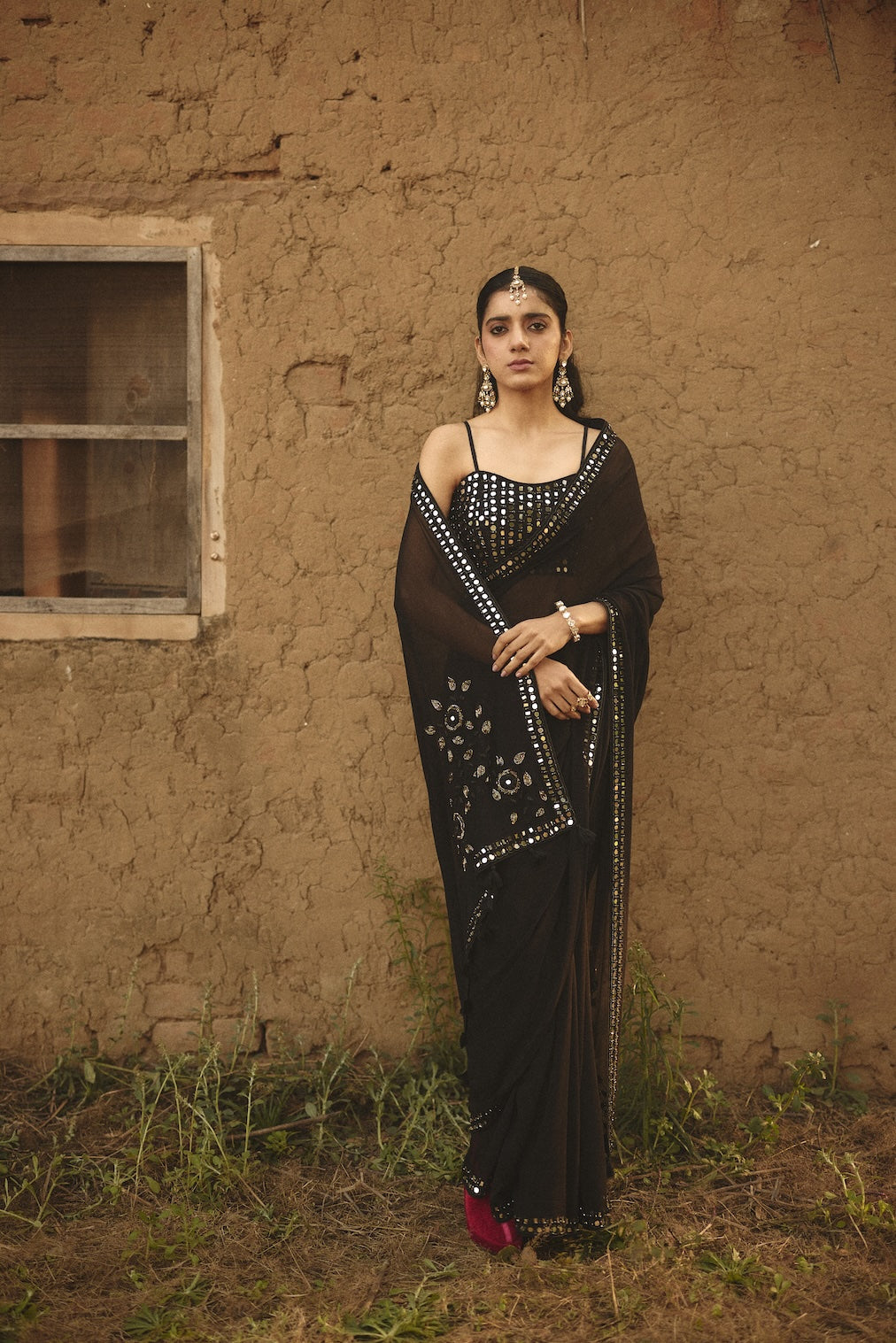
The Chandni black chiffon saree (₹22,500) is a deep black chiffon with vertical lines of sequins and cutdana along the border and small buta motifs across the body. The blouse in the photographs is not included.

For more shine, the Sarmaya black chiffon saree (₹35,100) has a continuous mirror-work border along every edge, floral mirror bootas on the pallu and scattered mirror accents across the body. It is a good choice for a bride's first Sankranti evening. The Gulmohar jet black georgette saree (₹45,500) is softer: dull gold and soft pink floral bootis, a scalloped border, and aari, sequin and resham work. Neither comes with a blouse, so pair them with one of these:


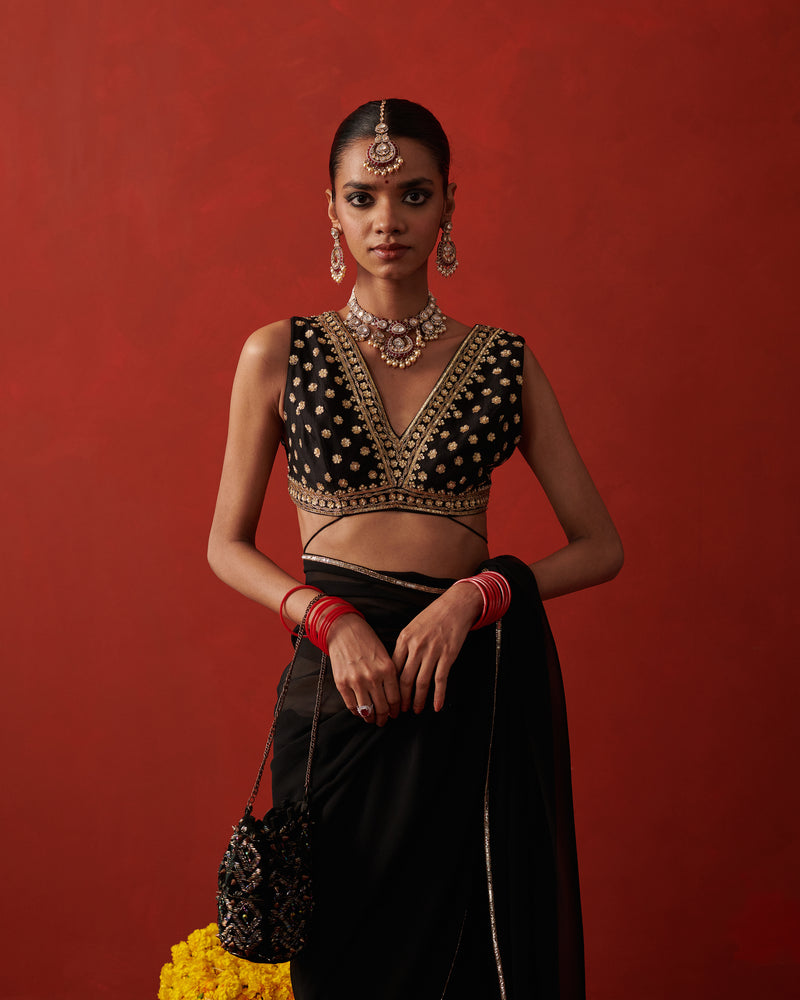
The Ulfat black silk blouse (₹8,500) is pure silk, sleeveless, with dotted motifs and a border in dull gold sequins and cutdana. The Roop black silk blouse (₹12,500) has floral aari work in pastel pinks and ivory along the sleeves, neckline and cutout back. Either one turns a black saree you already own into a Sankranti look.
If you don't wear sarees, the Ayesha black silk kurta with Mehr pant (₹28,500) is a deep black silk set with jaali-inspired borders in marodi, sequins and thread work, and a medallion at the back framed in plum silk. For more on wearing black well, see our guide to black in Indian fashion.

Gujarat: Uttarayan on the Rooftops
Gujarat's Uttarayan is a two-day festival: Uttarayan on 14 January and Vasi ("stale") Uttarayan the day after. Families spend both days on their terraces flying kites, cutting each other's lines with glass-coated manja, and eating undhiyu, chikki and jalebi. With the 2027 transit falling late on the 14th, check your local calendar for which day your society treats as the main one.
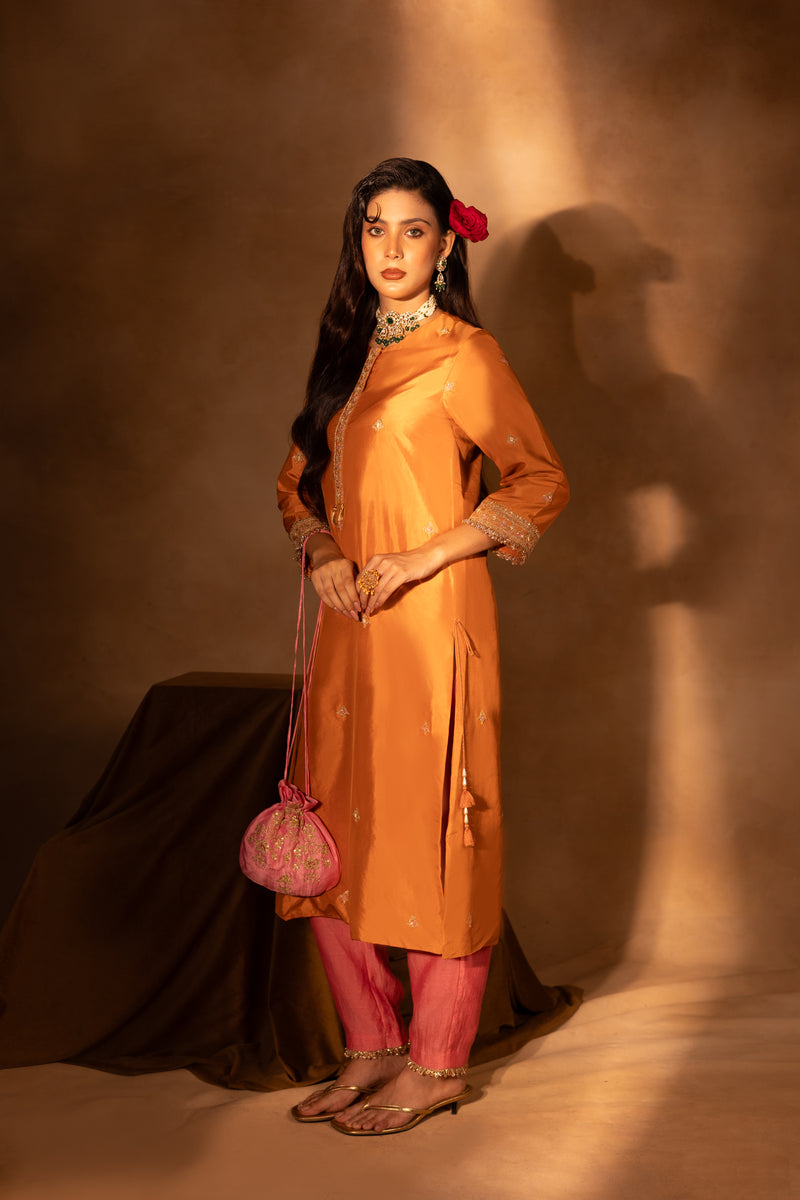
There is no traditional Uttarayan colour. You will be climbing stairs and reeling string all day, so our pick is a bright kurta set with pants, not a saree. The Gulal marigold orange silk kurta set (₹23,500), from our Haseena collection, has marodi embroidery down the placket, tassels and scattered motifs. It comes with dusty coral pink chanderi pants and the deep green Panna dupatta.

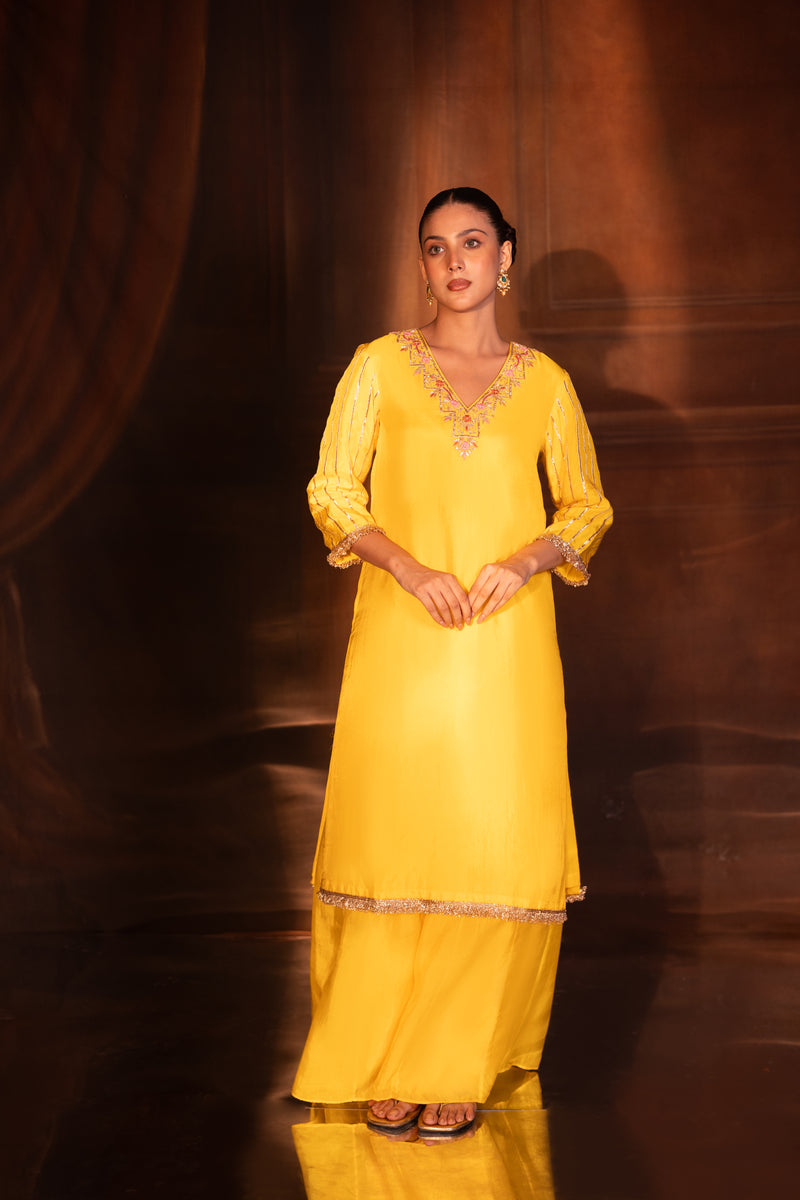
For an Uttarayan evening party, the Kanchan sunshine yellow sharara set (₹29,500), also Haseena, is a sunshine yellow silk with pink and gold-toned embroidery at the V-neck and embellished stripes down the sleeves. The Basanti burnt saffron sharara set (₹25,500) is a burnt saffron chanderi with gold-toned floral embroidery. It comes with the Rimza dupatta in sun-kissed ochre chanderi.


Punjab: Lohri and Maghi
Lohri is the bonfire night before Maghi. People throw til, gur, rewri, peanuts and popcorn into the fire, children go door to door singing songs about Dulla Bhatti, and families with a new bride or a new baby celebrate their first Lohri together. The next day is Maghi, marked by the Mela Maghi at Sri Muktsar Sahib in memory of the Chali Mukte, the Forty Liberated Ones.
Lohri has no set colour either. We don't make phulkari, the classic Punjabi festive touch. Our pick is deep red, which glows by firelight. The Jazabah deep red chanderi kurta with Saiyan pant (₹27,500) has tonal gota patti, marodi, resham and bead work on a floral bel at the neckline, hem and sleeves. The Fariha crimson red chanderi set (₹28,395) has a wide yoke of aari and marodi golden vines. A safety note: keep organza and chiffon well back from the fire, and wear a wool shawl over everything. Our Lohri outfit guide covers layering.
Assam: Uruka and Magh Bihu
Our founder Rashika grew up in Tinsukia, Upper Assam, so for this label mid-January means Bhogali, or Magh Bihu, as much as Sankranti. Drik Panchang puts Magh Bihu on Friday 15 January 2027 and Uruka, the last night of Poush, on the 14th. On Uruka, people build makeshift huts called meji from bamboo, leaves and thatch, and hold a community feast. The meji is burnt at dawn the next morning. Magh Bihu is about food and fire more than dress.
When people do dress up, it is in a mekhela sador of Assam silk. Muga has a natural golden sheen and pat is a bright cream, and that is where Bihu's "golden" look comes from: the silk itself, not a festival rule. We don't make mekhela sador,. If you are going to a Bihu gathering in Delhi, Bengaluru or abroad and want something in the same gold-and-cream family, the Sunheri beige moonga zari silk kurta with Sahana pant (₹18,500) is a beige jacquard with an all-over floral pattern, embroidery at the neckline and cuffs, and pants with gold stripes and red floral scallop embroidery at the hem. More on this in our Bihu outfit guide.

Karnataka, Andhra Pradesh and Telangana
Karnataka calls the harvest Suggi. The heart of the day is ellu birodhu: girls and women in new clothes visit homes with plates of ellu-bella (sesame, jaggery, coconut and groundnut), sugarcane and bananas, saying "ellu bella thindu olle maathadi", eat ellu-bella and speak well. The custom is new clothes, not a particular colour.
Andhra Pradesh and Telangana celebrate over four days: Bhogi, Sankranti (Pedda Panduga), Kanuma and Mukkanuma. Bhogi starts with the Bhogi mantalu bonfire, and children get Bhogi pallu, a shower of berries, sugarcane pieces and rice. Women draw muggulu in rice flour and place gobbemmalu, cow-dung balls, on them. Haridasus come round singing, and decorated Gangireddu bulls are led from house to house. Kanuma is the day for honouring cattle. No colour is prescribed. Our pick for the Sankranti day is the Phalgun yellow Banarasi silk sari with Myra blouse (₹27,500). It has floral motifs woven in silver thread and a lace border, and comes with an ivory Myra blouse with floral embroidery and sequins.
Bihar and Uttar Pradesh: Khichdi
In Bihar and much of Uttar Pradesh the festival is simply called Khichdi, after the rice-and-lentil dish. At Gorakhpur's Gorakhnath temple, devotees offer khichdi to Baba Gorakhnath. Bihar's Sankranti plate is dahi-chura (flattened rice with curd) and tilkut. There is no Khichdi colour. Hindi outlets often list saffron and yellow as auspicious on Sankranti, because of the sun and Brihaspati. That is an astrological association, not a rule. The Basanti set above, or a mustard dupatta over something you already own, fits it well.
Already Own Something? Restyle It
- Any black kurta or saree becomes a Sankranti look with gold or white jewellery and a bright dupatta. The Sonchampa mustard yellow georgette dupatta (₹14,500), with scattered motifs and a sequinned border, is a good one to add.
- A non-black saree for haldi-kumkum? Wear it with a black blouse (Ulfat or Roop above). It nods to the custom without a new saree.
For families, our kidswear collection has small versions of several adult designs.
Will It Arrive in Time?
Yes, if you order by early December. Every piece above is made to order in 4–5 weeks, plus 3–7 days shipping, so an order placed today (early November) arrives around 7–14 December. Adult custom measurements cost nothing extra. Design changes are not free, so ask us on WhatsApp what is possible on a design. Domestic orders above ₹30,000 ship free. For more ideas beyond colour, see our Makar Sankranti outfit guide.
Sources: Drik Panchang (2027 dates, New Delhi); Wikipedia; Gulf News and Atlas Obscura (halwa dagine); Navbharat Live; Hindupad and Deccan Chronicle (Telugu customs); Bihar Tourism; GoodReturns and LiveChennai (Tamil Nadu holidays).
Black Sarees and Festive Sets, Hand-Embroidered in Jaipur
Made to your measurements over 4–5 weeks, plus 3–7 days shipping. Order by early December for Sankranti. Browse our blouses, kurta sets or shop all, and message us on WhatsApp with any questions.
Shop the CollectionFrequently Asked Questions
What colour should I wear on Makar Sankranti 2027?
If you celebrate the Maharashtrian way, wear black. It is a long-standing regional custom, especially for haldi-kumkum and a bride's first Sankranti. Elsewhere there is no official Sankranti colour. New clothes in any colour are the custom in most other states.
Why do people wear black on Makar Sankranti?
It is mainly a Maharashtrian custom with no documented origin. The usual explanations are that black absorbs the sun's warmth in the coldest weeks of winter, and the astrological belief that Makar rashi is ruled by Shani, whose colour is black.
Is Makar Sankranti on 14 or 15 January 2027?
Most Indian panchangs, including Drik Panchang for New Delhi, observe it on Friday 15 January 2027. The sun enters Makar at about 9:14 PM on Thursday 14 January, after sunset, so the Punya Kaal moves to the next morning. Check your local panchang.
What does a new bride wear on her first Sankranti?
In Maharashtra, a newlywed bride traditionally wears a black saree with halwyache dagine, jewellery made from sugar-coated sesame, and the groom often wears black too. A black chiffon or silk saree with a simple black blouse lets the white sugar jewellery stand out.
Can I order now and receive it before Sankranti?
Yes. Our pieces are made to order in 4–5 weeks plus 3–7 days shipping, so an order placed in early November arrives around 7–14 December. Order by early December to be safe for Lohri and Sankranti on 14–15 January 2027.
More colour guides: Navratri colours · Pongal colours · Diwali colours · Lucky colours for 2027 · Holi colours
Made to order in 4–5 weeks
Have an event date? We’ll tell you exactly when to order by.
We take a limited number of orders each month — secure your slot early.
WhatsApp me my order-by date + a shortlistNot sure where to start?
Tell us what you're dressing for and we'll help you choose — fabric, fit, colour, and timeline — over WhatsApp or on a video call.
Your Cart
Pieces from this story
All pieces →Not sure which piece, or need it by a date? Book a video consultation Ask us on WhatsApp




Keep reading
The journal →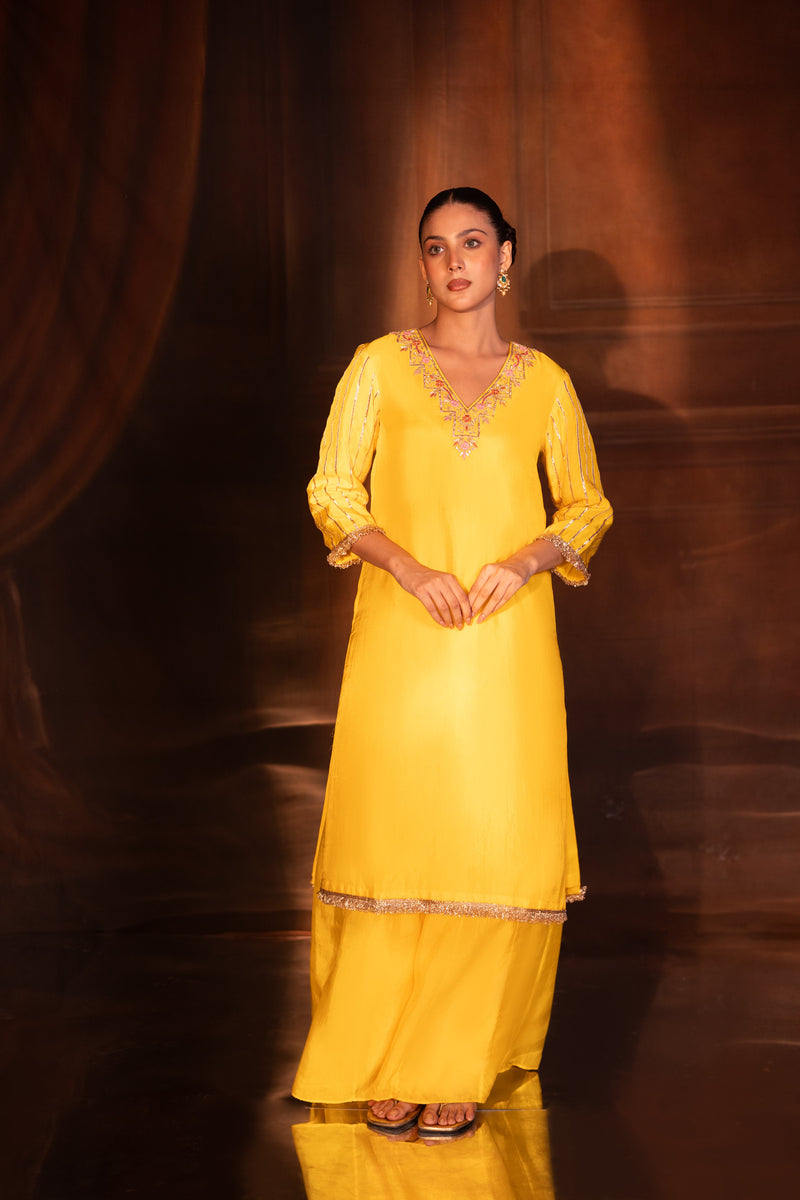
Pongal 2027 Colours: What to Wear on Bhogi, Thai Pongal, Mattu Pongal and Kaanum Pongal
Pongal 2027 runs 14–17 Jan. The colours for Bhogi, Thai Pongal, Mattu Pongal and Kaanum Pongal, where each comes from...
2 November 2026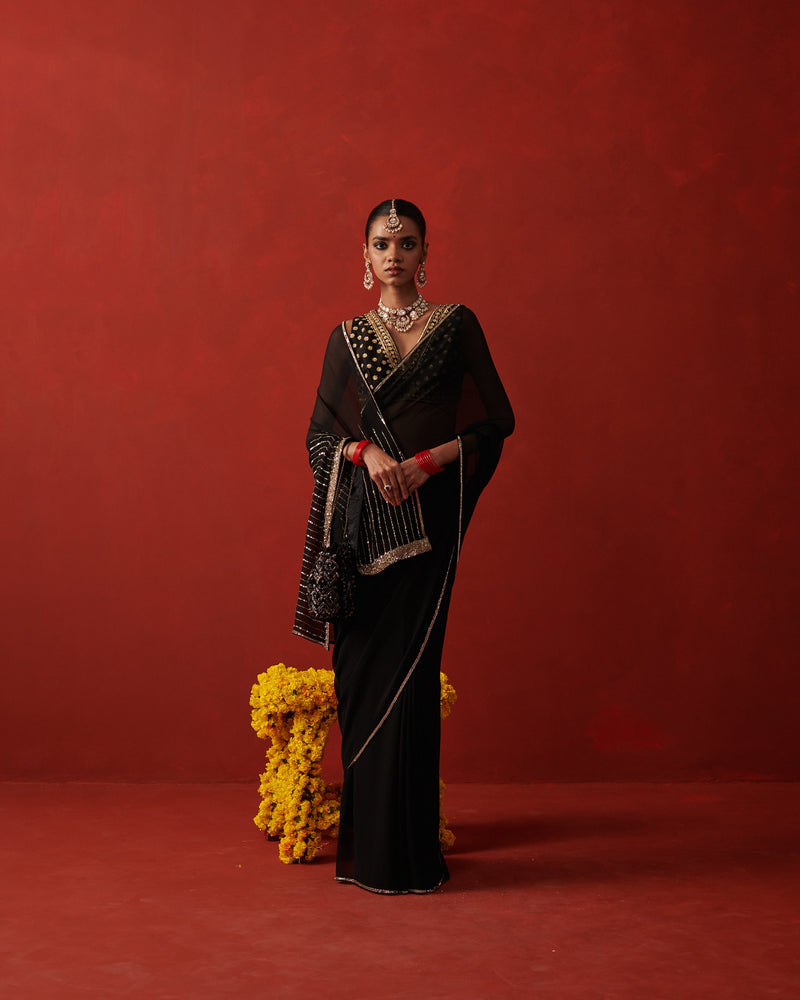
Haldi Kumkum Outfit Ideas: What to Wear for the Gathering
What to wear for Haldi Kumkum — the Sankranti-season women's gathering. Why Maharashtrian women wear black in January...
31 August 2026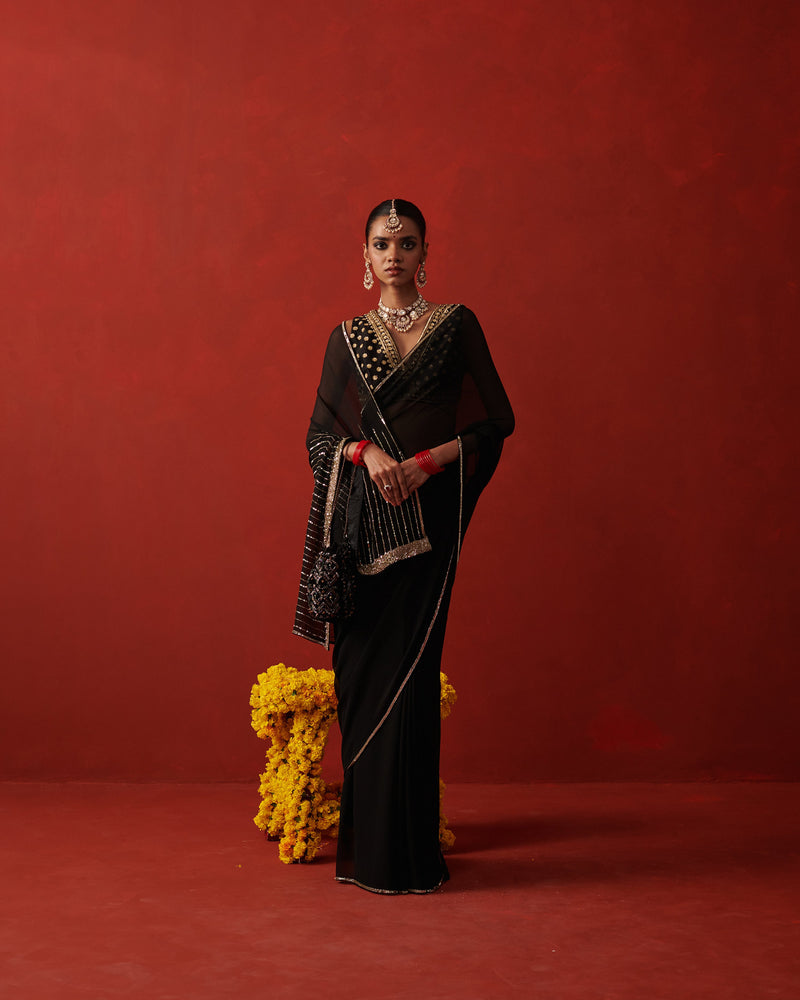
Black in Indian Fashion: Why the Boldest Colour Choice Is Now the Most Elegant
Black is the new power colour in Indian fashion. From black sarees to cape sets and brocade blazers — why black outfi...
8 March 2026