
What Colour to Wear on Each Day of the Week: The Weekday Colours of Hindu Tradition, Explained
In Hindu tradition, each day of the week is named after a graha, and each graha has a colour. The most common list is: Sunday (Surya, the Sun) orange or red; Monday (Chandra, the Moon) white; Tuesday (Mangal, Mars) red; Wednesday (Budh, Mercury) green; Thursday (Brihaspati, Jupiter) yellow; Friday (Shukra, Venus) white or soft pink; and Saturday (Shani, Saturn) black or dark blue. Thursday's yellow and Tuesday's red are the most settled. The other days change from list to list, and we show where.
This is a tradition, not a rulebook and not a promise. Nobody can tell you a colour will win you a promotion on a Thursday. What the weekday colours do give you is a lovely, very old way of thinking about a week: seven days, seven moods, and a reason to pull the yellow kurta out of the cupboard. Read it that way, then wear what you love. If you came here for a colour system with dates attached, our Navratri nine colours guide is the place, and further down we explain how that list is built from these same weekdays.
The Weekday Colours at a Glance
| Day (vaar) | Graha | Usual colour | Where lists differ | Common deity / vrat link |
|---|---|---|---|---|
| Sunday / Ravivaar | Surya (Sun) | Orange | Red, saffron, copper or gold | Surya |
| Monday / Somvaar | Chandra (Moon) | White | Silver, cream, light blue | Shiva; Solah Somvar, Sawan Somvar |
| Tuesday / Mangalvaar | Mangal (Mars) | Red | Some add orange or coral | Hanuman; Ganesha in Mumbai |
| Wednesday / Budhvaar | Budh (Mercury) | Green | Navratri lists use royal blue | Budh; Ganesha in many homes |
| Thursday / Guruvaar | Brihaspati (Jupiter) | Yellow | Almost none | Brihaspati, Vishnu; Brihaspativar vrat |
| Friday / Shukravaar | Shukra (Venus) | White, soft pink | Pastels; Navratri lists use green | Lakshmi, Santoshi Maa; 16 Fridays |
| Saturday / Shanivaar | Shani (Saturn) | Black, dark blue | Navratri lists use grey | Shani; Hanuman |
Why the Days Have Planets at All
The Sanskrit word for a weekday is vaara or vaasara, and each one carries the name of a celestial body: Ravivaara for the Sun, Somavaara for the Moon (Soma), Mangalavaara for Mars, Budhavaara for Mercury, Brihaspativaara or Guruvaara for Jupiter, Shukravaara for Venus and Shanivaara for Saturn. Look at the English and Latin names next to them and the match is exact: Sunday, Monday (the Moon's day), Tuesday (Mars, dies Martis), and so on. Scholars of the Hindu calendar think this alignment of names probably happened around the 3rd century CE. So the planetary week is shared with Europe, and very old.
The colours come from the grahas themselves. In Hindu iconography, Mangal is shown red-complexioned and riding a ram, Brihaspati is golden, and Shani is depicted dark, in blue or black robes. That is why those three days have the steadiest colours. The Sun, Moon, Mercury and Venus have softer, more argued-over palettes, and that is where the lists drift. For each day below we give the meaning, an easy way to wear it to work, and a piece for the days when there is somewhere to be.
Sunday (Ravivaar): Orange, Red or Gold for Surya
Sunday belongs to Surya, and its colours are the colours of sunrise: orange, saffron, red, and for some lists copper and gold. Ask three astrologers and you will hear all three. Our zodiac colours guide gives the Sun red, copper and gold. The Navratri lists go with orange.
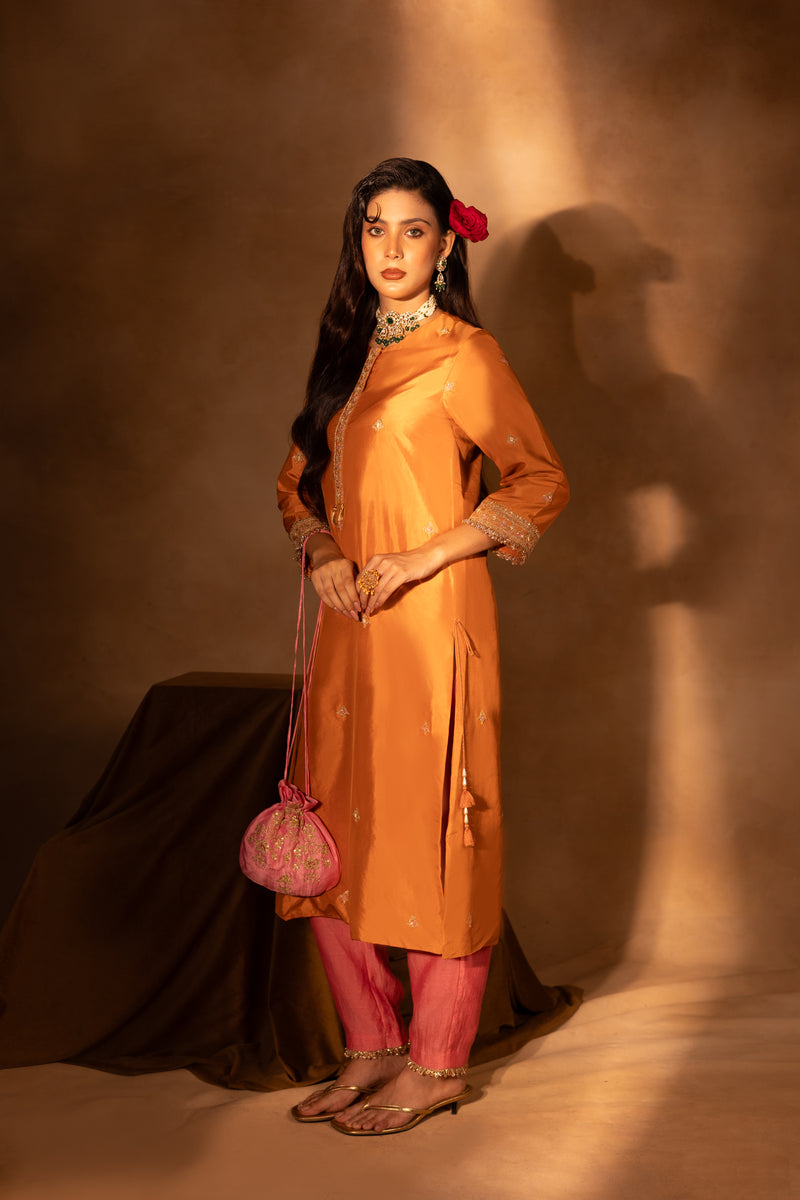
For work: for most people Sunday is not a workday, which is the nicest thing about it. It is the day for a long lunch, a family puja or a temple visit, so wear the colour properly. The Gulal kurta set (₹23,500) is marigold orange silk with marodi embroidery along the front placket, scattered embroidered motifs and tassels, paired with dusty coral pink Chanderi pants. It is warm without being loud, and it carries straight into Monday morning if you swap the pants for something plain.
Monday (Somvaar): White for Chandra and Shiva
Monday is the Moon's day, and white is its colour: think of moonlight, milk and pearls. Some lists add silver, cream or a light blue. Monday is also Shiva's day. Shiva wears the crescent moon in his hair, and the Monday fasts are kept for him: the Solah Somvar vrat of sixteen consecutive Mondays, and the Sawan Somvar fasts in the monsoon month of Shravan. Devotional guides most often suggest white or light colours for these pujas, though families vary.
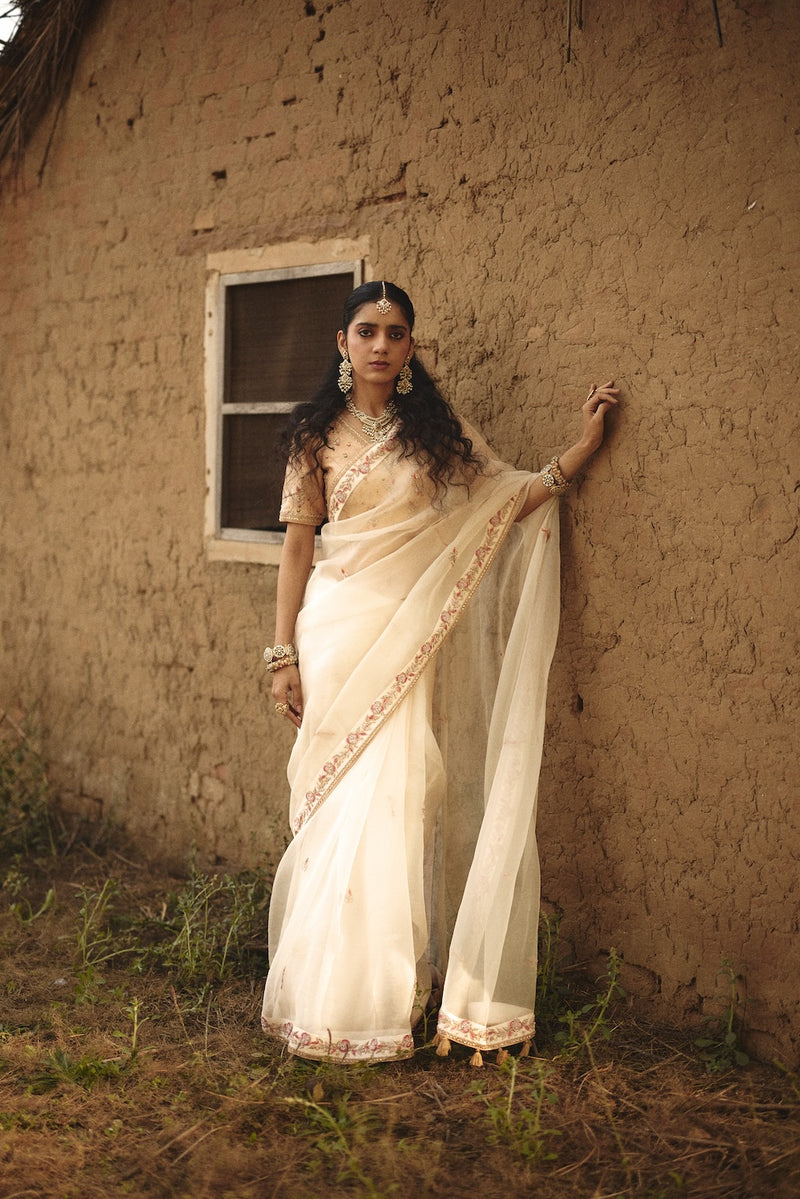
For work: white is the easiest weekday colour of all. The Naina and Ahalya set (₹12,500) is an ivory cotton kurta and pant with delicate hand-embroidered florals at the neckline, cuffs and pant hem: as close to a working Monday uniform as we make. For an occasion: the Shanvi saree (₹38,675) is soft ivory organza with a hand-embroidered border of marodi, gold zari, resham and beadwork in coral and gold, with tassels at the pallu. It suits a Monday wedding, a Sawan puja at home, or a day-time engagement.


Tuesday (Mangalvaar): Red for Mangal and Hanuman
Tuesday is the most confident day on the list. Mangal is the red planet in every tradition that names it, and red is Tuesday's colour almost everywhere. It is also Hanuman's day in North India: devotees visit his temples on Tuesdays (and Saturdays), offer red flowers and sindoor, and recite the Hanuman Chalisa. In Mumbai, Tuesday is also the big day at the Siddhivinayak temple, and when Sankashti Chaturthi falls on a Tuesday it becomes Angarki Chaturthi, when lakhs of devotees queue for Ganesha.
For work: a full red outfit on a Tuesday is a statement, so go tonal. The Jazabah and Saiyan set (₹27,500) is a deep red Chanderi kurta and pant with tonal gota patti, marodi, resham and bead work along the neckline, hem and sleeves. Because the embroidery is red on red, it reads rich rather than bright. For an occasion: the Rangrez saree (₹22,500) is deep red chiffon in a shade its description compares to alta on a bride's feet, with floral bootis hand-embroidered in sequins and beads. Our guide to colours for Indian skin tones will help you pick between a tomato red, a sindoori and a deep maroon.
Wednesday (Budhvaar): Green for Budh
Wednesday is Budh's day. Mercury is the planet of speech, trade and quick thinking, and its colour in the planetary lists is green, the same green tied to its gem, the emerald. In many North Indian homes Wednesday is also a day for Ganesha, though, as above, Mumbai's Ganesha day is Tuesday. This is the day where the Navratri list breaks with the planets most clearly: it puts royal blue on Wednesday, not green.
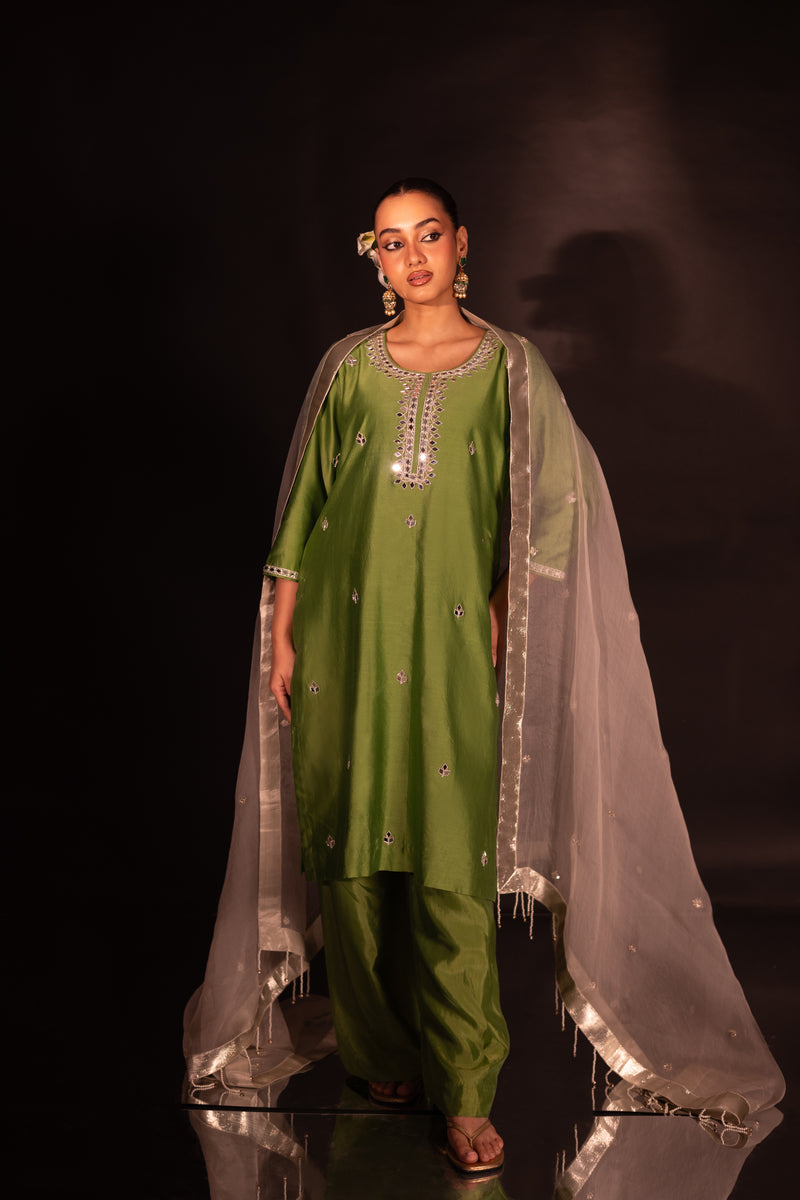
For work: the Mehrab kurta set (₹23,500) is mehendi green Chanderi with mirror work along the round neckline, front placket and sleeve borders, and scattered mirror motifs across the kurta, with matching Chanderi pants. It is a quiet, easy green for the office. For an occasion: the Humrahi and Faridah saree (₹34,500) is green silk jacquard with an all-over jaal, hand-embroidered floral butas and a densely embroidered pallu and border, paired with a pink mulberry silk brocade blouse. Green with pink is a classic Indian pairing; our colour combinations guide has more.

Thursday (Guruvaar): Yellow for Brihaspati and Vishnu
If you remember one weekday colour, make it this one. Thursday is Brihaspati's day (Guru, the teacher of the gods, and the planet Jupiter), and yellow is its colour in nearly every list we checked, including the Navratri one. The Thursday fast, the Brihaspativar vrat, is kept for Brihaspati and for Vishnu: devotional guides describe wearing yellow, eating a yellow meal such as chana dal, and offering turmeric and water at the root of a banana tree. Some families keep it for sixteen Thursdays, others for life.
For work: the Afreen and Maahi set (₹15,875) is sunshine yellow Chanderi with hand-embroidered cutdana and bead flowers and beaded neck and sleeve hems: light enough for an ordinary Thursday. For an occasion: the Kanchan sharara set (₹29,500) is sunshine yellow silk with pink and gold-toned embroidery along the V-neckline, embellished stripes down the sleeves and a matching flared sharara. It is a haldi outfit, a Basant Panchami outfit and a Thursday puja outfit at once.


Friday (Shukravaar): White or Pink for Shukra and Lakshmi
Friday is Shukra's day. Venus rules beauty, comfort and love, and the lists split between white (Shukra's classical colour) and soft pink and pastels (the modern favourite). Friday is also a goddess day: many women keep Friday fasts for Lakshmi, and for Santoshi Maa, whose vrat is kept on sixteen successive Fridays with an offering of gur and roasted chana and no sour food. Santoshi Maa was a little-known goddess until the 1975 film Jai Santoshi Maa made her worship a phenomenon across North India.
For work: Friday is the dressiest workday, so it can take a little more. Any of the white pieces from Monday work for the white-Friday lists. For pink, keep it soft and pair it with ivory. For an occasion: the Sajni saree (₹21,000) is blush-pink chiffon with scattered floral clusters hand-embroidered in sequins, cutdana and bead work, and a scalloped border. Its description imagines it for intimate weddings and haldi-mehendi afternoons, and it is just right for a Friday-evening sangeet. If Friday means the office party, our guide to Indian outfits for the office covers where the line is.

Saturday (Shanivaar): Black or Dark Blue for Shani
Saturday belongs to Shani, who is depicted dark, in blue or black robes, and those are the day's colours: black, navy and deep blue. Saturday is the day Shani is worshipped, often with sesame or mustard oil at his temples, and many devotees also visit Hanuman on Saturdays, which devotional guides link to protection from Shani's harder influences. Black is a colour many families avoid for weddings and pujas, but Saturday is its traditional home. Maharashtra wears black on Makar Sankranti for a different reason, which we explain in our Makar Sankranti colours guide.
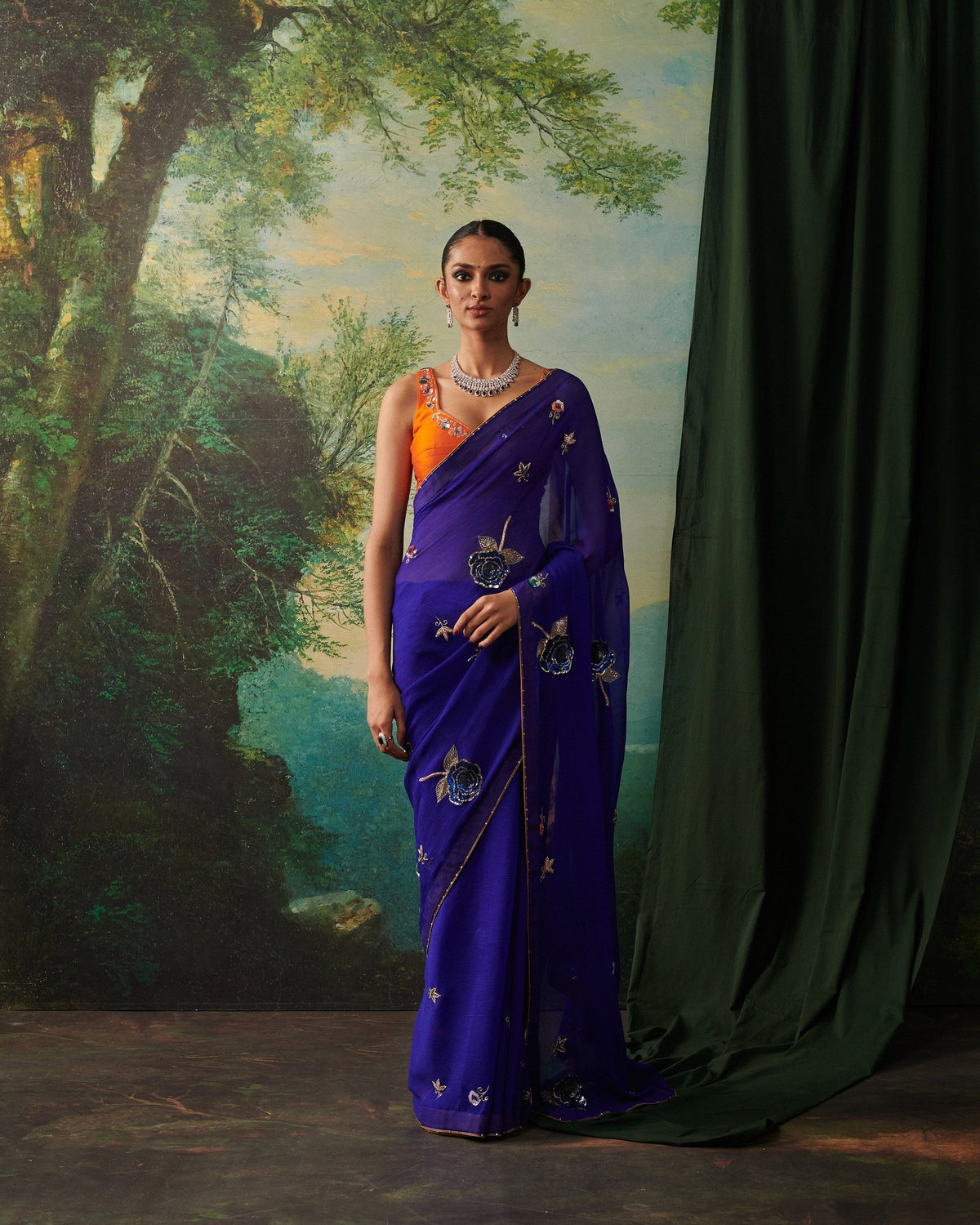
For the day: navy is the gentler Saturday colour. The Tara and Pari set (₹21,175) is deep navy blue satin with a contrast magenta yoke and resham, sequin and bead florals in ice blue and soft peach, with a matching navy pant finished in a scalloped hem. For the evening: the Chandni saree (₹22,500) is deep black chiffon hand-embroidered with vertical lines of sequins and cutdana along the border and subtle butas across the body. It is the most useful saree for a Saturday-night wedding reception.

How the Navratri Colours Come From the Weekdays
The nine Navratri colours, the ones that fill office photos every autumn, are built from the weekdays. Drik Panchang, which publishes the list each year, explains that the first colour is decided by the weekday on which Navratri begins. The days then follow a fixed cycle. In 2026 Sharad Navratri began on Sunday 11 October, so the list ran: Sunday orange, Monday white, Tuesday red, Wednesday royal blue, Thursday yellow, Friday green, Saturday grey, then purple on the eighth day and peacock green on the ninth. Drik Panchang's 2027 list begins on a Thursday, so it starts with yellow.
Put that list next to the planetary one and four days match (Sunday orange, Monday white, Tuesday red, Thursday yellow). Three do not: Wednesday becomes royal blue instead of green, Friday becomes green instead of white or pink, and Saturday becomes grey instead of black. The last two days do not follow the weekday rule at all. They rotate through pink, purple and peacock green.
The custom is also younger than it looks. In a 2016 piece for The Quint, writer Ashish Dikshit, drawing on former Maharashtra Times editor Bharatkumar Raut, describes the nine colours as a Maharashtra Times campaign to win readers. Later reports, among them Curly Tales in 2024, date its start to 2003. It spread from Mumbai to the rest of India. That does not make it any less joyful. It just means the Navratri list is a modern newspaper idea built on very old weekdays, not a scripture.
Thailand Has Its Own Weekday Colours
The same seven grahas travelled to Thailand, where each day also has a colour, and the colours are different. In the Thai system, Sunday is red, Monday yellow, Tuesday pink, Wednesday green, Thursday orange, Friday light blue and Saturday purple, each tied to the same Hindu planetary deities, Surya through Shani. Monday's yellow is the best known: King Bhumibol and his son, King Vajiralongkorn, were both born on a Monday, so the country is decorated in yellow on their birthdays. Only Wednesday's green is shared with the Indian list.
Wearing the Weekday Colours Without Overthinking Them
- Start with one piece. A dupatta, a blouse or a kurta in the day's colour is enough. Shop our dupattas if you'd rather add the colour than build a whole outfit around it.
- Use the softer list when the bold one doesn't suit you. Sunday can be gold instead of red, Saturday navy instead of black, Friday ivory instead of pink.
- Keep a neutral base. Ivory and black carry every weekday colour on top.
- Festival days come first. On Diwali, the festival's own customs matter more than the weekday. See our Diwali colours, day by day.
- And if you love a colour, wear it on any day. No tradition on this page was ever meant to stop you.
What we don't make: astrologers often pair each planet with a gemstone (ruby for the Sun, pearl for the Moon, blue sapphire for Saturn), and we make no jewellery. We don't make menswear either, though weekday colours are for everyone. We also don't weave: we buy handwoven cloth and embroider it by hand in our Jaipur atelier. Many of the Monday and Thursday pujas mentioned here are also the occasions sarees are made for; for how the drape itself came to be, read our history of the saree.
Sources: weekday names and their alignment with European names, Wikipedia's Hindu calendar entry (citing Underhill and Dalal); planetary iconography and colours, Wikipedia's Navagraha, Brihaspati and Shani entries (Navagraha citing Gopinatha Rao, Elements of Hindu Iconography, 1914); Santoshi Maa vrat and the 1975 film, Wikipedia; 2026 and 2027 Navratri colours and the weekday rule, Drik Panchang (accessed November 2026); Navratri colours' origin, The Quint (Ashish Dikshit, 9 October 2016) and Curly Tales (9 October 2024); Angarki Chaturthi at Siddhivinayak, Free Press Journal; Thai weekday colours, Wikipedia (citing Tien-Rein Lee, 2013). Day-colour lists and vrat customs vary by region and family, and devotional sources disagree on Sunday, Monday and Friday, as noted above.
Seven Days, Hand-Embroidered
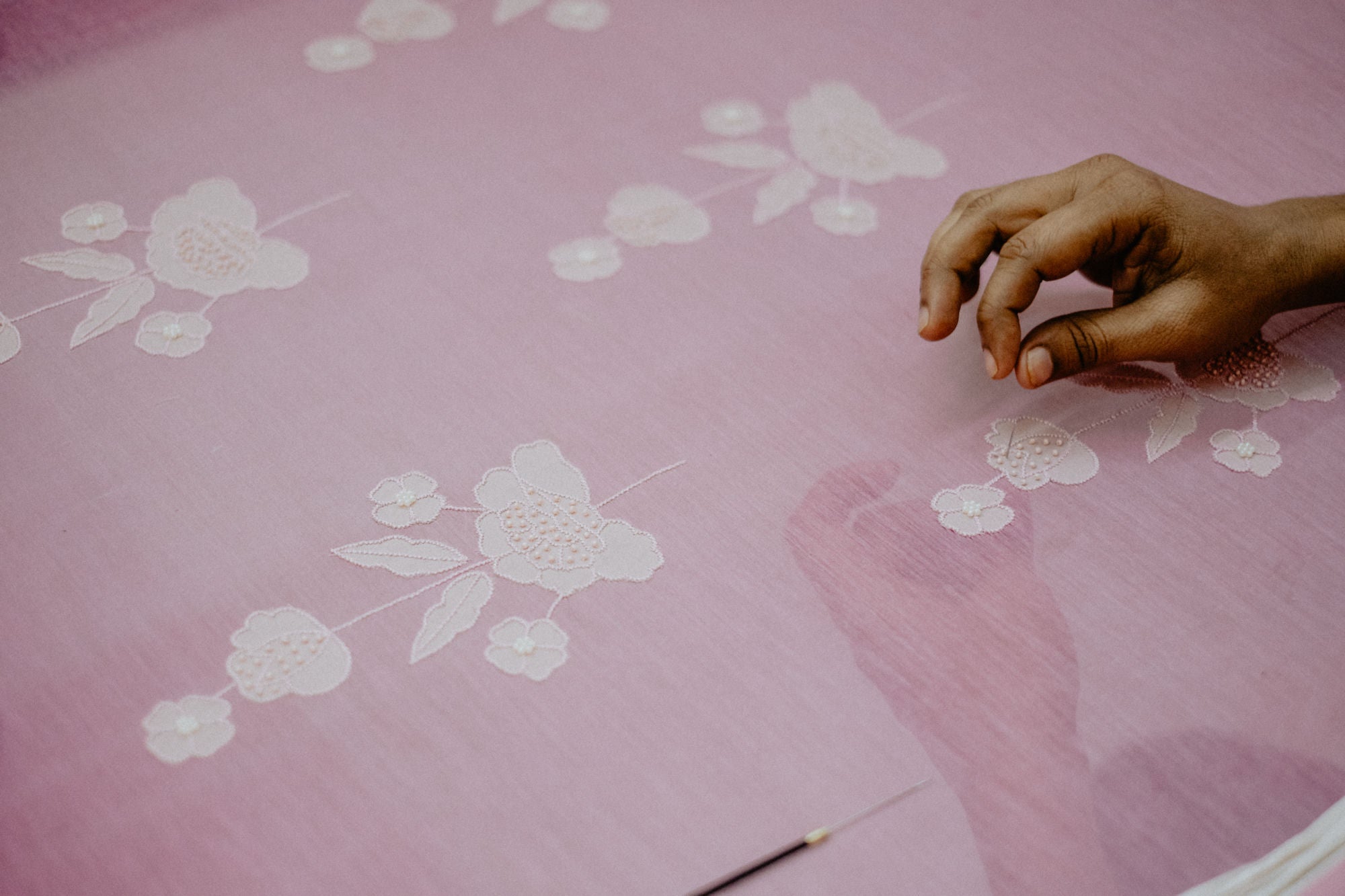
Every piece is hand-embroidered in Jaipur and made to your measurements at no extra charge, over 4–5 weeks plus 3–7 days of shipping, so an order placed today arrives around mid-December at the earliest. Free shipping on domestic orders above ₹30,000. Express is sometimes possible, depending on the piece and the month: ask on WhatsApp. Browse our kurta sets, dupattas and the full collection.
Shop AllFrequently Asked Questions
Which colour should I wear on which day of the week?
By the common Hindu planetary list: Sunday orange or red (Sun), Monday white (Moon), Tuesday red (Mars), Wednesday green (Mercury), Thursday yellow (Jupiter), Friday white or soft pink (Venus) and Saturday black or dark blue (Saturn). Lists vary most for Sunday, Monday and Friday. These are traditions, not predictions, so wear what you love.
Why is yellow worn on Thursday?
Thursday (Guruvaar or Brihaspativaar) is the day of Brihaspati, the planet Jupiter, whose colour is yellow, and it is also a day of Vishnu worship. Devotees keeping the Thursday vrat traditionally wear yellow and eat yellow food such as chana dal.
What colour is lucky on Saturday?
Saturday is Shani's day, and Shani is depicted in black or blue, so black, navy and dark blue are Saturday's traditional colours. The Navratri colour list uses grey for Saturday instead.
How are the nine Navratri colours decided?
According to Drik Panchang, the first colour is set by the weekday Navratri begins on, and the rest follow a fixed cycle: Sunday orange, Monday white, Tuesday red, Wednesday royal blue, Thursday yellow, Friday green, Saturday grey, with pink, purple or peacock green on the last days. The custom is widely reported to have started as a Maharashtra Times campaign in the early 2000s.
Are the Thai day colours the same as the Indian ones?
No. Thailand links each day to the same Hindu planetary deities, but its colours are Sunday red, Monday yellow, Tuesday pink, Wednesday green, Thursday orange, Friday light blue and Saturday purple. Only Wednesday's green matches the common Indian list.
More colour and culture: Navratri nine colours · Lucky colours by zodiac sign · Diwali colours, day by day · The history of the saree
Made to order in 4–5 weeks
Have an event date? We’ll tell you exactly when to order by.
We take a limited number of orders each month — secure your slot early.
WhatsApp me my order-by date + a shortlistNot sure where to start?
Tell us what you're dressing for and we'll help you choose — fabric, fit, colour, and timeline — over WhatsApp or on a video call.
Your Cart
Pieces from this story
All pieces →Not sure which piece, or need it by a date? Book a video consultation Ask us on WhatsApp





Keep reading
The journal →
Navratri 2026 Nine Colours Guide: What to Wear Each Day
All nine Navratri 2026 colours with dates: Day 1 orange (11 Oct) to Day 9 peacock green (19 Oct), plus outfit ideas f...
22 June 2026
Lucky Colours for 2027 by Zodiac Sign: What to Wear on New Year's Eve and Through the Year
Your rashi's ruling planet and its traditional colour, for all 12 signs: a New Year's Eve 2027 look and an everyday o...
2 November 2026
Best Colours for Indian Skin Tones: A Complete Guide
Find the best colours for your Indian skin tone. Guide to warm, cool, and neutral undertones, plus colour recommendat...
14 April 2026