

What to Wear to a Himachali Wedding: A Guest's Guide to Pahari Customs, Cold Evenings and the Kullu Shawl
At a Himachali wedding, the most beautiful thing in the room is often not an outfit at all. It is the shawl. A Kullu shawl with its bands of geometric pattern, a Kinnauri shawl woven in colours that seem too bright for wool, worn by the bride's grandmother over whatever she has on. Pahari families dress well for weddings, but they dress for the mountains first — and a guest who arrives in a sheer lehenga without a plan for the cold will spend the evening wishing they had thought about it.
This guide is for a guest at a Himachali family's own wedding — in Shimla, Kullu, Mandi, Kangra, Chamba or a village above them. That is different from a destination wedding that happens to be held in the hills, which our hill-station wedding guide covers. Here the customs, the food and the dress are the family's own, and customs vary considerably from one district and valley to the next, so ask your hosts about anything specific to theirs.
What the Family Wears — and What We Don't Make
You will see pieces at a Himachali wedding that belong to the hills and nowhere else:
- Pattu — a handwoven woollen wrap worn draped over the shoulders, often over a ghagra.
- Dohru — the Kinnauri woman's woollen garment, wrapped and pinned around the body like a sari, with an embroidered border running down its length. Darker shades are preferred.
- Dhatu — the woollen headscarf worn by women in upper Himachal, especially Kullu and Kinnaur, often brightly patterned.
- The Himachali topi — and in Kinnaur, the round grey thepang with its coloured velvet band, worn by men and women.
- Kullu and Kinnauri shawls — both carry Geographical Indication status, and a good one is a family heirloom.
We should be clear: we make none of these. They are woven and worn by the people of Himachal, and if you want one, buy it from Himachal's own weavers — the weavers' co-operatives in Kullu are a good place to start. Nobody expects a guest from outside the state to arrive in a pattu or dohru. What guests do is wear their own festive clothes with the mountains in mind, and very often with a Kullu shawl on top. That is where we can help.
The Baraat and the Welcome
Listen for the karnal and the ranasingha — the long brass horns of the hills — with the dhol and nagara. They are part of wedding music across much of Himachal and they announce the baraat long before it arrives. At the welcome, the bride's family receives the groom's side with shagun, and it is common for the bride's uncles to honour the groom's uncles with mufflers and Himachali topis. Honouring a guest with a topi or shawl is a deep Himachali courtesy, so if you are handed one, wear it. It is a compliment.
The Dham: Dress to Sit on the Floor
The dham is the heart of a Himachali wedding for many guests. It is a traditional feast cooked in brass vessels — in Kangra by the botis, hereditary Brahmin cooks — and served in courses on leaf plates called pattal, to guests sitting in rows on the floor. Rajma, madra, kadhi, sepu badi; the dishes vary by district and the cooking begins the night before.
This one detail should shape your outfit more than anything else. You will sit cross-legged on the ground, possibly outdoors, and rise again several times. That rules out a heavy trailing lehenga, a very fitted kurta, and anything pale that will not forgive a drop of kadhi. It rewards a straight pant or palazzo, an anarkali with room in the flare, or a sari you are comfortable sitting in.
Nati: You Will Be Pulled Into the Circle
Nati is the folk dance of the hills, performed in long, linked lines at weddings and fairs. It is not a performance you watch from a chair — at a family wedding, guests are pulled in, and it is rude to refuse more than once. The steps are slow and repetitive, the lines are long, and it can go on for a very long time. A flared anarkali moves beautifully in it; a stiff, heavy skirt does not. Wear flat or low-heeled shoes with grip, because courtyards and village paths are rarely level.
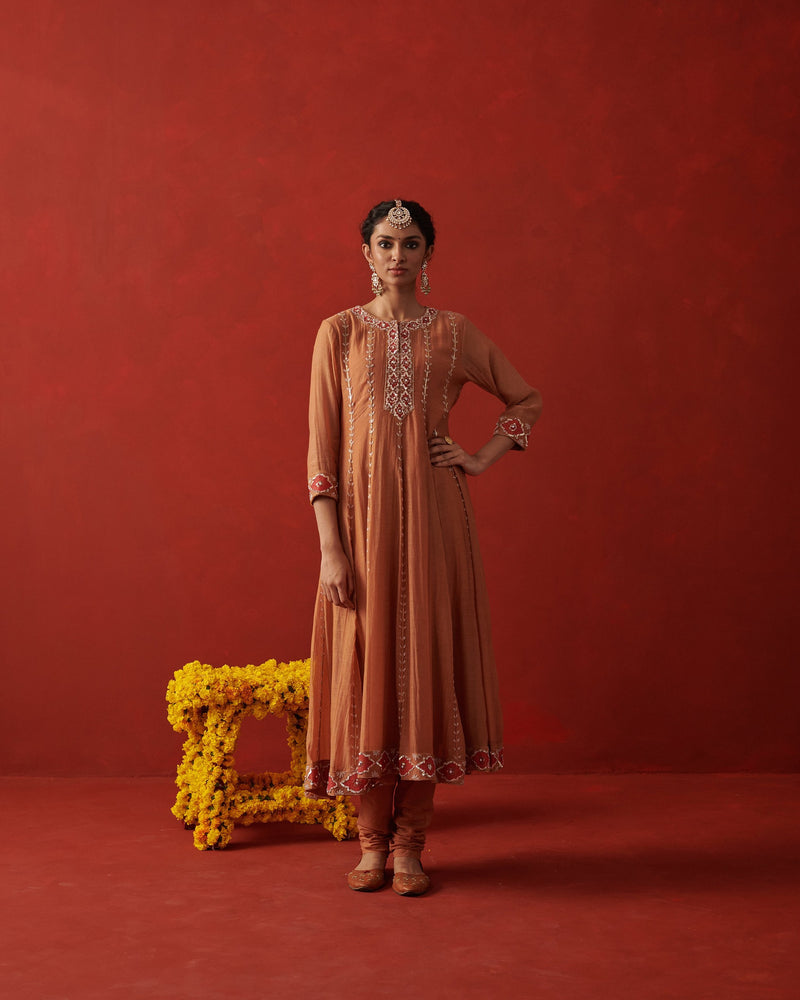
The Suroor anarkali (₹22,775) is made for exactly this: Bandhej Banarasi silk with woven gold bootis, sequin work at the neckline and sleeves inspired by vintage temple jewellery, and full-length gathers that swing as you move. The Heeriye & Reva set (₹19,500) is a rich cinnamon-brown Chanderi anarkali with a scarlet-and-ivory contrast border, over a tonal churidaar. Its earthy colour sits beautifully under a patterned Kullu shawl.


How to Dress Around a Kullu Shawl
Whatever the month, the evenings in the hills are cold, and the pheras — the seven rounds around the fire with the couple's garments knotted together — are often held late. For most of the night, then, your outfit will be partly hidden under a shawl. Plan for that rather than fighting it.
- Let the shawl replace the dupatta. Two layers of drape over your shoulders is one too many. Leave the dupatta at home and let the shawl do its job.
- Choose outfits whose embroidery lives at the edges. A shawl covers the body of a kurta but not the hem, the cuffs or the pant border. Pieces worked at the sleeves and hem still look finished under a shawl.
- Solid colours under patterned shawls. Kullu and Kinnauri shawls are busy and beautiful; a plain jewel-toned or earthy outfit lets them show.
- Go full sleeve. A shawl slips; sleeves do not.
- Thermals are allowed. Nobody can see them. Our guide to what to wear under Indian outfits covers the practical side.
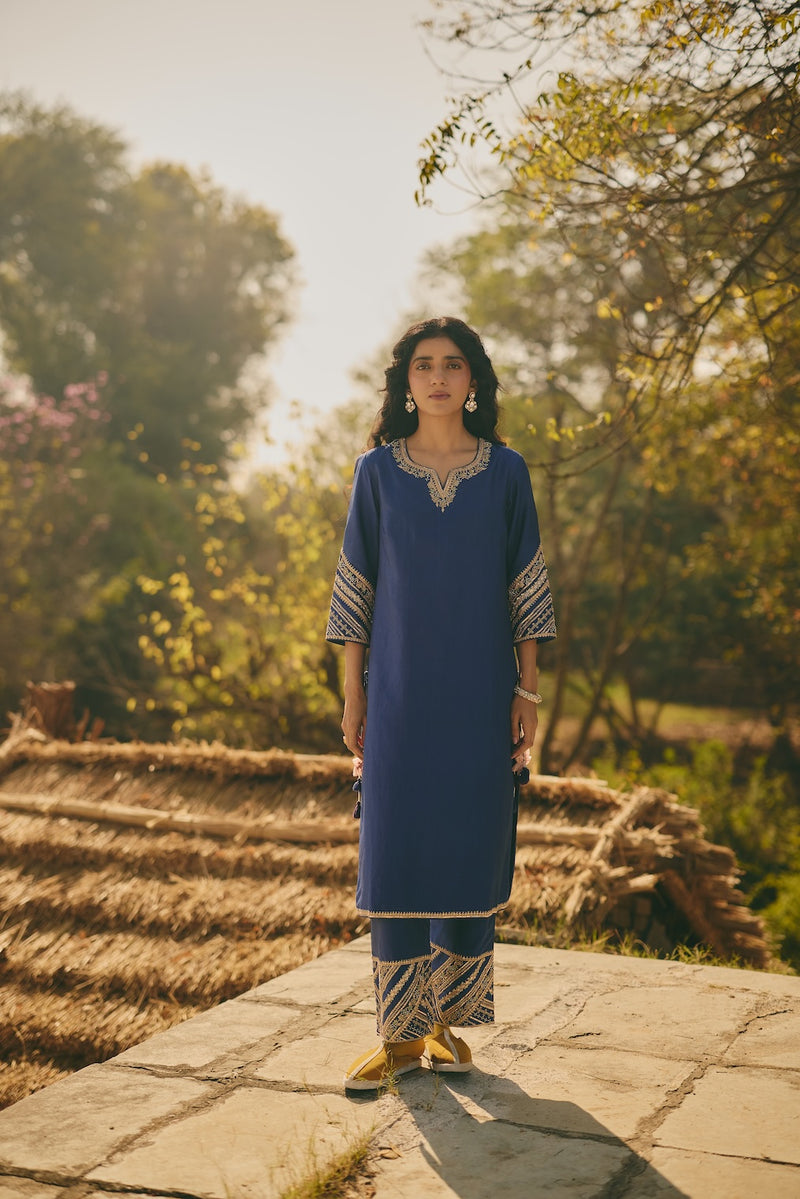
The Ameera & Hoorain set (₹32,500) is a good example: deep sapphire-blue silk with marodi, resham, sequin, cutdana, bead and aari embroidery concentrated at the neckline, sleeve hems and hemline, and linear placements at the pant hem — so it still reads as finished with a shawl over the shoulders. The Rangrez & Aliza set (₹18,750) pairs a moonga silk brocade kurta, woven with gold motifs, with silk pants in an all-over floral jaal print highlighted with aari and zardozi — brocade has body and holds its shape under a heavy wrap.


The Warmest Thing We Make
If the wedding is in winter, or high up, velvet is the fabric to reach for. The Sahiba set (₹27,500) is a kurta and palazzo in deep maroon velvet, hand-embroidered in antique gold with kasab dori, metal sequins and zardozi at the neckline, sleeves and hem, with a sheer maroon organza dupatta edged in kinari. The palazzo is generous to sit on the floor in, and the velvet does real work against the cold. It is also exactly the depth of colour that looks right against wool.

Colour: What to Wear and What to Avoid
Avoid white. In many Himachali communities white is associated with mourning, and it is best left out of a wedding outfit entirely. Deep, warm colours suit both the hills and the occasion — maroon, deep red, sapphire, forest green, mustard, magenta, rust. If you are close family, deep red is welcome; if you are a friend of the couple, some families prefer to leave true bridal red to the bride, so ask.
The Jazabah & Saiyan set (₹27,500) is deep red silk with tonal gota patti, marodi, resham and bead work along the neckline, hem and sleeves, drawing on heirloom festive styles from Northern India — a good choice for family. The Naureh & Suhail set (₹23,375) is a rich magenta satin kurta with blue and pink resham, sequins and bead work, over a rust satin pant — a bold palette that holds its own next to a bright Kinnauri shawl.
Five Practical Notes
- Footwear with grip. Slopes, steps, gravel and dew. Juttis with a rubber sole or low block heels.
- A hem that clears the ground. Village paths and courtyards are not ballrooms.
- Pack a warm layer even in summer. The temperature drops sharply after sunset at altitude.
- Keep your head covering ready. Many families cover their heads for the pheras and pujas.
- Buy a shawl while you are there. It is the best souvenir of a Himachali wedding, and it will outlast everything else you wear.
Going to a Wedding in the Hills?
Tell us the dates, the town and the functions on WhatsApp. Everything is made to order in 4–5 weeks, plus shipping, and cut to your measurements at no extra charge — including extra room for a thermal layer underneath if you want it.
Browse Kurta SetsMore regional guides: Punjabi · Kashmiri · Rajasthani · Winter weddings
Frequently Asked Questions
What should a guest wear to a Himachali wedding?
Festive Indian wear planned for the cold: a full-sleeved kurta set, anarkali or silk sari in a deep, warm colour, with a shawl on top. Choose something you can sit on the floor in for the dham and move in for the nati, and wear shoes with grip.
Can I wear white to a Himachali wedding?
It is best avoided. In many Himachali communities white is associated with mourning. Choose maroon, sapphire, green, mustard, magenta or rust instead.
What is a dham?
The traditional Himachali wedding feast, cooked in brass vessels and served in courses on leaf plates called pattal to guests seated in rows on the floor. In Kangra it is cooked by botis, hereditary Brahmin cooks. Dishes such as rajma, madra and kadhi vary by district.
Should I wear a dupatta with a shawl?
Usually not. In the cold, the shawl takes the dupatta's place. Pick an outfit whose embroidery sits at the hem, cuffs and pant border so it still looks finished under the shawl.
Do I need to wear traditional Himachali dress as a guest?
No. Pattu, dohru, dhatu and the Himachali topi are worn by the family and community, and nobody expects a guest from outside the state to wear them. If your hosts honour you with a topi or shawl, wear it gratefully.
Made to order in 4–5 weeks
Have an event date? We’ll tell you exactly when to order by.
We take a limited number of orders each month — secure your slot early.
WhatsApp me my order-by date + a shortlistNot sure where to start?
Tell us what you're dressing for and we'll help you choose — fabric, fit, colour, and timeline — over WhatsApp or on a video call.
Your Cart
Pieces from this story
All pieces →Not sure which piece, or need it by a date? Book a video consultation Ask us on WhatsApp



Keep reading
The journal →
Hill Station Wedding Outfit Ideas: What to Wear in the Mountains
What to wear to a mountain or hill station wedding — layering that photographs well, altitude, and the thirty-degree ...
12 September 2026What to Wear Under Indian Outfits: The Complete Undergarments Guide
What goes underneath your Indian outfit determines how it looks on top. The right foundations smooth lines, provide s...
27 May 2026
What to Wear to a Punjabi Wedding: Outfit Ideas for Every Function
Punjabi wedding outfit ideas for every function — Roka, Mehendi, Jaggo, Chooda, wedding day, and reception. Bold colo...
10 March 2026