
How to Wear a Saree in Winter (Without Hiding It Under a Coat)
To wear a saree in winter without hiding it under a coat, do the warming in layers nobody sees and in the one layer everybody does: a sleeved blouse, a denser saree, a thin thermal underneath and a warm drape over the pallu. Choose a blouse with full or three-quarter sleeves and a higher neck, pick a silk or Banarasi drape over a sheer chiffon for outdoor evenings, wear a skin-tone thermal and leggings under the blouse and petticoat, and finish with a shawl, cape or second drape you can take off indoors. In Bengaluru you may need only the blouse; in a Delhi farmhouse at midnight you will want all four.
Below, each layer in turn. For lehengas, shararas and kurta sets, see our winter wedding outfit ideas. This one is only about the saree.
First, How Cold Is Your Wedding?
"Winter" means very different things across India, and it should change how much you layer.
- Delhi and the north: the India Meteorological Department puts Delhi's normal January minimum at 7.5°C, and in January 2026 Palam recorded a low of 2.3°C, with several days of dense fog and cold-wave conditions. Daytime is pleasant at around 20°C; the problem is the evening, when most receptions and pheras happen.
- Lucknow and the plains of Uttar Pradesh: climate averages put the January minimum at around 8°C, with the coldest nights dropping to about 3°C, and fog at night and in the early morning from November to February.
- Bengaluru and much of the south: January lows are around 15–16°C and afternoons near 28°C. A winter wedding here is a mild evening, not a cold one.
So the rule of thumb: in the north, plan for an outdoor evening in single figures; in the south, plan for air-conditioned halls and a cool night. Always check whether the function is indoors or on a lawn — a heated banquet hall in Delhi needs less than an open-air mandap in Bengaluru after dark.
Layer One: The Blouse Does Most of the Work
Your arms, shoulders and back are where a saree leaves you exposed, so the blouse is the single biggest winter decision — and, unlike a coat, it is part of the look. Three things help: sleeves, a higher neckline, and a closed or less-open back.
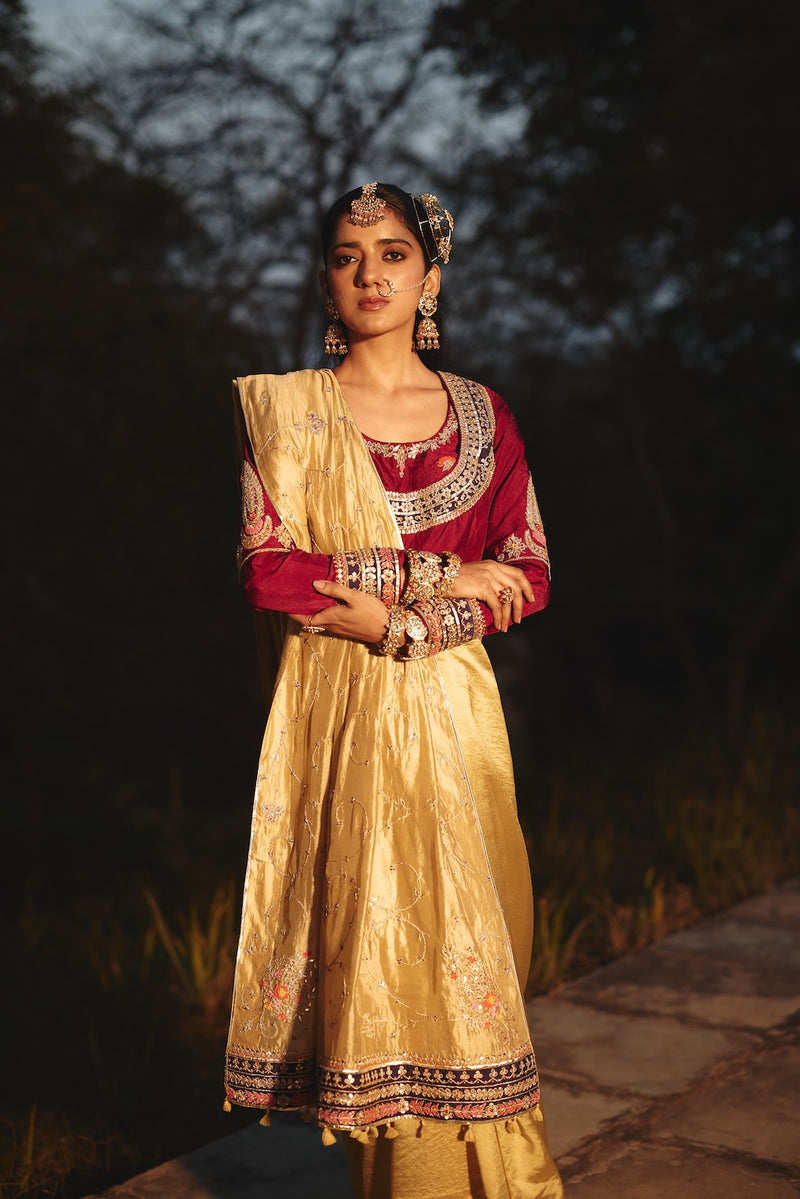
Full sleeves. The Ziya blouse (₹6,500) is jewel-toned silk with a classic round neckline and full-length sleeves, hand-embroidered with tonal sequin vines and florals that flow across the body and the arms. Its description suggests pairing it with our Laal Ishq saree, and that is a very good winter trick: a sheer saree over a full-sleeved silk blouse. For something grander, the Zehraat blouse (₹25,500) is wine-maroon silk with full-length sleeves and a deep scoop neckline, a navy-and-zari bib at the neck and heavy banded cuffs — the statement over a plainer silk saree.


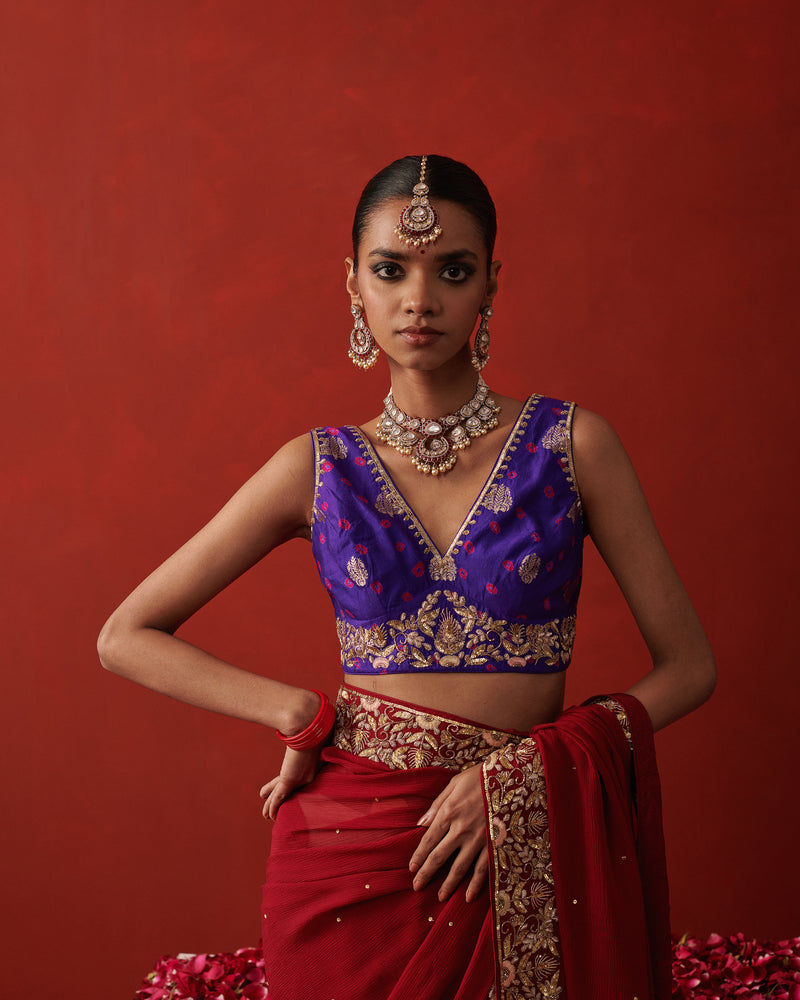
Brocade and woven silks. A brocade blouse is denser than a plain silk one and feels it. The Ojasvi blouse (₹18,500) is champagne gold brocade with a V-neckline and a tasselled tie-up square back, with marodi, zari and resham florals across the bodice and sleeves. The Abeer blouse (₹11,495) is Bandhani Banarasi silk with a wide V-neckline and classic short sleeves — the in-between choice for a mild southern evening, or for a heated hall where full sleeves would be too much.
A note on sleeves and necklines: our blouses are made to your measurements at no extra charge, but design changes are a different matter. If you love a sleeveless design and want sleeves added, or a back closed up, ask us on WhatsApp what is possible on that design before you order — it isn't automatic. Our guide to choosing a saree blouse covers necklines and sleeve lengths in more detail, and designer blouses under ₹20,000 lists the rest of our blouses by price.
Layer Two: The Saree Fabric
An honest word about warmth first. A saree is a single length of cloth, and no saree is as warm as a wool coat. Research on clothing insulation finds that much of an outfit's warmth comes from still air trapped in and between its layers, and that wind passing through a more open, air-permeable fabric carries heat away. In plain terms: a dense, heavier weave holds a little more warmth and blocks a little more breeze than a sheer, open one, but the real warmth comes from what you layer under and over it. Be wary of anyone promising that a particular saree "keeps you warm" on its own.
What fabric does change is how the saree behaves in the cold. A silk or Banarasi saree has body; it holds its pleats, doesn't flutter in the evening breeze, and looks right next to a shawl. Chiffon, georgette and organza are lighter and more see-through, which means the blouse and what's under it show more — fine in a heated hall, less forgiving on a lawn.
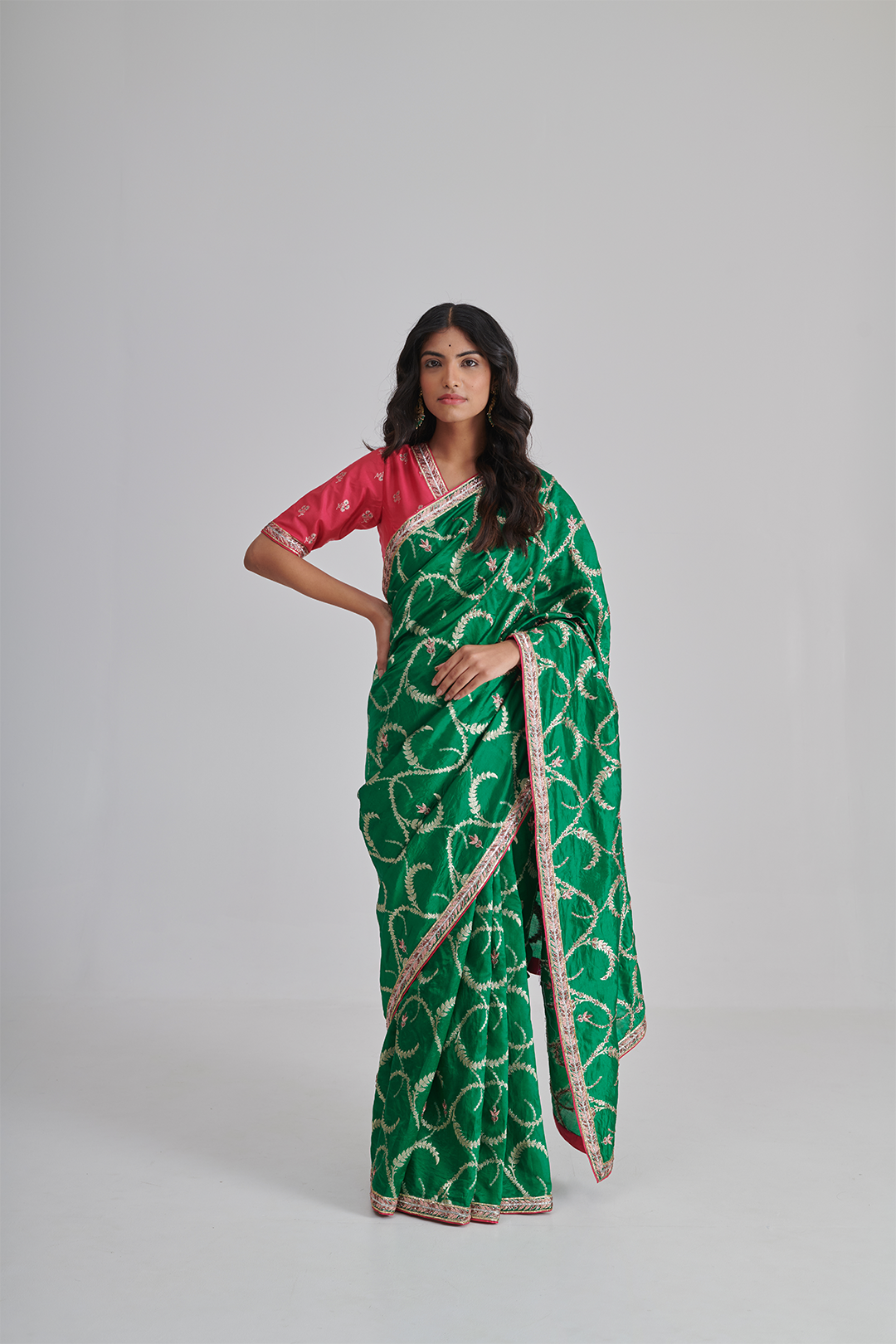
Banarasi and woven silk, for outdoor evenings. The Phalgun & Myra set (₹27,500) is yellow Banarasi silk with florals woven in silver thread, with the round-necked ivory Myra blouse. The Rahi & Amara set (₹24,500) is fuchsia Banarasi silk woven with gold florals, with a champagne stripe silk blouse. The Humrahi & Faridah set (₹34,500) pairs a green silk jacquard sari with a pink mulberry silk brocade blouse. And the Bano & Siya set (₹32,500) is ivory moonga zari silk with a Siya blouse embroidered around the neckline and sleeves. All four include their blouse; the two above ₹30,000 ship free within India.

Sheer sarees, kept for winter. You don't have to put your chiffons away until March. The Laal Ishq saree (₹19,500) is deep vermilion organza silk with sequin vines and abstract florals trailing along the body. Over the full-sleeved Ziya blouse and a skin-tone thermal, it works at an indoor winter reception, and the blouse does the warming. For a mild southern evening, the Zariya saree (₹22,595) is a soft mint green Banarasi base with diagonal bands of sequins and gota in antique gold — described as light and fluid, so think of it as a Banarasi for Bengaluru rather than for a Delhi lawn. Neither includes a blouse.
We don't weave: our Banarasi, silk and tissue are handwoven cloth that we buy and then embroider by hand in Jaipur. For more saree choices by budget, see designer sarees under ₹50,000.
Layer Three: What Goes Underneath (and Stays Invisible)
This is where the real warmth comes from, and nobody needs to know it's there.
- A thin thermal top in your skin tone, cut low enough not to peep out of your blouse neckline and short enough to stop above the saree's waist. Sleeveless or short-sleeved thermals sit neatly under a full-sleeved blouse.
- Thermal leggings under the petticoat. Ankle length, close-fitting and in a neutral tone — the saree's length hides them completely.
- A heavier petticoat. A thicker cotton or satin petticoat in place of a thin one adds a layer at the legs and stops a fine saree from clinging. Our saree shapewear and petticoat guide goes through the options; avoid shapewear and thermals stacked so tightly that you can't sit through the pheras.
The one thing to plan ahead: a fitted blouse is cut to your body, and a thermal under it takes up room. If you will wear a thermal under a made-to-measure blouse, take your bust, upper-arm and armhole measurements wearing that thermal, and tell us so. Custom measurements cost nothing extra with us. Our outfit trial checklist is useful here too — do your trial in the exact layers you plan to wear.
Layer Four: Shawls, Capes and the Pallu
The top layer should be something you can take off when you walk into a warm hall, and something that looks deliberate when you keep it on.
A shawl over the pallu. A fine wool or pashmina shawl is the warmest thing you can add to a saree, and a long-familiar sight at northern winter weddings. Lay it over both shoulders on top of the pallu, or fold it lengthwise over the pallu shoulder so the saree's border still shows in front. Outdoors, wrap the pallu itself round the back and over the other shoulder like a stole first. We don't make shawls, so buy one from a specialist, in a quiet tone that echoes your saree's border. Our saree draping styles guide covers drapes that keep the pallu secure under a second layer.
A cape over the blouse. A cape gives you shoulders and arms without a coat's bulk. The Veda & Tishya set (₹18,500) is a bustier and cape: the Veda bustier in yellow silk with a sweetheart neckline, and the Tishya cape in silver-grey silk, open at the front with structured short sleeves and diagonal rows of gold marodi, zari and resham embroidery wrapping the bodice and sleeves. It is shown over a saree (not included), and it is the most modern way we know to cover up a saree without hiding it. For more cape and jacket ideas, see layering techniques: capes, jackets and creative styling.


A second drape. A silk dupatta worn over the shoulders, on top of the pallu, adds a layer and a colour. The Gulnaaz dupatta (₹8,500) is bandhani silk in a muted brown, hand-embroidered with zardozi, sequins and cutdana, with bold paisleys at the corners; it pairs well across pinks, rusts and neutrals. An organza dupatta, by contrast, adds almost nothing in warmth. Most of our dupattas are organza, so wear them for colour, and a shawl for heat.
Mind the heaters. Winter weddings in the north often have patio heaters, braziers or a bonfire. Keep a loose pallu, a long dupatta and any shawl fringe well clear of open flame, and pin the pallu at the shoulder so it can't swing.
Your Feet: Cold Floors and Lawns
A floor-skimming saree means nobody sees your shoes, so put warmth first.
- Closed shoes over strappy heels outdoors: closed-toe juttis, mojaris or a closed block heel.
- Block heels or wedges on lawns, which are often damp after a foggy northern evening; stilettos sink.
- Thin skin-tone socks or footed tights under closed shoes are invisible under a floor-length saree.
- Shoes often come off for the ceremony, sometimes on marble or stone. Plain socks in your potli help through the pheras, if the family is comfortable with it.
When to Order for a Winter Wedding
Everything here is made to order in our Jaipur atelier: 4–5 weeks to make, plus 3–7 days of shipping. Ordered today, in late October 2026, a saree or blouse reaches you around the first week of December at the earliest. That is too late for Diwali on 8 November, but comfortable for weddings from mid-December to February. For an early-December date, ask us on WhatsApp first; express is sometimes possible, depending on the piece and the month.
Planning a Winter Saree?
Send us your wedding city, the time of the function and whether it's indoors or out, and we'll help you pair a saree with a sleeved blouse or a cape that works for the weather. Every piece is hand-embroidered in Jaipur, made to order in 4–5 weeks, and cut to your measurements at no extra charge — tell us if you'll wear a thermal underneath.
Shop SareesMore saree guides: Choosing a blouse · Draping styles · Petticoats and shapewear · Winter wedding outfits · Blouses
Frequently Asked Questions
How can I wear a saree in winter and still stay warm?
Layer in four places: a full- or three-quarter-sleeved blouse, a denser silk or Banarasi saree, a skin-tone thermal top and leggings under the blouse and petticoat, and a shawl, cape or second drape over the pallu that you can remove indoors. Add closed shoes for outdoor evenings.
Which saree fabric is best for a winter wedding?
For an outdoor evening, a silk, Banarasi or silk jacquard saree holds its drape and blocks a little more breeze than a sheer one. No saree is as warm as wool, though, so the warmth mostly comes from your blouse, thermals and shawl. Chiffon and organza work well indoors over a sleeved blouse.
Can I wear a thermal under a saree blouse?
Yes. Choose a thin, skin-tone thermal cut lower than your blouse neckline and shorter than the waist. If your blouse is made to measure, take your measurements wearing the thermal so the blouse isn't tight on the day.
How do I wear a shawl with a saree without hiding it?
Drape the saree first, then lay the shawl over both shoulders on top of the pallu, or fold it lengthwise over the pallu shoulder so the saree border still shows in front. Pick a quiet shawl that echoes a colour from the border, and take it off for photographs.
If I order a saree now, will it arrive for a December wedding?
For mid-December onwards, yes. Our pieces take 4 to 5 weeks to make plus 3 to 7 days of shipping, so an order placed in late October 2026 arrives around the first week of December at the earliest. For an early-December date, ask us on WhatsApp first; express is sometimes possible depending on the piece and the month.
Made to order in 4–5 weeks
Have an event date? We’ll tell you exactly when to order by.
We take a limited number of orders each month — secure your slot early.
WhatsApp me my order-by date + a shortlistNot sure where to start?
Tell us what you're dressing for and we'll help you choose — fabric, fit, colour, and timeline — over WhatsApp or on a video call.
Your Cart
Pieces from this story
All pieces →Not sure which piece, or need it by a date? Book a video consultation Ask us on WhatsApp




Keep reading
The journal →
Winter Wedding Outfit Ideas: Luxe Indian Outfits for Cold Weather Celebrations
What to wear to a winter wedding in India. Heavy silk, brocade, and velvet outfit ideas with layering tips — jackets,...
12 March 2026
How to Choose the Perfect Saree Blouse: Neckline, Sleeves & Fit
You can spend a fortune on a saree and still let it down with the wrong blouse. The blouse is where fit, flattery, an...
16 June 2026
Designer Blouses Under ₹20,000: 16 Hand-Embroidered Picks to Make an Old Saree New
Designer saree blouses under ₹20,000 — 16 hand-embroidered silk pieces from ₹6,250, by price band, with how to restyl...
29 September 2026