
Jain Diwali Outfit Ideas: What to Wear for Mahavir Nirvana and the Jain New Year
For Jains, Diwali is not a Lakshmi festival first. It marks the night Bhagwan Mahavira, the twenty-fourth Tirthankara, attained nirvana at Pavapuri, and the lamps are lit for the light of his knowledge. So what you wear is shaped by the derasar rather than the party: covered, clean, unfussy clothes in ivory or soft colours for darshan and recitation, nothing made of leather, and a little more colour for the Jain New Year visits that follow. Below is how to dress for each part of it, what to do if your family avoids silk, and an honest note on timing if you are planning to buy something new.
One thing first. Jain practice varies widely between Shvetambara and Digambara families, between sanghs and between regions, and some customs below belong more to one tradition than the other. Where that is the case, we say so. Your own derasar, basadi or family elders are always the final word.
The Dates for 2026, and Why Calendars Differ
Diwali 2026 falls on Sunday, 8 November, and the Kalnirnay panchang lists Mahavir Nirvana on that day alongside Lakshmi Pujan. However, a Digambara festival list we checked places Mahavir Nirvan Kalyanak on Monday, 9 November. Amavasya runs into the late morning of 9 November this year, and Mahavira's nirvana is traditionally placed at the dawn of amavasya, which is where the one-day gap comes from. Neither date is wrong; they are counting the same tithi differently.
The Jain New Year, the start of Vira Nirvana Samvat 2553, begins on Kartik Shukla Pratipada. Kalnirnay lists it on Tuesday, 10 November 2026, the same day as Govardhan Puja and Padwa, though some Gujarati calendars put the new year on 9 November. That morning also marks the day Gautam Swami, Mahavira's chief disciple, is said to have attained kevala jnana (omniscience). Gyan Panchami, the day for honouring scripture and knowledge, follows on Saturday, 14 November.
Practically, you are dressing for three or four days: the fast and recitation leading into Diwali, the Diwali night itself, the nirvana morning at the derasar, and the new year round of visits.
What the Days Actually Involve
It helps to know what you are dressing for, because the Jain observance is quieter than the festival around it.
- Fasting. Many Shvetambara Jains keep a two-day fast in remembrance of Mahavira's own two-day fast before his nirvana.
- Recitation of the Uttaradhyayana Sutra. Mahavira is said to have preached his final sermon at Pavapuri over 48 hours before his nirvana, and Shvetambara Jains recite and study the Uttaradhyayana, which holds those last teachings. This is a Shvetambara text; Digambaras do not accept it as canon, so you will not hear it at a Digambara basadi.
- Lamps. The Kalpa Sutra tells of eighteen kings who lit their doorways on the night of the nirvana, so that the light of knowledge would not leave the world. Diyas, not fireworks: many Jain organisations actively ask families to skip crackers on ahimsa grounds.
- The nirvana laddoo. On the nirvana morning, a laddoo is offered at the temple after prayers to Mahavira. The custom is especially associated with Digambara temples, though it is observed widely.
- Pilgrimage. Some families travel to Pavapuri in Bihar, where the Jal Mandir stands in a lotus tank at the place associated with Mahavira's cremation.
- New account books. For business families, the new year means settling the old year's accounts and starting new books.
Long sitting on the floor, a long morning at the derasar, a fasting body that feels the cold, and very little that calls for heavy embellishment. That is the brief.
Rule One: No Leather, Anywhere
Ahimsa is the centre of the festival, so the most important styling decision has nothing to do with your outfit. Many derasars ask visitors to leave leather outside, and some provide lockers for it. Belt, bag, wallet, watch strap and shoes all count. Fabric juttis or embroidered mojris, a cloth potli, and a metal or fabric watch strap solve it. You will be taking your shoes off at the door anyway, so slip-ons are kinder.
We should be clear that we don't make footwear or bags, so those have to come from elsewhere. What we can help with is everything between your shoulders and your ankles.
Puja Clothes Are Not the Same as Festive Clothes
This catches people out. If you are performing puja yourself, rather than going for darshan, the traditional requirement is about the clothes' purity, not their design: freshly washed, ideally unstitched and white, kept only for puja and never worn while eating. Women traditionally wear an unstitched saree. Digambara guidance stresses hand-washed clothes that you have not eaten in. Many temples are more relaxed today, but for strict observance, a hand-embroidered kurta set is not your puja outfit, and you should not try to make it one.
Where a well-made outfit belongs is everything around the puja: darshan, the recitation in the upashraya or hall, the evening lamps at home, and the new year visits.
For the Derasar: Ivory, Soft Colour, Sleeves
Shvetambara literally means "white-clad", after the white robes of its monks and nuns, and white or ivory always feels right at a Jain temple. Keep shoulders and knees covered, choose sleeves, and carry a dupatta for your head if your family covers it in the temple.
The simplest answer is the Naina ivory cotton kurta with Ahalya pant (₹12,500), with delicate hand-embroidered floral motifs around the neckline, cuffs and pant hem. It is cotton, so the silk question does not come up at all, and it is comfortable enough for a long, cross-legged morning. The Pardesi kurta with Amaya pant (₹10,715) is the other cotton set: hand embroidery in sequins, cutdana and thread work, in a two-piece that is easy to sit in for hours.

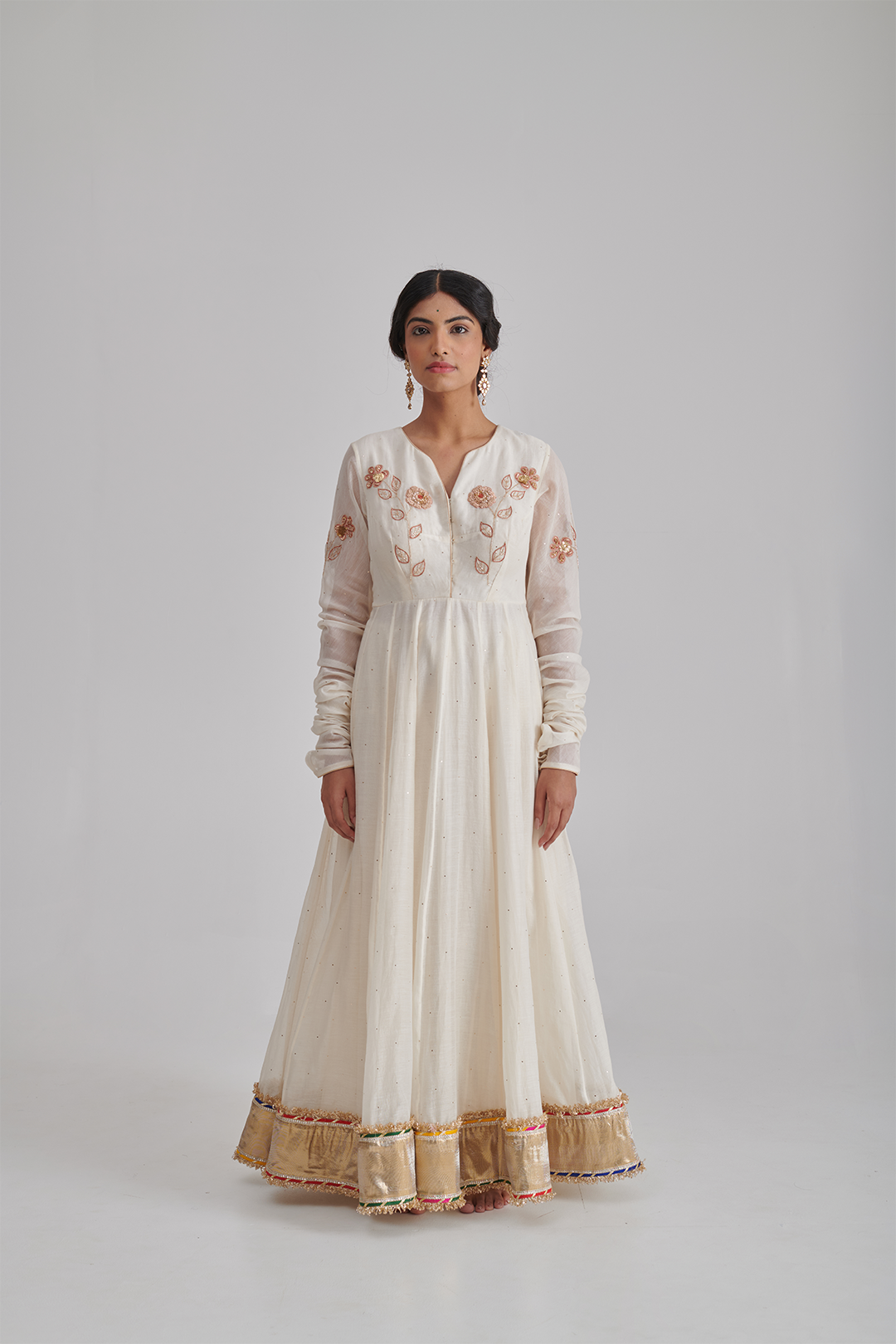
If you want something more formal in ivory, the Noor ivory anarkali with Ahana churidar (₹14,500) has Mukesh work, hand-embroidered floral motifs with delicate sequin detailing, and embroidery across the bodice and sleeves. The Bhayli ivory anarkali with Ahana churidar (₹14,500) has Mukesh work with gold hand-embroidered motifs along the V-neckline and cuffs, sequins throughout, and a gold and silver border at the hem. Both are handwoven fabrics, and neither listing names the fibre, so if silk matters to you, ask us before ordering (see below).


To cover your head, the Adhira ivory organza dupatta (₹4,500), with mirror work and delicate resham thread work, sits lightly over almost anything. If you prefer colour near the face, the Zarveen sage chanderi dupatta (₹9,500) is sheer with a delicate zari border. Our guide to draping a dupatta over your head shows how to keep it in place through a long recitation.
The Silk Question, Honestly
Some observant Jains avoid silk, because conventional silk production kills the silkworm. Plenty of Jain families wear silk without a second thought, and some temples are stricter about it than others. If you are in the first group, here is how we would put it.
A lot of what we make is silk, or a blend with silk in it. For example, the Eila ivory and gold kurta with Riya pant (₹23,500) is beautiful for the new year but is silk cotton jacquard, so it is not for someone avoiding silk. Fabric names are not always a clear guide either: chanderi, organza and tissue can be woven with or without silk. Resham is also the Hindi word for silk, so if you are strict, ask about the embroidery thread as well as the base fabric.
We don't weave cloth. We buy handwoven fabric and embroider it in our Jaipur atelier, so we know what each length is. Message us before you order and we will tell you exactly what a specific piece, and its thread, is made of. The cotton sets above are the only pieces in this guide where the answer is obviously yes without checking. More on this in our Jain wedding guest guide.
Diwali Night at Home: Light Colour, Light Embroidery
Lamps at home, family, perhaps the end of a fast. The register is festive but restrained. Embroidery that glows under diyas suits it better than heavy sequins. The Leela chanderi kurta with Sifat pant (₹18,500) has a central panel with a stylised floral jaal that builds into a bold, leaf-like motif at the hem, worked in fine gota patti, sequins, resham and bead work. It is lightweight chanderi, which helps if the evening is warm. The Afreen and Maahi chanderi set (₹15,875) in sunshine yellow, with cutdana and bead flowers embroidered across it and beaded neck and sleeve hems, is a softer, sunnier choice.
One safety note. Lamps are on the floor and on low ledges, and dupatta ends are what catch. Pin the dupatta, or take it off while you light the diyas.
The New Year Visits: Now You Can Wear Colour
The Jain New Year is about greeting elders, visiting relatives, and in business families, opening the new books. It is the most social day of the week, and the one where a richer colour feels natural. In Gujarati Jain homes it overlaps with Bestu Varas, and our Bestu Varas guide covers that house-hopping day in detail.
The Haniya magenta chanderi kurta with Mithila pant (₹21,000) is an A-line cut with hand-embroidered floral motifs in gold thread, sequins and multicolour thread work along the sleeves and hem. The Nawaazish deep vermillion chanderi kurta with Zivah pant (₹17,500) has a distinctive square yoke, climbing bel-like vines on the sleeves and a paisley motif at the back. Both are covered and festive, and comfortable for a day of sitting down and getting up again.


For the rest of the Diwali week, including Dhanteras, Govardhan Puja and Bhai Dooj, our Diwali 2026 outfits for every function covers each day.
If You Are Reading This in October 2026: A Note on Timing
Everything we make is hand-embroidered to order, which takes 4–5 weeks, plus 3–7 days for shipping. A new order placed today, in the third week of October, will reach you around the last week of November at the earliest. That is after Diwali, after the Jain New Year and after Gyan Panchami. We would rather tell you that plainly than let you hope.
Express making is sometimes possible, depending on the piece and the month, so ask on WhatsApp before assuming either way. For this year, the best approach is to restyle what you already own. Wear your simplest ivory or pastel kurta set to the derasar, add a dupatta for your head, and keep your one richer piece for the new year visits. Swap a leather bag for a cloth potli, and you are dressed correctly.
The pieces above are worth planning for anyway. Covered, light-coloured, non-leather-friendly clothes work straight through the wedding season from December to February. Our temple wedding guide covers a lot of the same ground. And if you order with plenty of time for next year's Diwali, you can have a conversation about fabric first, which is exactly what the silk question needs.
Ask Us What It Is Made Of
Every piece is hand-embroidered by karigars in our Jaipur atelier and made to your measurements, at no extra charge, over 4–5 weeks plus shipping. That is too late for this Diwali, but in good time for the wedding season. Tell us if you avoid silk and we will tell you exactly what a piece is woven from before you order. Browse our kurta sets and dupattas.
Shop Kurta SetsMore festive guides: Bestu Varas and Labh Pancham · Govardhan Puja and Annakut · What to wear to a temple
Frequently Asked Questions
When is Jain Diwali in 2026?
Diwali falls on Sunday, 8 November 2026, and the Kalnirnay panchang lists Mahavir Nirvana that day. Some Digambara calendars mark Mahavir Nirvan Kalyanak on Monday, 9 November, because amavasya continues into that morning. Kalnirnay lists the Jain New Year (Vira Nirvana Samvat 2553) on Tuesday, 10 November, though some Gujarati calendars mark it on 9 November. Check your own sangh's calendar.
What should I wear to a Jain temple on Diwali?
Wear clean, modest clothes that cover your shoulders and knees, preferably with sleeves, in ivory, white or soft colours, with a dupatta if your family covers the head. Leave all leather behind, including belt, bag, wallet, watch strap and shoes. If you are performing puja yourself, the traditional rule is freshly washed, usually white, unstitched clothes kept only for puja.
Do Jains wear silk for Diwali?
Some do and some do not. Conventional silk production kills the silkworm, so observant Jains may avoid it, especially for religious occasions. Cotton is the clear alternative. Chanderi, organza and tissue can be woven with or without silk, so ask the maker what a specific piece and its embroidery thread are made of.
How do Jains celebrate Diwali?
Jains mark Mahavira's nirvana at Pavapuri by lighting lamps for the light of his knowledge, usually without firecrackers. Many Shvetambara Jains keep a two-day fast and recite the Uttaradhyayana Sutra, held to contain his final teachings. A nirvana laddoo is offered at temples on the nirvana morning, a custom especially associated with Digambara temples. The next day begins the Jain New Year.
Can I still order a handmade outfit for Diwali 2026?
Not for delivery before the festival, if you order from mid-October. Made-to-order pieces take 4–5 weeks plus 3–7 days of shipping, so they arrive around late November at the earliest. Express is sometimes possible, depending on the piece and the month, so ask on WhatsApp. Otherwise, restyle what you own this year and plan new pieces for the wedding season or next Diwali.
Made to order in 4–5 weeks
Have an event date? We’ll tell you exactly when to order by.
We take a limited number of orders each month — secure your slot early.
WhatsApp me my order-by date + a shortlistNot sure where to start?
Tell us what you're dressing for and we'll help you choose — fabric, fit, colour, and timeline — over WhatsApp or on a video call.
Your Cart
Pieces from this story
All pieces →Not sure which piece, or need it by a date? Book a video consultation Ask us on WhatsApp


Keep reading
The journal →
How to Drape a Dupatta Over Your Head: A Styling Guide
How to drape a dupatta over your head elegantly for a pooja, gurudwara, temple, or wedding — draping styles, how to p...
29 July 2026
What to Wear to a Jain Wedding: A Guest's Guide
What to wear to a Jain wedding — why no leather is the rule that catches guests out, the silk question, and what dayt...
7 September 2026
Bestu Varas Outfit Ideas: What to Wear for Gujarati New Year & Labh Pancham
What to wear for Bestu Varas on 9 November 2026 and Labh Pancham on 14 November — bandhani, brocade and festive outfi...
14 August 2026