

Sharara vs Lehenga: Which Should You Wear to the Wedding?
The short answer: wear a sharara when the day involves dancing, sitting on the floor, travelling between venues or a long stretch on your feet, and you want your midriff covered without fuss. Wear a lehenga for the main wedding ceremony or the reception — especially if you're close family — when you want the most traditional, most formal look in the room and the photographs to match. Both are dressy; the lehenga is simply the more ceremonial of the two.
The rest of this guide goes through the difference point by point — silhouette, comfort, dancing, travel, height, cost, re-wearability and photographs — with pieces we make in both, including two that cost exactly the same.
What's the Difference?
A sharara is a pair of wide trousers that flare from the waist or hip down to the ankle, with so much volume in each leg that, standing still, it often reads as a skirt. It is worn with a kurta — short, hip-length or knee-length — or with a short top or bustier. Because it is trousers, each leg moves independently.
A lehenga is a long, flared skirt, worn with a fitted blouse (a choli) and usually a dupatta. The volume comes from panels, gathers or pleats, sometimes with a lining or can-can underneath to hold the shape.
If you're also weighing a gharara or a palazzo, our guide to sharara vs gharara vs palazzo covers those. We make shararas, not ghararas, so everything below is about the sharara.
Point by Point
Comfort and coverage
A sharara set wins on comfort for most people. You can sit cross-legged at a mehendi, climb into a car, take stairs and use the bathroom without gathering up a skirt. The kurta covers the midriff, so there's nothing to keep adjusting — useful at a gurdwara, a temple or a family puja, or simply if you'd rather not think about it all day.
A lehenga asks a little more of you. The skirt needs lifting on stairs, a heavily worked one carries real weight at the waist, and the blouse usually leaves some midriff showing unless you drape the dupatta to cover it. None of that is a problem for a few hours at a ceremony or reception; it is more noticeable across a twelve-hour day.
Dancing
Both dance well, differently. A sharara gives you full freedom of the legs and swings with every step, which is why it is the default sangeet outfit for so many people. One honest caveat: a very wide sharara hem can catch under a high heel, so set the length with the shoes you will actually wear. A lehenga gives you the twirl — nothing photographs a spin like a flared skirt — but you'll be lifting the front to move quickly. Our guide to dancing comfortably in Indian outfits has practical tips for both.
Travel and packing
If you're flying to a destination wedding with three functions in one suitcase, a sharara set is easier: a kurta and a pair of trousers fold flat. A lehenga with a full flare, a pleated lining or a can-can takes more room and comes out needing a steam. Neither should be checked in with the rest of your luggage if you can help it.
Height and proportion
These are guidelines, not rules. If you're petite, a sharara with a shorter, hip-length kurta shows more of the flare and lengthens the leg; a very long kurta over a sharara can cut you in half. A lehenga with a fitted, slightly longer blouse and a high-waisted skirt also elongates. If you're tall, both silhouettes work — a knee-length kurta over a sharara is especially elegant, and a lehenga's flare has room to fall. Our petite and tall styling guides go further. Since our pieces are made to your measurements at no extra charge, length is the easiest thing to get right.
Cost
Silhouette matters less than you'd think. Across the market, the price of either is set mostly by the fabric and how much of it is hand-embroidered. Our own sharara sets run from ₹21,500 to ₹73,450 and our lehengas from ₹16,500 to ₹1,75,000, and they overlap heavily in the ₹25,000–40,000 band. Two examples make the point:
- The Mehergul & Abroo lehenga (₹25,000) and the Rohi & Zoey sharara set (₹25,795) cost almost the same.
- The Ishq-e-Gul & Inara lehenga (₹37,500) and the Gulrukh & Leher sharara set (₹37,500) cost exactly the same.
So decide on the silhouette first, then the budget. For price guides, see designer sharara sets under ₹40,000 and designer lehengas under ₹50,000. And budget for a dupatta either way: none of our sharara sets or lehengas includes one, even where one is shown in the photographs.
Re-wearability
A sharara set splits easily. The kurta goes over straight pants for a Diwali lunch or a dinner; the sharara goes under a plain short kurta or a fitted top for a sangeet next year. A lehenga splits too, with a little more thought: the blouse can be worn with a saree in a matching or contrasting colour, and the skirt with a different blouse or a crisp shirt. Our guide to re-wearing lehengas beyond the wedding day has ideas.
Photographs
A lehenga is made for the stage photograph and the portrait: the full skirt, the border at the hem and the dupatta frame you from head to toe, and the twirl is a shot every photographer asks for. A sharara photographs best in movement — candids on the dance floor, walking in, sitting with the bride at the mehendi. Standing still in a group photo, a full sharara reads very like a skirt, so you lose less than you might expect.
Which Function Suits Which
- Haldi and mehendi: a sharara set, almost always. You'll be sitting on the floor, getting haldi on your clothes or waiting for mehendi to dry.
- Sangeet: either. A sharara if you're performing; a lehenga if you're there to twirl and be photographed. See our sangeet dress code guide.
- Wedding ceremony: a lehenga if you're close family; either as a guest, with a heavier, more formal sharara set if you choose that.
- Reception: a lehenga or a statement sharara set — the evening, the lighting and the stage all favour volume.
- Puja, gurdwara or temple visits within the wedding: a sharara set, for coverage and ease of sitting.
If you're close family — the bride's sister, a sister-in-law, a mother or aunt — many families expect a lehenga or a saree at the main ceremony, so it is worth asking. A good plan is a sharara for the mehendi and sangeet and a lehenga for the wedding itself. If you're choosing between a lehenga and a saree for that day instead, see saree vs lehenga.
Sharara Sets We Make
All our sharara sets are two or three pieces, made in Jaipur, hand-embroidered and cut to your measurements.
For a daytime function, the Roshni & Nazreen set (₹31,800) pairs a mustard-yellow Chanderi kurta, covered in an all-over trellis of aari vines and golden thread with pink resham florals, sequins, nakshi and moti, with a soft pink Chanderi sharara with a voluminous flare. The Rohi & Zoey set (₹25,795) is a yellow tissue silk kurta over a pale mint-green sharara that falls in wide pleats, worked in zardozi, sequins, cutdana and beads — a natural mehendi or haldi set.
For a morning wedding or an engagement, the Chanbeli & Badli set (₹32,850) is an ivory satin kurta with an aari floral jaal, multicolour resham, French knots, sequins and cutdana, over a sharara in sheer organza that keeps the lower half airy. For the sangeet, the Gulrukh & Leher set is a sleeveless pink Chanderi kurta with sequin and cutdana sprays, aari and moti, over a crushed Chanderi sharara striped in mustard and deep purple with a wide lappa border at the hem. And if you want a sharara look that skips the kurta altogether, the Mastani, Leyla & Nalini set (₹21,500) is a one-shoulder cape, a strap bustier and a sharara in emerald bandhani jacquard silk woven with gold and silver florals.


For a wedding ceremony or reception where a sharara has to carry the weight of a lehenga, the Zehan & Aabha set (₹62,250) is a purple silk kurta covered in hand-done gota appliqué — metallic ribbon folded and stitched into rhombus and floral shapes in a geometric trellis, with sequins, resham and moti — over a gold tissue sharara with a voluminous flare.

Lehengas We Make
The Mehergul & Abroo set is rani-pink silk: a lehenga with fluid gathers and a blouse hand-embroidered with sequins, cutdana and thread work in floral and vine motifs. The Bano & Dilruba set (₹28,500) is pistachio silk tissue with a voluminous flare and a wide embroidered border of roses and vines in sequins and beads, touched with coral and rose gold, and a sleeveless V-neck blouse to match — a lehenga for a day wedding or a mehendi where you'd still like a skirt.
The Raanisa & Mahira set (₹35,500) is a sindoori-orange lehenga in woven booti silk with gota, marodi, bead and thread work at the hem and a pleated lining for volume, with a blouse embroidered at the neckline, sleeves and waist. The Ishq-e-Gul & Inara lehenga is soft tissue jacquard in panels of pink, gold, peach, ivory and green, each edged with sequin-lined gota and finished with a gota-patti and marodi border, with an antique-gold marodi blouse.


For a wedding ceremony, the Rehmat & Vasl set (₹42,500) is red Varanasi silk brocade with floral motifs drawn from Rajputana and Mughal inlay designs, gold zari all over and a broad gold border at the hem — the matching red dupatta in the photographs is sold separately. And for close family, the Driti & Hesyra set (₹75,000) is radiant yellow silk: a blouse embroidered all over in zari, resham, marodi, gota patti, sequins, cutdana, beads and aari, and a voluminous lehenga with a scalloped floral border of gota patti appliqué and the same techniques at the hem.
We are not weavers. We buy the cloth — silk, tissue, Chanderi, brocade, organza — and our karigars embroider it by hand. For the wider market, our roundup of the best sharara brands in India names other labels worth looking at. We don't make jewellery or footwear, so plan those separately.
Still Deciding? Tell Us the Function
Every sharara set and lehenga is made to order in Jaipur over 4–5 weeks, plus 3–7 days of shipping, and cut to your measurements at no extra charge. Message us on WhatsApp with your functions and dates and we'll help you choose — and tell you honestly whether it can reach you in time. Browse our sharara sets and lehengas.
Shop Sharara SetsMore silhouette guides: saree vs lehenga, lehenga vs gown and sharara vs gharara vs palazzo.
Frequently Asked Questions
Should I wear a sharara or a lehenga to a wedding?
Wear a sharara for functions with dancing, floor seating or a long day on your feet, such as the mehendi, haldi and sangeet. Wear a lehenga for the main wedding ceremony or reception, especially if you are close family. As a guest at the ceremony, a heavily embroidered sharara set is also appropriate.
What is the difference between a sharara and a lehenga?
A sharara is a pair of wide trousers that flare from the waist or hip, worn with a kurta or short top. A lehenga is a long flared skirt worn with a fitted blouse and usually a dupatta. From a distance they can look similar, but a sharara moves as two legs and a lehenga as one skirt.
Is a sharara cheaper than a lehenga?
Not necessarily. Price depends mostly on the fabric and the amount of hand embroidery, not the silhouette. Our sharara sets cost ₹21,500 to ₹73,450 and our lehengas ₹16,500 to ₹1,75,000, with many in both between ₹25,000 and ₹40,000.
Is a sharara or a lehenga better for dancing at a sangeet?
A sharara gives more freedom of movement because each leg moves independently, so it suits choreographed performances. A lehenga gives a better twirl for photographs but needs lifting to move quickly. Set the hem length of either with the shoes you will wear.
Do your sharara sets and lehengas come with a dupatta?
No. Our sharara sets are a kurta and sharara (one is a cape, bustier and sharara) and our lehengas are a lehenga and blouse. Where a dupatta appears in the photographs it is sold separately; our dupattas start at ₹4,500.
Made to order in 4–5 weeks
Have an event date? We’ll tell you exactly when to order by.
We take a limited number of orders each month — secure your slot early.
WhatsApp me my order-by date + a shortlistNot sure where to start?
Tell us what you're dressing for and we'll help you choose — fabric, fit, colour, and timeline — over WhatsApp or on a video call.
Your Cart
Pieces from this story
All pieces →Not sure which piece, or need it by a date? Book a video consultation Ask us on WhatsApp


Keep reading
The journal →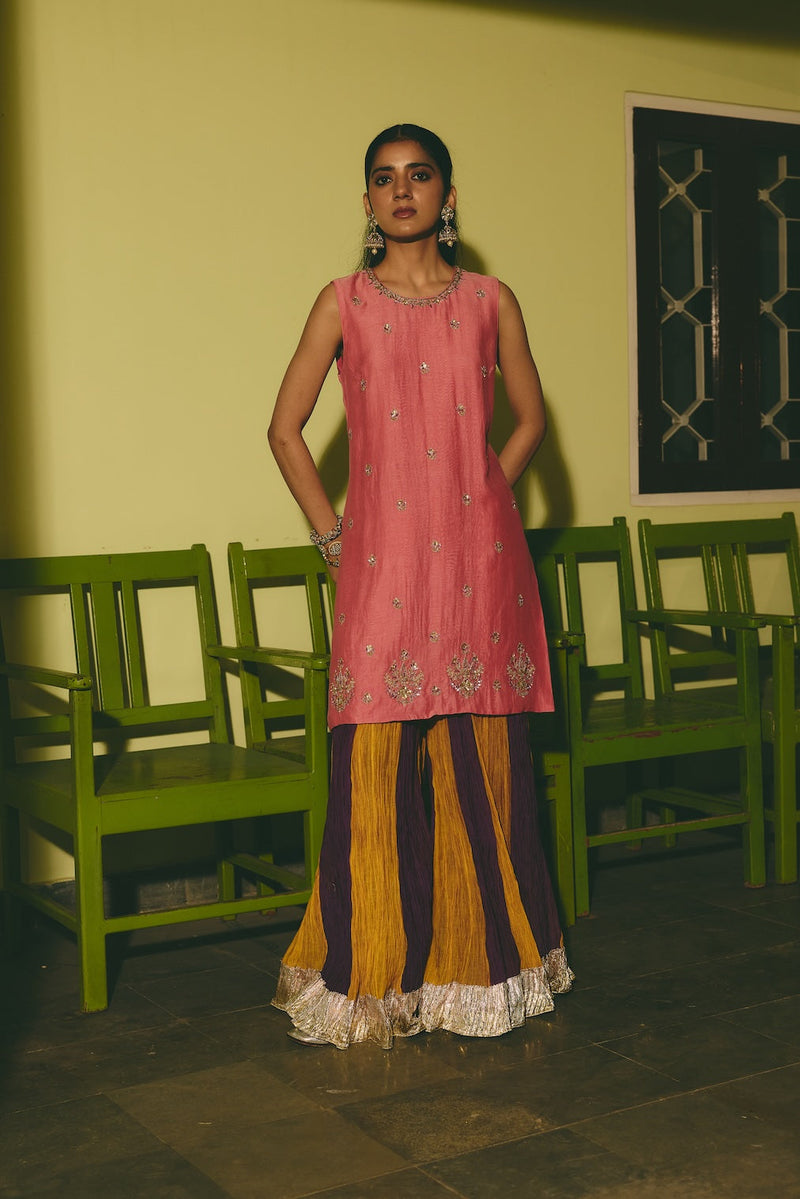
Sharara vs Gharara vs Palazzo: What's the Difference and Which to Choose
Sharara vs gharara vs palazzo — learn the key differences in silhouette, construction, and styling. Compare body type...
12 March 2026How to Dance Comfortably in Indian Outfits: Lehenga, Saree & More
Indian weddings mean dancing—whether it's a choreographed sangeet performance or spontaneous baraat moves. But heavy ...
27 May 2026
Petite Women's Indian Outfit Styling Guide: Look Taller, Feel Elegant
Petite frames have a real advantage in Indian wear — once you dress for your proportions, everything looks intentiona...
16 June 2026