

What to Wear to a Colleague's Indian Wedding: Boss, Client & Office Friend
The short answer: dress one notch below the family and one notch above the office. For a colleague's, boss's or client's Indian wedding you are usually invited to one function, most often the reception, sometimes the sangeet or the wedding itself. A well-cut silk kurta set, an anarkali or a saree in a rich, non-bridal colour is right for almost all of them. Skip bridal red, think twice about all-white and all-black, keep the embroidery polished rather than loud, and if you are coming straight from work, plan the switch: same base outfit, a dupatta and jewellery in your bag.
A colleague's wedding is a slightly odd social situation: you know the person well from Monday to Friday, you may not know a single member of their family, and half your team will be next to you in the photographs. Here is how to get it right.
First, Work Out Which Function You Are Invited To
Indian weddings often run over several functions, and a work invitation is usually for one of them. Check the card, or the WhatsApp invite, carefully.
- The reception is the most common work invitation: an evening, often at a hotel or banquet hall, where guests go up to congratulate the couple on stage. Formal, but forgiving, because you are one of hundreds. Our reception dress code guide covers it in detail.
- The sangeet or cocktail is livelier and often for a closer group. If your colleague has invited you here, you are a friend, not just a co-worker. Dress for dancing and a little more fun.
- The wedding ceremony itself is more traditional and may be in daylight, or at a temple or gurdwara. Go more classic and more covered.
If the invitation carries a dress code ("Indian Formal", "Festive Chic"), follow it. Our invitation dress code decoder explains what each one means in practice.
How Dressy to Go: Colleague, Boss or Client
The relationship changes the brief slightly.
An office friend's wedding. Dress as any guest would. If you are close enough to be at the sangeet, you can wear something with more colour and movement. The general rules in our complete guest guide apply in full.
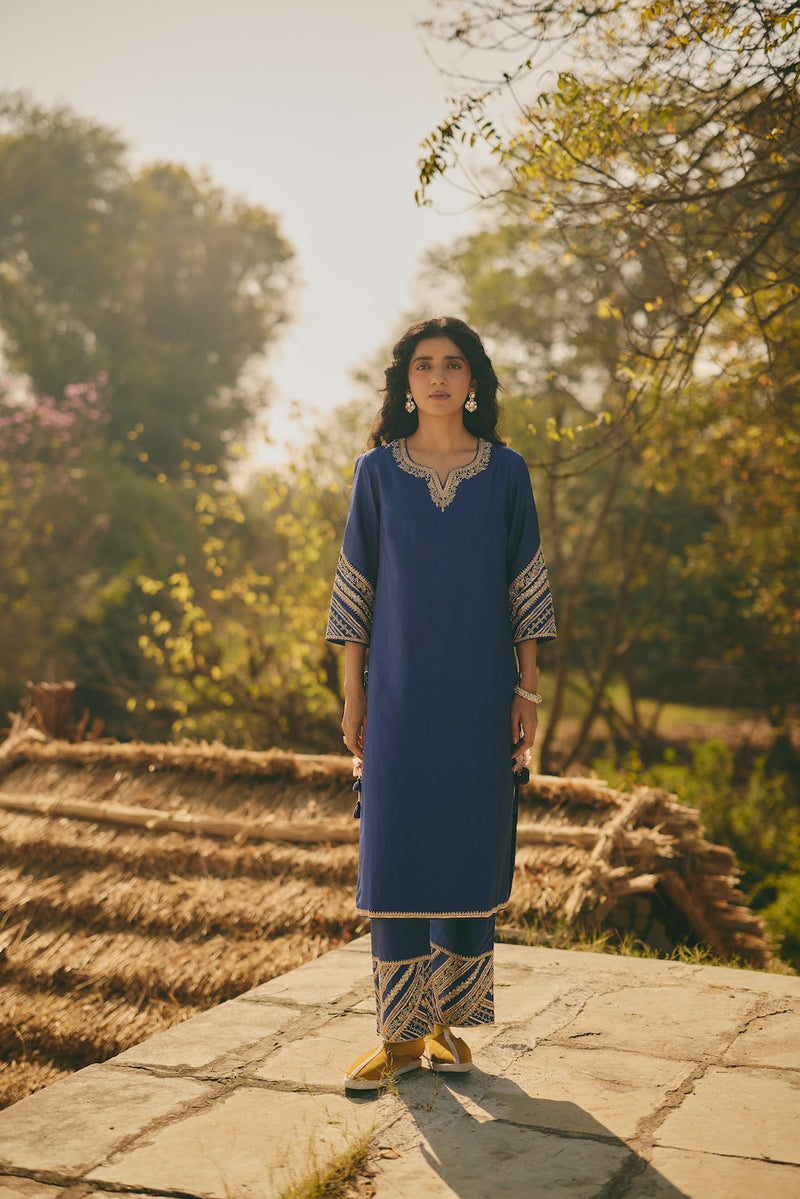
Your boss's or a senior colleague's wedding. Polished, elegant, never louder than the family: good fabric, a clean silhouette, embroidery that rewards a closer look rather than shouting across the room. The Ameera & Hoorain set (₹32,500) is exactly this register: a kurta and pant in deep sapphire blue silk, with hand embroidery along the neckline, sleeve hems and hemline in marodi, resham, sequins, cutdana, bead and aari, delicate florals at the neck and structured geometric lines along the sleeves and pant hem. It reads rich and festive without being bridal.

A client's wedding. This is the most conservative of the three. You are, in a quiet way, representing your firm. Choose a classic silhouette, keep necklines and backs modest, and avoid anything you would feel awkward being photographed in next to the client's grandparents. The Vanya & Bani set (₹23,425) is a warm beige silk kurta and matching straight pant, with Guldasta (bouquet) motifs in dusty rose and peach resham at the neckline, nakshi and zardozi on the stems and borders, and scattered butis with sequins and fine beads. Understated in colour, ceremonial in detail.
Colours: What to Skip and What Always Works
Colour etiquette varies by community and by family, so treat these as sensible defaults rather than rules. Our what not to wear guide goes further.
- Bridal red: in many Hindu and Sikh weddings red is the bride's colour, so a guest in head-to-toe red can look as though she is competing. Deep pinks, corals, wines and oranges give you the warmth without the confusion.
- All-white: in many Hindu families white is associated with mourning, so an all-white outfit can land badly, especially at the ceremony. Ivory with colour in the embroidery is usually fine; a plain white look is the one to avoid.
- All-black: some families see black as inauspicious at a wedding; many urban families now wear it happily at receptions and cocktails. If you do not know the family, keep black for the cocktail and away from the ceremony.
- What always works: jewel tones (sapphire, emerald, plum, deep pink), warm metallics (champagne, antique gold) and soft festive neutrals with colour in the embroidery.
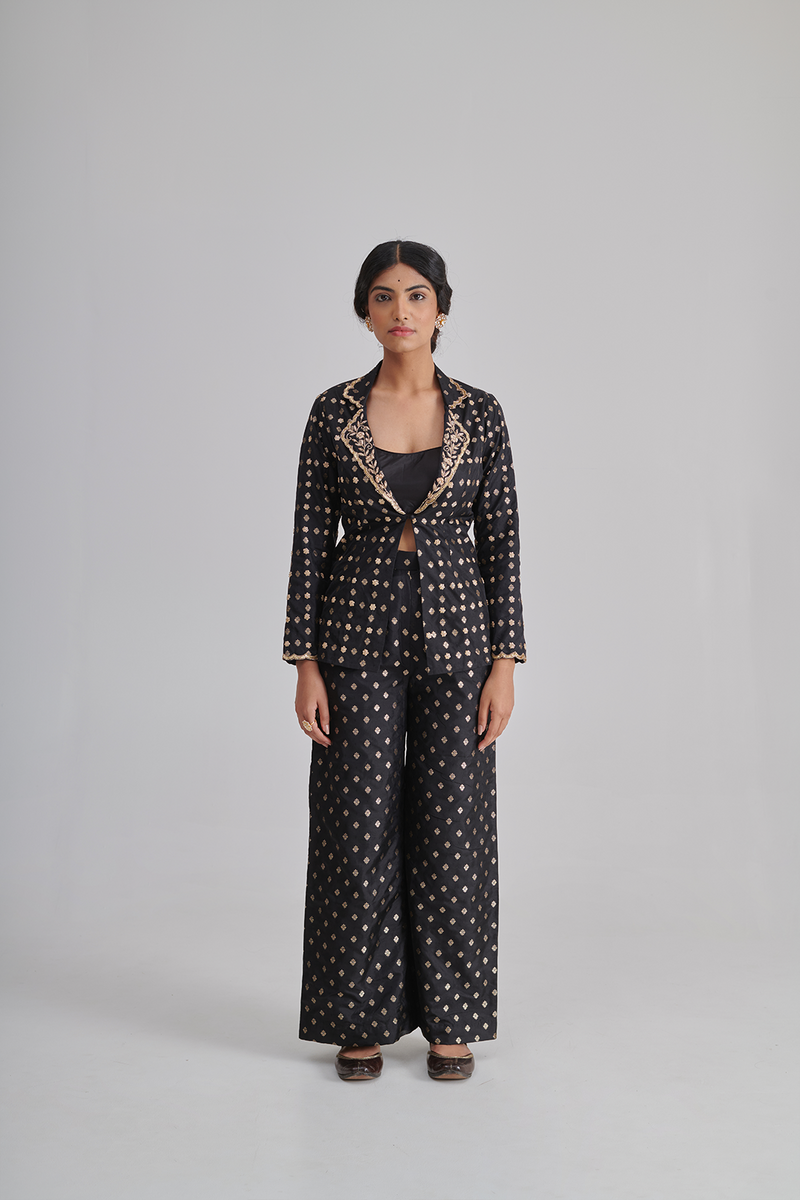
If you love black, the Raat Rani, Vani & Kiyara set (₹16,500) is a smart way to wear it at a cocktail or a cosmopolitan reception: a fitted blazer and wide-leg pants in black Varanasi silk brocade with an all-over gold jaal and hand-embroidered borders and collar, worn over a dupion silk bustier. The gold does the festive work. Our guide to wearing black in Indian fashion covers when it works.
Coming Straight From Work: The Office-to-Reception Switch
Weekday receptions are common, and many people go directly from the office. The trick is to wear a base outfit that is appropriate at your desk, then add the festive layer in the car or the office washroom. Our guide to office festive dressing has more ideas for the working day itself.
The base: a silk kurta set with its embroidery concentrated at the neckline and cuffs is ideal, because it reads as smart office wear in daylight and as festive at night. The Darya & Keya set (₹20,175) is fine silk in a champagne-taupe, a straight long-line kurta with a V-neckline, embroidered only around the neck and sleeve hems in magenta-pink florals and golden vines worked in zari, metallic thread, sequins, cutdana and micro-beads. In a meeting it is a quiet, beautiful kurta; under hotel lights the shimmer comes alive.
If your office is less traditional, the Khwaab & Inara shirt set (₹11,500) does the same job in a different shape: a beige silk brocade shirt and pant with delicate gold leaf motifs and hand-embroidered detailing throughout. It works at a desk and at a reception, especially a cocktail-style one.
The festive layer: this is where a dupatta earns its place. Fold it into your bag in the morning and drape it on before you walk in. The Falak dupatta (₹6,500) is deep forest green organza silk with a soft zari border and a body scattered with floral bootis in sequins, cutdana and thread work. The Zarveen dupatta (₹9,500) is sheer sage-green chanderi with a delicate zari border, for a softer finish. Add earrings, swap flats for heels, and you have changed register in five minutes.


One practical point: keep the jewellery in a pouch rather than wearing it all day. Nothing announces "I am going somewhere after this" quite like chandbalis at a 10 a.m. stand-up.
If You Prefer a Saree or an Anarkali
A saree is the classic choice for a colleague's reception and rarely looks overdone. The Aashiqui saree (₹37,295) is deep royal blue chiffon with hand-embroidered floral motifs in sequins and cutdana, a delicate border and scattered leafy accents. Chiffon is light and forgives a long evening of standing. The saree comes without a blouse; the Ziya blouse (₹6,500), in a jewel-toned silk with a round neckline, full-length sleeves and tonal sequin vines, is a covered, elegant option for a work crowd. Ask us on WhatsApp about colour pairings.
For something more affordable, the Ranjha saree (₹16,695) is plum georgette with hand-embroidered scalloped lines and floral jaals running diagonally across the drape, in sequins and thread work in antique gold and muted ruby. Plum is one of the most useful colours for a guest: festive, flattering, and nowhere near bridal.
If you do not drape sarees, an anarkali gives you the same occasion-appropriate length with far less fuss. The Heeriye & Reva set (₹19,500) is a rich cinnamon-brown chanderi anarkali with a tonal churidaar, delicate resham, cutdana and sequin florals on the front and back yoke, long panel embroidery through the flare, and a contrast border in scarlet and ivory. It is warm, unusual and quietly festive.


Not Upstaging the Family
- Keep a lehenga light. A lehenga is fine for a guest at a sangeet or reception; leave trails and bridal-weight dupattas for family weddings.
- Embroidery concentrated, not all-over. A rich neckline or border reads elegant; head-to-toe sequins can read like the wedding party.
- One statement piece of jewellery, not three.
- Ask if you are unsure. Most colleagues will happily tell you what the family is wearing.
Going With the Team: Coordinate, Don't Match
When a group of colleagues goes together, someone in the WhatsApp group usually suggests "let's all wear blue". It can look lovely in the stage photograph, if handled well:
- Agree a palette, not an outfit. "Jewel tones" lets everyone wear what suits them, including what they already own.
- Keep it optional. A dupatta in the agreed colour is enough to join in.
- Avoid the family's colour if the bride's side has one for that function.
Navy works well for teams because it suits almost everyone. The Tara & Pari set (₹21,175) is deep navy satin with a contrast magenta yoke and floral resham, sequin and bead embroidery in ice blue and soft peach across the bodice and sleeve hems, with a straight pant finished in a scalloped hem.
The Gift: Keep It Simple
The usual options are a shagun envelope with cash, a gift, or a contribution to a team gift. How much to give is personal: it depends on your relationship, your seniority, your city and what your team usually does, so we will not suggest an amount. Plenty of offices pool money for one gift or envelope from the whole team, which saves everyone the guessing. Whatever you give, a short handwritten note to the couple matters more than people expect.
If This Is Your First Indian Wedding
If you are not Indian, or simply have not been to one before, wearing Indian clothes to a colleague's wedding is usually welcomed as a warm gesture. A comfortable kurta set with a dupatta is the easiest place to start. Take your cue from the venue: you remove shoes at a temple or gurdwara, and at a gurdwara everyone covers their head, so carry a dupatta or scarf. Our first Indian wedding guide walks through the whole evening.
What to Spend, and When to Order
For a one-function work invitation, one good outfit plus a dupatta is plenty, and it will get worn again at festivals, other weddings and work dinners. Our guide to how much to spend on a wedding guest outfit goes through each price tier.
Timing matters. Everything we make is made to order: 4–5 weeks to make, plus 3–7 days to ship. Order today and it will reach you around the end of November or the first week of December at the earliest, so not in time for a November wedding. Weddings from mid-December through February are comfortably reachable. If your date is tight, message us before ordering: express production is sometimes possible, depending on the piece and the month, and we will tell you honestly.
What We Make, and What We Don't
We make women's clothing only: kurta sets, anarkalis, sarees, shararas, lehengas, blouses and dupattas, all hand-embroidered in our Jaipur atelier and cut to your measurements at no extra charge. We do not make menswear, jewellery or footwear, so if your partner is coming along, his outfit will need to come from elsewhere. And we do not weave: our silks, chanderi and brocades are handwoven cloth that we buy and then embroider.
Invited to a Work Wedding?
Send us the date and the function on WhatsApp and we will suggest a piece that works at your desk and at the reception. Every piece is made to order in 4–5 weeks, plus shipping, and cut to your measurements at no extra charge. Browse our kurta sets and dupattas, or the full collection.
Browse the CollectionMore wedding guest guides: What to wear as a guest · What not to wear · Reception dress code · Your first Indian wedding
Frequently Asked Questions
What should I wear to a colleague's Indian wedding reception?
A silk kurta set, an anarkali or a saree in a rich, non-bridal colour such as sapphire, emerald, plum, deep pink or champagne. Keep the embroidery polished rather than heavy, and dress one notch below the family.
Can I wear black or white to a colleague's Indian wedding?
It depends on the family. In many Hindu families white is linked to mourning and black is seen as inauspicious, while many urban families are relaxed about black at a reception or cocktail. If you do not know the family, avoid all-white, keep black for the cocktail, and choose ivory or black only with colour or gold in the embroidery.
What should I wear if I am going to the reception straight from work?
Wear a silk kurta set with embroidery concentrated at the neckline and cuffs, which looks smart in the office, and carry a festive dupatta, earrings and heels to add before you arrive.
How much should I give as shagun at a colleague's wedding?
There is no fixed amount; it depends on your relationship, seniority and what your team usually does. Many offices pool money for one group gift or envelope, which is an easy, comfortable option. A handwritten note to the couple is always appreciated.
Should a group of colleagues match outfits at a wedding?
Coordinate rather than match. Agree a loose palette, such as jewel tones or blues and greens, keep it optional, and avoid any colour the family has chosen for its own members at that function.
Made to order in 4–5 weeks
Have an event date? We’ll tell you exactly when to order by.
We take a limited number of orders each month — secure your slot early.
WhatsApp me my order-by date + a shortlistNot sure where to start?
Tell us what you're dressing for and we'll help you choose — fabric, fit, colour, and timeline — over WhatsApp or on a video call.
Your Cart
Pieces from this story
All pieces →Not sure which piece, or need it by a date? Book a video consultation Ask us on WhatsApp



Keep reading
The journal →
Indian Wedding Reception Dress Code: What to Wear as Bride, Groom & Guest
Complete reception dress code guide - what brides, grooms & guests should wear. Colours, formality levels, styling ti...
20 May 2026
Wedding Invitation Dress Codes, Decoded: What 'Indian Formal' and 'Festive Chic' Actually Mean
What Indian Formal, Festive Chic, Pastel Florals, Black Tie Indian and every other invitation dress code actually mea...
26 August 2026
What to Wear to an Indian Wedding: A Complete Guest Guide
What to wear to an Indian wedding as a guest — outfits for mehendi, sangeet, wedding & reception. Discover handcrafte...
2 March 2026