
Hand Block Printing: How It's Made and How to Spot the Real Thing
A printer stands at a long padded table, lifts a carved wooden block, presses it into a shallow tray of dye, and strikes it down onto cotton with the heel of his hand. Then he lifts it, moves it along by eye, and does it again — several thousand times, across twenty metres of fabric, keeping the pattern in register without a single measurement. That is hand block printing, and almost everything sold as "block print" today is not it. Here's how the real thing is made, and how to recognise it.
It Starts With the Block
Before any fabric is printed, someone carves the block. Traditionally sheesham or teak, seasoned for months so it won't warp, then carved in reverse by hand — a skilled block carver takes days over a single intricate design, and a complex pattern needs a separate block for every colour, each one carved to interlock with the others.
A single motif might therefore require three or four blocks: an outline block, a fill block, and one for each additional colour. The printer then lays them down in sequence, each pass registering against the last. Get it wrong by two millimetres and the outline no longer sits over the fill.
This is why hand block print is expensive relative to its apparent simplicity, and why the same designs persist for decades — those blocks are an asset.
Sanganer, Bagru and Dabu
Rajasthan holds the two most famous centres, both a short drive from Jaipur, and they do opposite things.
Sanganer prints fine, delicate designs on white or pale grounds — small florals, trailing vines, and the scattered bootis most people picture when they hear "Jaipuri print". Sanganeri work is characterised by its clarity and by the crispness of the outline.
Bagru works darker and earthier, and is best known for dabu — a mud-resist technique in which a paste of clay, gum and chaff is printed onto the cloth, dusted with sawdust, dried, and then dyed. The paste blocks the dye, leaving the pattern in the original colour underneath. Wash the mud away and the design appears in reverse. Indigo, madder red and iron black are the classic Bagru palette.
Ajrakh, from Kutch in Gujarat and Sindh across the border, is the most technically demanding of the lot — a resist-and-mordant process running to sixteen or more stages of printing, dyeing and washing, producing deep indigo and madder geometry printed on both sides of the cloth.
How to Tell Hand Block From a Screen Print
This is the practical part, and it's easier than people think once you know what to look at.
- Look for the joins. Hand block printing is done in repeats, and where one block impression meets the next there is almost always a slight discontinuity — a hairline overlap, a tiny gap, a motif very slightly out of line. Screen and digital prints have no joins at all.
- Look for variation between identical motifs. The same flower printed two hundred times by hand will vary in ink density — some heavy, some faint where the block was running dry. Machine printing is uniform.
- Check the reverse. Hand block dye penetrates the cloth, so the pattern is visible on the back, softer but clearly there. A pigment screen print sits on the surface, and the reverse is markedly paler or blank.
- Feel it. Natural-dye hand block print feels like cloth. Heavy pigment printing has a faint plastic hand, especially over large areas of colour.
- Look at the edges of the motif. Hand block edges are very slightly irregular under close inspection. Digital print edges are mathematically clean.
Worth saying plainly: none of this makes a screen-printed cotton kurta a bad thing to own. It makes it a different thing, at a different price. The problem is only when one is sold as the other.
The Irregularities Are the Point
Newcomers to block print sometimes return pieces because a motif is faint in one corner or a repeat doesn't line up perfectly. Both are evidence of hand printing, not defects. The value sits precisely in the fact that a person made every impression, and the small inconsistencies are the record of that.
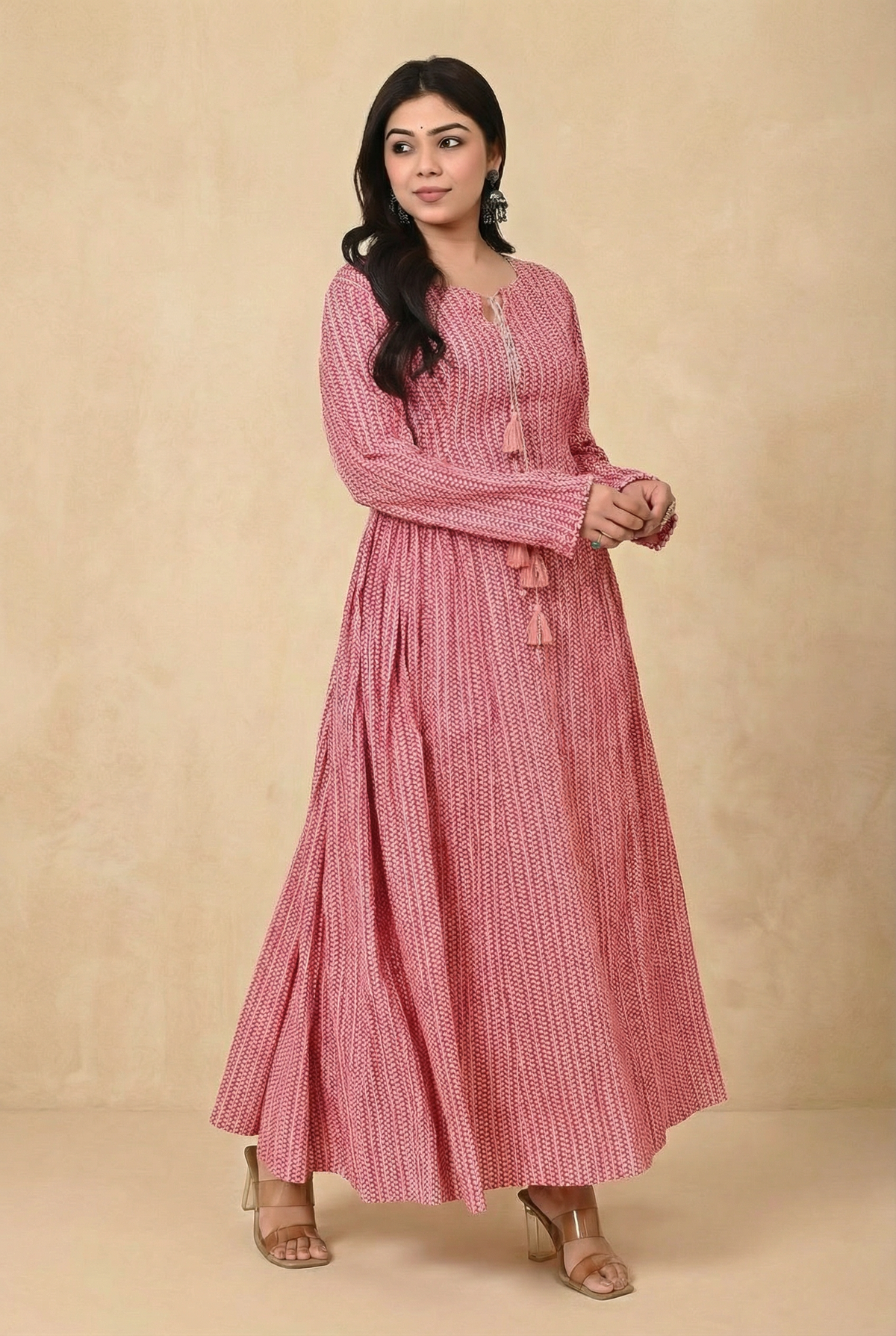
The Laalima kurta set is a good example of the craft used structurally rather than decoratively — soft pintucks cotton carrying a hand-block printed linear pattern in rich red and white, where the print itself creates the elongating effect. The Sweet Pea kurta set takes the classic Sanganeri approach: a soft blush pink cotton base with an all-over hand block-printed floral booti in rose pink and sage green.

Laalima pintucks cotton kurta set with hand-block printed red and white linear pattern
₹3,500 Shop Now
Sweet Pea blush pink cotton co-ord with all-over hand block-printed floral booti
₹4,599 Shop NowThe Wider Printed-Cotton Vocabulary
The visual language of block printing — bootis, jaals, bel borders, floral and animal motifs — carries far beyond hand-printed cloth, into printed cottons at every price. The Taruja kurta set captures the earthy warmth of Indian block prints in printed cotton, with a floral jaal in deep reds and beige against a rich mustard ground. The Kaashi kurta set works a deep maroon base with handblock-style floral motifs in mustard and cream, and the Neelaya kurta set places handblock-style floral bootis in delicate blue on an off-white ground.

Taruja printed cotton kurta set with floral jaal in deep reds and beige on mustard
₹2,500 View ProductThe same vocabulary appears in dresses — the Saira dress in deep maroon with classic ivory floral block prints, and the Sufiyana dress in soft indigo tones, alternating floral and animal motifs reminiscent of ancient block prints.
How to Care for Block Print
- Wash separately the first two or three times. Natural dyes release excess colour early on. This is normal and settles.
- Cold water, mild detergent, no bleach. Bleach and harsh detergents strip natural dyes fast.
- Dry in shade, inside out. Direct Indian sun fades natural dyes noticeably within a season.
- Expect it to soften rather than fade. Good vegetable-dyed block print mellows over years — that's the intended life of the cloth.
- Iron on the reverse while slightly damp for the best finish.
Our full fabric care and laundry guide covers the rest.
Where to See It Being Made
If you're anywhere near Jaipur, an hour at a printing unit in Sanganer or Bagru is worth more than any amount of reading — you will never mistake a screen print for hand block again after watching a printer register a block by eye across a long run. Our Jaipur shopping guide covers how to get there and what else to see.
Printed Cotton, Made by Hand in Jaipur
Our cotton pieces are made to your measurements over 4–5 weeks, in the city where the craft lives. Browse our kurta sets and summer essentials.
Shop Cotton Kurta SetsFrequently Asked Questions
How can you tell if something is really hand block printed?
Look for the joins where one block impression meets the next — a hairline overlap or slight misalignment that machine printing never has. Identical motifs will vary in ink density, and the dye will have penetrated to the reverse of the cloth rather than sitting only on the surface.
What is the difference between Sanganeri and Bagru printing?
Sanganer prints fine, delicate designs on white or pale grounds — small florals, vines and scattered bootis with crisp outlines. Bagru works darker and earthier, and is known for dabu, a mud-resist technique using clay paste to block the dye, in a palette of indigo, madder red and iron black.
Why is my block print uneven in places?
Because a person printed it. Variation in ink density, faint impressions where the block was running dry, and slight misalignment at the repeats are evidence of hand printing rather than defects — they're the record of every individual impression made by hand.
How do you wash hand block printed clothes?
Separately for the first two or three washes, since natural dyes release excess colour early on. Use cold water and a mild detergent, never bleach, and dry inside out in the shade — direct sun fades natural dyes noticeably within a season.
Made to order in 4–5 weeks
Have an event date? We’ll tell you exactly when to order by.
We take a limited number of orders each month — secure your slot early.
WhatsApp me my order-by date + a shortlistNot sure where to start?
Tell us what you're dressing for and we'll help you choose — fabric, fit, colour, and timeline — over WhatsApp or on a video call.
Your Cart
Pieces from this story
All pieces →Not sure which piece, or need it by a date? Book a video consultation Ask us on WhatsApp



Keep reading
The journal →
How to Care for Indian Fabrics: The Complete Laundry & Storage Guide
The complete guide to washing, ironing, and storing Indian fabrics — silk, organza, chiffon, chanderi, Banarasi, and ...
13 March 2026
Where to Shop for Wedding & Festive Clothes in Jaipur: A Complete Guide
A complete Jaipur shopping guide for wedding and festive clothes — Johari Bazaar, Bapu Bazaar, Sanganer and Bagru blo...
21 August 2026
Dabka, Nakshi, Cutdana: A Glossary of Hand Embroidery Materials
What dabka, nakshi, cutdana, resham, marodi, gota and moti actually are — a plain-English glossary of the materials b...
22 August 2026