
AI in Indian Fashion in 2026: What's Actually Happening, and What It Means for Handmade
In 2026, AI arrived in Indian fashion mostly through the shopping app, not the atelier. Myntra says its AI size-and-fit tools now cover about 85% of its eligible apparel and that its "Maya" assistant lets you shop by occasion or mood; Nykaa put its beauty and fashion stores inside ChatGPT in June 2026; Google's virtual try-on reached India in December 2025; and since 20 February 2026, India's IT Rules require platforms to label AI-generated images and video. At the same time, AI images have been used to mislead, most visibly in April 2026, when a Pakistani label posted AI-edited pictures of Alia Bhatt "wearing" its suits. What AI has not done is embroider anything. The needle is still in a karigar's hand, and that changes how you should shop.
1. Shopping by Conversation: Myntra's Maya
Myntra's assistant is older than the current wave. When it launched Maya in September 2023, Apparel Resources reported that it was built on OpenAI's ChatGPT, offered recommendations across 2.3 million styles, and was opened first to 10% of Myntra's users.
In July 2026, Myntra set out a much bigger AI programme, reported by YourStory and InFashion Business (17 July 2026). The figures, all Myntra's own:
- Size and fit: its size-and-fit intelligence covers about 85% of its eligible apparel, explaining a size recommendation in under two seconds, with fit visualisation across different body types rolling out progressively.
- Styling: a "Contextual Styling Suite" suggests real-time look pairings across the catalogue.
- Sellers: onboarding cut from 10–15 days to about 1–2 days, catalogue generation from a day to four hours, and 400–600 dynamic product videos produced a day.
ELLE India (14 August 2026) described Maya as letting customers search by "occasion, mood, destination or styling dilemma" rather than keywords, and reported a "Try On Me" avatar feature as coming next. Sharon Pais, head of Myntra, told ELLE: "AI is not just a layer we have added on top, it sits at the heart of how Myntra operates."
The gain is real for clothes made to a fixed size chart. It matters less for made-to-measure pieces, cut to your own measurements after you order.
2. Nykaa Moves Into ChatGPT
On 16 June 2026, Nykaa announced a multi-year partnership with OpenAI. As MediaNama reported the next day, Nykaa Beauty and Nykaa Fashion are now connected apps inside ChatGPT: ask for, say, a wedding outfit, and ChatGPT draws on Nykaa's catalogue and sends you to Nykaa's app or website to complete the purchase. Its chief product and technology officer, Rajesh Uppalapati, described "search-and-scroll shopping" as transitional, and said the future is "conversational, agentic, and deeply personal".
When a garment is first met as a chatbot's recommendation, a photograph and a few lines of text, the honesty of both matters more, not less.
3. Virtual Try-On Comes to India
Google rolled out its AI virtual apparel try-on in India in early December 2025 (Social Samosa, 3 December 2025). You upload a full-length photo of yourself and see clothes from select listings rendered on your body. According to Social Samosa, the model is trained to recognise body proportions and how fabric drapes, folds and stretches. The categories named at launch were tops, dresses, trousers, jackets and shoes.
A try-on image is a prediction, not a fitting. It can't tell you how heavy a hand-embroidered yoke feels at the end of a long sangeet, or how stiff a tissue sharara is.
4. AI Behind the Picture
The quieter change is in the images themselves. Marketplaces have been building AI image tools for sellers for a while: back in June 2024, Business Today reported that Meesho had a "content-to-image" feature that generates product images from a seller's description. Today a whole category of AI "model photoshoot" apps markets itself to Indian marketplace sellers. We couldn't find reliable figures on how many sellers use them, so we won't guess.
Image-makers are split. In a Hollywood Reporter India feature published yesterday (29 October 2026), photographer Dabboo Ratnani said "the joy and the mood… can never be generated artificially", though he finds AI useful for product work. Photographer Sasha Jairam was blunter about brands passing off AI as real: "Consumers aren't stupid, and deceptive marketing is tacky."
5. When the Picture Lies
In April 2026, the Pakistani label Wajayesha Official posted AI-edited images of Alia Bhatt in its silk salwar suits, with the caption "Even Alia Bhatt likes our pure sheesha silk collection!! Colour can be customised, book your order now" (The Tribune, 21 April 2026). Asked whether she knew, the brand replied, in Hindi, asking followers to make the post viral so she would find out. WION reported on 23 April that the post was removed after the backlash.
It is not only a celebrity problem. In May 2026, an ABC News visual investigation (8 May 2026) found dozens of online retailers, clothing sellers among them, using AI-generated images and videos of fake founders and craftspeople, including videos of people supposedly making the products, to pose as small, struggling businesses. "People can do this at scale, create these images, create these websites, put them up quickly, take them down quickly," Marshini Chetty, a computer scientist at the University of Chicago, told ABC. It was a US investigation, but the trick travels.
India's government has responded at the platform level. Amendments to the IT Rules, notified on 10 February 2026 and in force from 20 February, require social media platforms that allow audio-visual uploads to ask users to declare synthetic content and to make sure it is "clearly labeled and embedded with traceable provenance data" (TechCrunch, 10 February 2026). But the rules cover platforms: a brand's own product page may carry no label, and a missing label proves nothing.
6. What Designers Are Saying
At Lakmé Fashion Week x FDCI on 22 March 2026, the FDCI x Pearl Academy "First Cut" showcase was titled C'est Magnifique fAIntastique. According to InFashion Business (23 March 2026), the student designers used generative AI, in collaboration with OpenAI, to generate visual concepts, develop prints and textures and render sketches, then refined them with human judgement and craft. FDCI chairman Sunil Sethi said the theme reflected "the engaging intersection between tech and humans, which is only going to get more intense in the coming years."
Speaking at the BRICS+ Fashion Summit in Moscow this autumn (reported by Arab News on 30 September and FashionUnited India on 22 October 2026), Kanika Goyal of KGL put the limits plainly: "AI can help with the design process, but it cannot understand how a model feels or whether an embroidery detail is in the right place." And: "Democratising the tools doesn't democratise taste." Sethi, quoted in the same FashionUnited report, said: "The foreign customer appreciates handmade crafts, as they represent true luxury through their timeless quality." For the money behind all this, see India's ethnic wear market in numbers; for younger shoppers, how Gen Z is reinventing Indian wear.
7. The Part AI Can't Do: The Needle
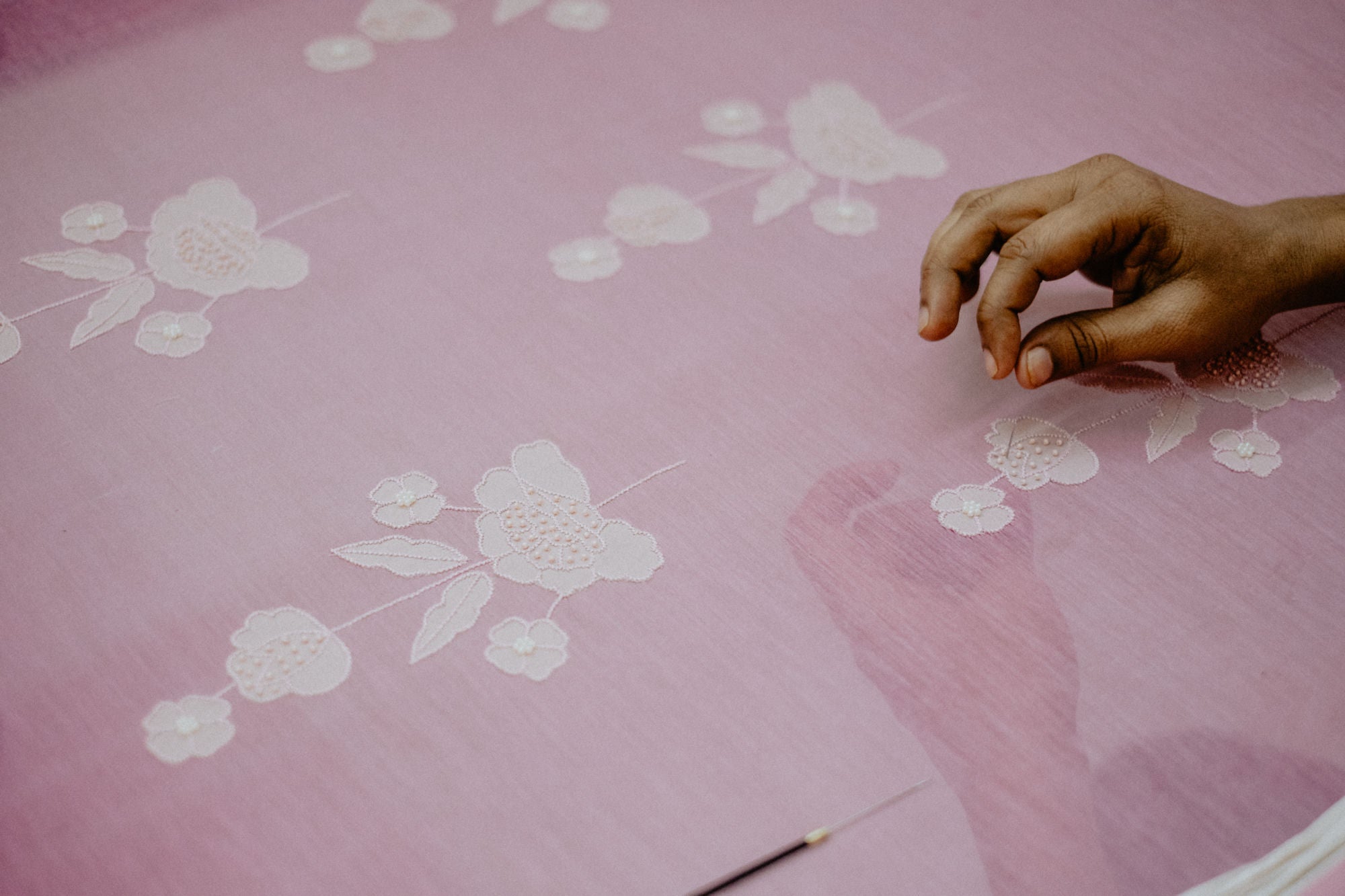
All of the above happens around a garment: finding, sizing, picturing and selling it. None of it puts a stitch into the cloth. Hand embroidery is still done by karigars working thread, metal and beads by hand, and on our pieces that takes weeks. A few examples, in each piece's own description:
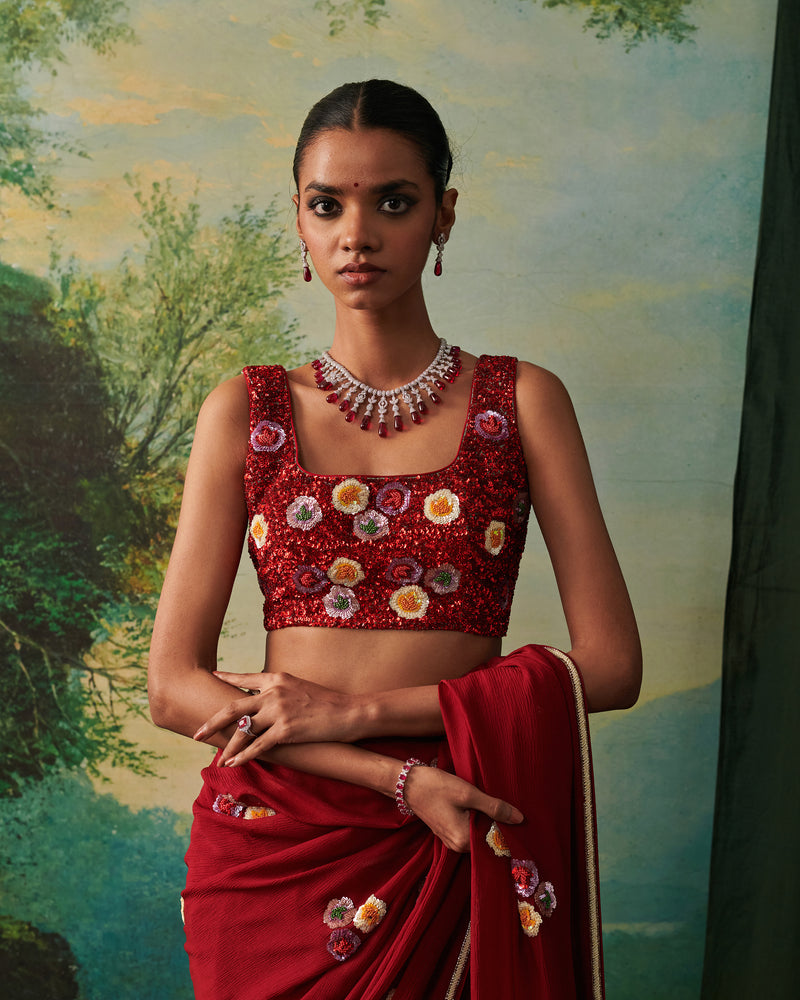
The Utsav blouse (₹25,895) is red silk, hand-embroidered with beadwork and sequins, where every floral motif is "built through a layering of colours, using a needle and thread to almost 'paint' each bloom": marigold yellow, ivory and deep plum across a bed of tonal red sequins, with a deep U-back and tie-up.

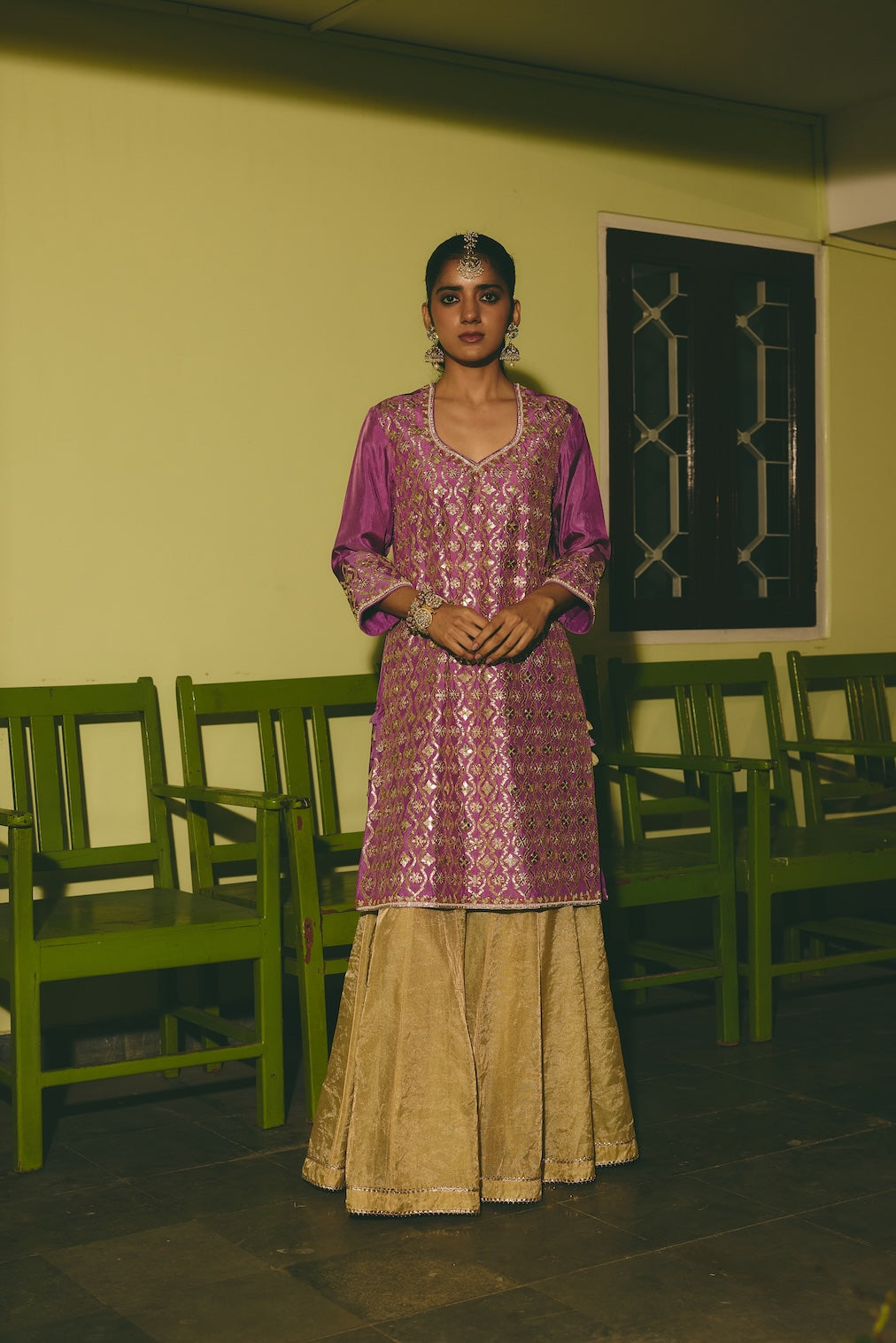
On the Zehan & Aabha sharara set (₹62,250), the purple silk kurta is covered in hand-done gota appliqué: each metallic ribbon is folded and hand-stitched into rhombus and floral shapes to form a trellis, layered with sequins, resham and moti, over a gold tissue sharara. The Eila & Riya kurta set (₹23,500) is ivory and gold silk cotton jacquard whose gold floral and vine embroidery is, in its description's words, "meticulously hand-done", with a zari stripe pant.


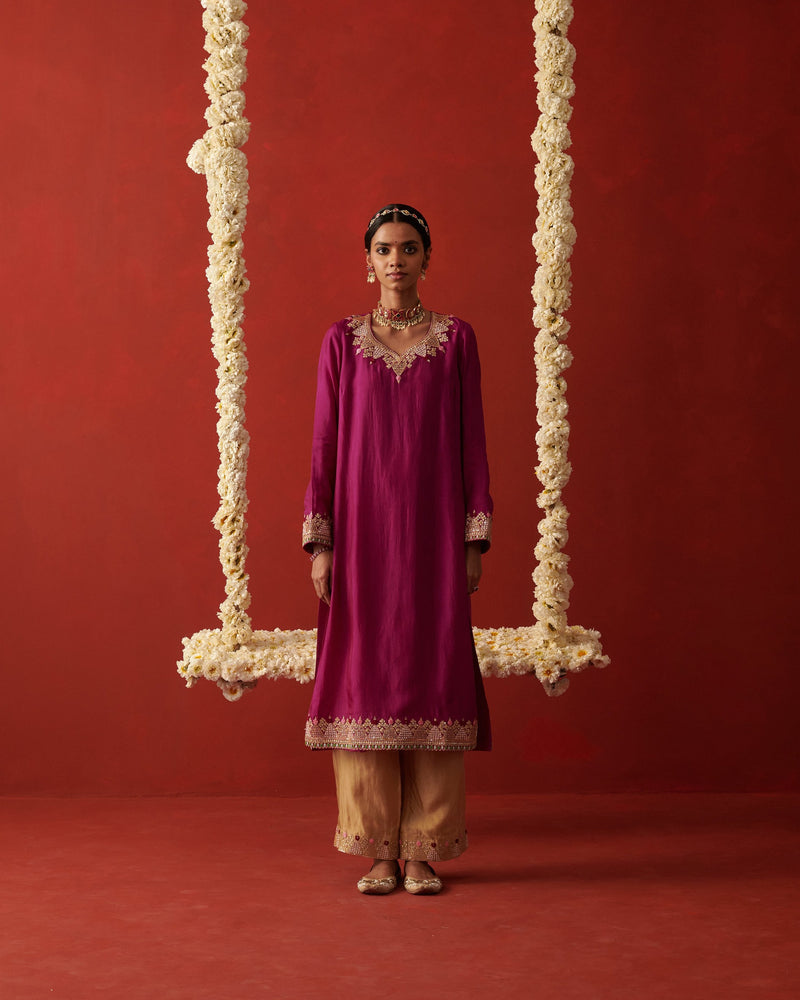
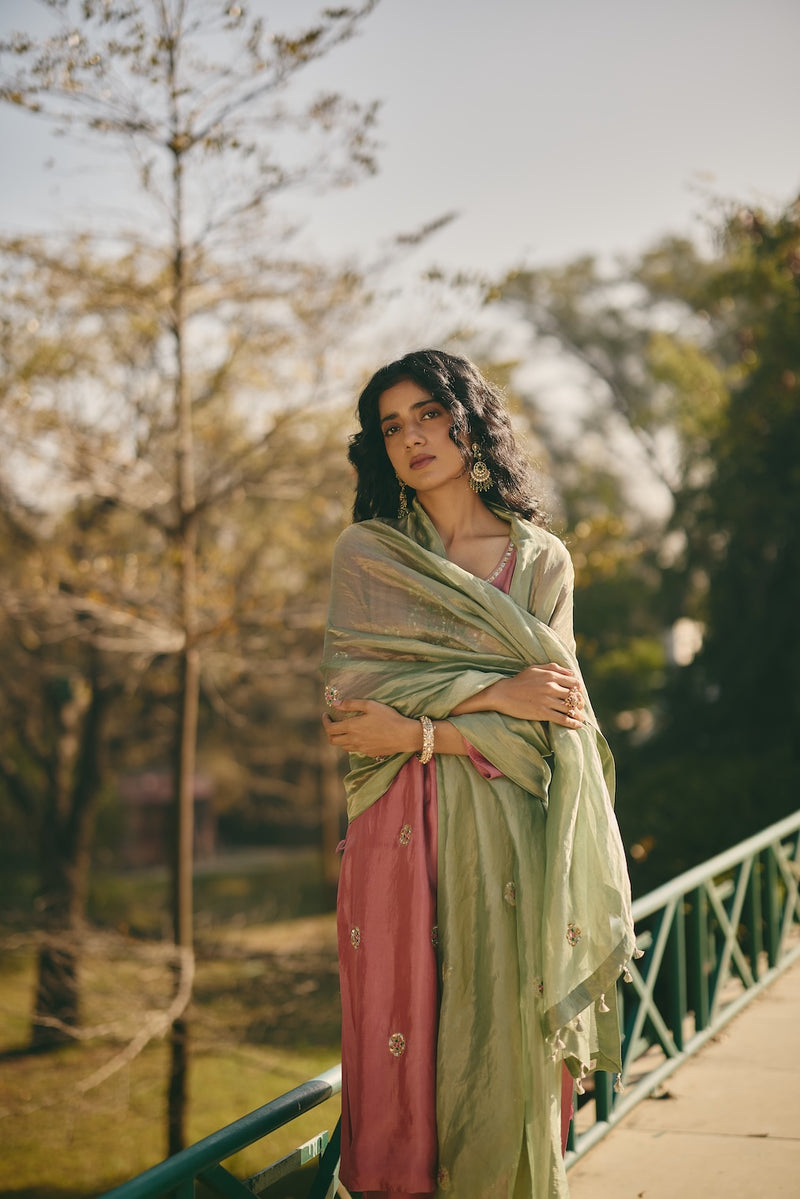
The Shailee & Amira kurta set (₹27,500) is silk, hand-embroidered in marodi, sequins and thread with triangular motifs and floral clusters in soft pinks, gold and greens that echo old temple jaalis. And the Miraal dupatta (₹15,500) is sage-green tissue scattered with circular floral butis hand-embroidered in green, orange and pink resham with mirror work, sequins and beads.

One honest note: we don't weave. We buy handwoven cloth and our karigars embroider it by hand in our Jaipur atelier. More in our blouses and dupattas.
How to Tell a Real Handmade Piece From an AI-Rendered Image
This needs no technical skill, just a seller willing to show you the real thing. Whoever you buy from, ask for:
- An unedited phone video of the actual garment. Not a filtered reel: a plain daylight video, with a movement you ask for, such as turning it over or holding up the hem, so you know it was shot for you.
- The reverse of the embroidery. Ask for a close-up of the back. Handwork has an organic, slightly irregular reverse with small knots; machine work tends to look neat and uniform, often with a backing. Our hand vs machine embroidery guide shows what to look for.
- Consistency across photos. Count motifs, check border widths and look at the neckline in every image. If the pattern changes from one angle to the next, or the embroidery melts into the fabric, be wary.
- A shot only the real piece could give you. The garment beside a note with your name and today's date takes a genuine seller two minutes.
- Celebrity claims, checked at source. "As worn by" should be verifiable on the star's own posts or a stylist's credits.
- A business that exists. A real address, a phone that answers, and a history. ABC's investigation found sites that vanished once bad reviews piled up.
Our side of that: we're happy to send real videos of a piece on WhatsApp before you order, including close-ups of the embroidery. For bigger orders such as bridal, we can also set up a video call. Our virtual consultation guide explains how remote ordering works.
What This Means If You're Ordering Now
AI makes finding clothes faster; it doesn't make handwork faster. Our pieces are made to order in 4–5 weeks, plus 3–7 days of shipping, so anything ordered today, 30 October 2026, reaches you around the first week of December at the earliest. That's too late for Diwali on 8 November and anything else in November, but comfortable for December–February weddings. Express making is sometimes possible, depending on the piece and the month, so ask us on WhatsApp.
Every adult piece is cut to your measurements at no extra charge. Design changes such as a different sleeve or neckline are a separate question, so ask us on WhatsApp what is possible on that design. Shipping is free on domestic orders above ₹30,000.
Want to See the Real Thing?
Message us on WhatsApp with the piece you like and we'll send you real videos of it, close-ups of the handwork included. Everything is hand-embroidered by karigars in our Jaipur atelier, made to order in 4–5 weeks plus 3–7 days of shipping, and cut to your measurements at no extra charge.
Shop AllMore from this series: Ethnic wear market in numbers · Gen Z and Indian wear · The karigars behind the craft · Hand vs machine embroidery
Sources: Apparel Resources (27 September 2023, Maya launch); Business Today (4 June 2024, Meesho); Social Samosa (3 December 2025, Google try-on in India); TechCrunch (10 February 2026, IT Rules amendments); InFashion Business (23 March 2026, Pearl Academy x FDCI); The Tribune (21 April 2026) and WION (23 April 2026, Wajayesha); ABC News (8 May 2026); MediaNama (17 June 2026, Nykaa and OpenAI); YourStory and InFashion Business (17 July 2026, Myntra); ELLE India (14 August 2026, Myntra); Arab News (30 September 2026) and FashionUnited India (22 October 2026, BRICS+ Fashion Summit); The Hollywood Reporter India (29 October 2026). Company figures are the companies' own.
Frequently Asked Questions
How is AI being used in Indian fashion in 2026?
Mostly in shopping and selling: Myntra's Maya assistant and AI size-and-fit tools, Nykaa's stores inside ChatGPT since June 2026, Google's virtual try-on in India since December 2025, and AI catalogue images. Designers are experimenting with it for concepts and prints; hand embroidery is still done by hand.
What is Myntra Maya?
Myntra's conversational shopping assistant, launched in September 2023 on OpenAI's ChatGPT. It lets you search by occasion, mood, destination or styling problem rather than keywords.
How can I tell if a product photo is AI-generated?
Check that motifs, borders and necklines stay consistent across every photo, then ask the seller for an unedited daylight video of the actual garment, a close-up of the reverse of the embroidery, and a photo next to something specific to your request. A genuine seller can send these quickly. A missing AI label is not proof an image is real.
Does India require AI-generated images to be labelled?
On social media platforms, yes. Amendments to the IT Rules notified on 10 February 2026 and in force from 20 February require platforms to ask users to declare synthetic audio-visual content and to label it with traceable provenance data. The rules apply to platforms, so not every product page will carry a label.
Can I see real videos of a Rashika Mittal piece before ordering?
Yes. Message us on WhatsApp and we'll send real videos of the piece, including close-ups of the embroidery. Every piece is hand-embroidered in our Jaipur atelier and made to order in 4–5 weeks plus 3–7 days of shipping.
Made to order in 4–5 weeks
Have an event date? We’ll tell you exactly when to order by.
We take a limited number of orders each month — secure your slot early.
WhatsApp me my order-by date + a shortlistNot sure where to start?
Tell us what you're dressing for and we'll help you choose — fabric, fit, colour, and timeline — over WhatsApp or on a video call.
Your Cart
Pieces from this story
All pieces →Not sure which piece, or need it by a date? Book a video consultation Ask us on WhatsApp


Keep reading
The journal →
India's Ethnic Wear Market in 2026, in Numbers: Market Size, the Big Brands and What Handwork Really Costs
How big India's ethnic wear market is, why estimates differ, the latest Manyavar, ABFRL and Sabyasachi numbers, handl...
30 October 2026
How Gen Z Is Reinventing Indian Wear: Sneaker Sarees, Mum's Almirah and Thrift
How Gen Z is wearing Indian clothes: sarees with sneakers, mum's sarees reworn, thrift, handloom, chatpata dressing a...
27 October 2026
The Hands Behind the Craft: How Karigars Keep Indian Embroidery Alive
Meet the karigars — master artisans who hand-embroider Indian garments using zardozi, gota patti, aari, and resham te...
9 April 2026