
India's Ethnic Wear Market in 2026, in Numbers: Market Size, the Big Brands and What Handwork Really Costs
There is no single official figure for the size of India's ethnic wear market in 2026. The most detailed public estimate comes from Technopak Advisors, in an industry report dated 13 March 2024 and filed with Baazar Style Retail's IPO papers. It put ethnic wear at ₹1,62,898 crore in FY2023, about 30% of all clothing sold in India. Women's ethnic wear made up ₹1,34,547 crore of that, about 67% of what women spend on clothes. Among listed companies, Vedant Fashions (Manyavar, Mohey) reported revenue of ₹301 crore for April–June 2026, up 7.2%, and Aditya Birla Fashion and Retail's ethnic portfolio ₹454 crore, up 4%.
Every figure below comes from a company filing, a credit rating report, a government release or a named consultancy, with its date. Where estimates disagree we say so. If a number only appeared on a "market research" website with no method behind it, we left it out.
How Big Is the Market? Two Estimates, One Picture
Search for the market size and you will find figures from under US$20 billion to over US$100 billion, mostly from report-selling websites that do not show their working. Two named consultancies broadly agree:
| Source (date) | Year | Ethnic wear estimate |
|---|---|---|
| Technopak (13 Mar 2024) | FY2023 | ₹1,62,898 crore (about US$20.4 billion at ₹80 to the dollar) |
| Wazir Advisors (Images BoF, 6 Aug 2024) | FY2023 | US$20.9 billion |
| Technopak projection | FY2027 | ₹3,16,721 crore |
Estimates differ mainly because of definitions (does unstitched suit fabric count? a saree bought at a village haat?), exchange rates, and financial versus calendar years. The biggest unknown is the unorganised market: Technopak estimated that about 74% of ethnic wear in FY2023 was sold by tailors, local shops and weavers selling direct. The two estimates above land within about 3% of each other, which is as close as this kind of number gets.
Treat the forecast with more caution. Technopak's FY2027 figure assumes the market roughly doubles in four years. It was made in March 2024; since then Vedant Fashions, the largest listed player, has reported revenue growth of just 3.5% for FY2026. We found no fresh, sourced estimate for 2026 itself, and we will not dress up an old figure as a new one.
Women Wear Most of It
In FY2023, by Technopak's count, ethnic wear was about 67% of India's ₹2,00,859 crore womenswear market but only about 6% of the ₹2,23,125 crore menswear market. That is ₹1,34,547 crore for women against ₹13,992 crore for men: more than eight rupees in every ten spent on ethnic wear goes on women's clothes.
Sarees are the biggest single piece. Redseer Strategy Consultants, writing on its website in July 2025, put the saree market at US$12 billion in calendar 2024, with 60–65% unbranded and 25–30% held by regional brands. Weddings matter too: in a June 2024 report covered by Business Standard, Jefferies estimated that almost 11% of India's US$84 billion apparel retail market is wedding and celebration wear. And on 14 October 2026, CAIT said it expects Navratri-to-Diwali trade to cross ₹7 lakh crore, with readymade garments about 7% (as reported by Business Today). Its estimate for this winter's wedding season was not out when we wrote this; our wedding season 2026 in numbers covers its past figures.


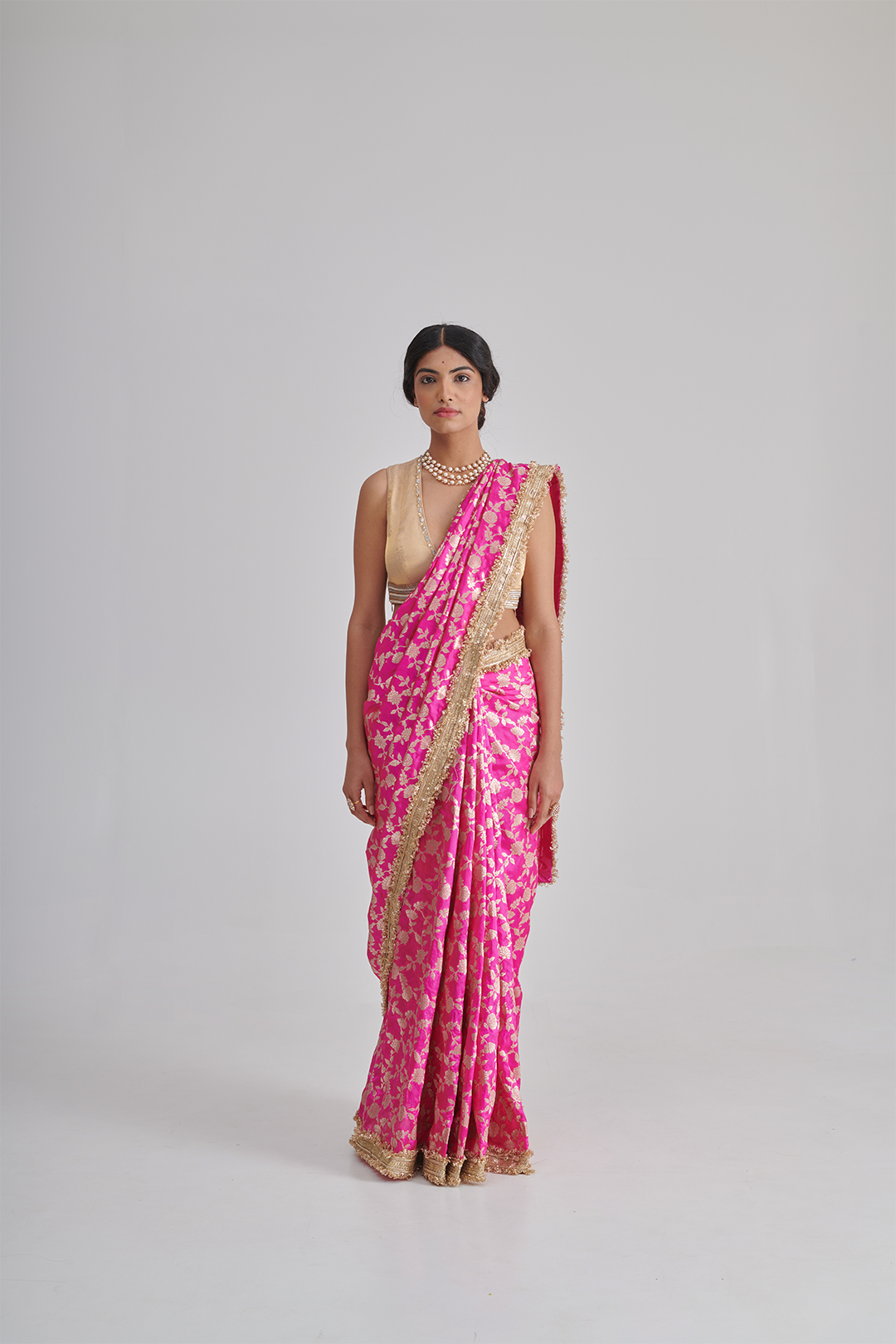
Two of our own sarees sit at the handwoven end of that US$12 billion. Rahi & Amara (₹24,500) is a fuchsia pink Banarasi silk sari with floral motifs woven in gold thread and a gold lace border, with a champagne stripe silk blouse carrying hand-embroidered florals and sequin work. Humrahi & Faridah (₹34,500) is a green silk jacquard sari with an all-over jaal, hand-embroidered floral butas and a densely embroidered palla and border, with a pink mulberry silk brocade blouse. Both fabrics are handwoven. For other places to buy, see our best Banarasi saree brands.
The Listed Players: What the Latest Results Say
Vedant Fashions (Manyavar, Mohey, Twamev). India's largest listed wedding and celebration wear company told analysts on 11 May 2026 that FY2026 sales to customers reached ₹2,008 crore (up 6.1%), on revenue of ₹1,436 crore (up 3.5%). For April–June 2026, reported on 27 July, revenue was ₹301.4 crore (up 7.2%) and profit after tax ₹80.6 crore (up 14.7%). On Mohey, its women's brand, chief revenue officer Vedant Modi said the company has "doubled down on our non-bridal categories, such as stitched suits, sarees, crop-top lehengas". He said "November to March will be a fantastic period". July–September results were not out when we wrote this.
Aditya Birla Fashion and Retail (ABFRL). ABFRL owns 51% of Shantanu & Nikhil (bought 2019), 51% of Sabyasachi (January 2021, ₹398 crore) and 51% of Tarun Tahiliani's company (33.5% in 2021, raised in July 2024), plus TCNS, Jaypore and Tasva. On its 10 August 2026 call it said the ethnic portfolio earns more than ₹2,200 crore a year. April–June revenue was ₹454 crore, up 4%, which it put down to fewer wedding dates and Adhik Maas; the designer-led brands grew at a high single-digit rate, and Tasva grew 35%. Managing director Ashish Dikshit expects the ethnic segment to grow "20% plus" for the full year, with the second half "significantly higher".
Sabyasachi. CareEdge Ratings' release of 23 June 2026 shows Sabyasachi Calcutta LLP's revenue rising from ₹487.31 crore in FY2025 to ₹645.37 crore in FY2026, about 32.5%, "driven by increased jewellery and apparel sales".
Reliance Brands. Reliance's designer deals date from 2021–22: 40% of Manish Malhotra's company (October 2021), 52% of Ritu Kumar's through Reliance Retail Ventures (October 2021), 60:40 joint ventures for Anamika Khanna's AK|OK (December 2021) and Rahul Mishra's ready-to-wear business (January 2022), and 51% of Abu Jani Sandeep Khosla (April 2022). Reliance does not report these labels' revenue separately.
Taneira (Titan). In Titan's July–September 2026 business update, as reported by Business Standard on 7 October, its saree and ethnic wear brand grew at a high single digit.
Read together: scale brands are growing in single digits, wedding dates swing every quarter, and the fastest growth is at luxury houses and newer occasion-wear labels. On online sales, Technopak estimated that 20.5% of all apparel and accessories sold in FY2023 was sold online. We could not find a reliable figure for ethnic wear alone, or for D2C labels, so we have left those out.
The Luxury End: Bridal Pays the Bills
Speaking to CNN for a report published on 30 July 2026, during India Couture Week, Masaba Gupta said: "Occasion wear has contributed to 80 percent of my business since 2018." Manish Malhotra said bridal couture "gives us a strong foundation to continue investing in our ateliers, our artisans, and the preservation of craftsmanship". CNN also cited Bain & Company's projection that luxury spending in India will reach €25–30 billion by 2030. Yet CareEdge's Sabyasachi report calls the luxury designer apparel industry "highly fragmented with many unorganised players". Buyers see exactly that: a few famous names, mostly part-owned by Aditya Birla or Reliance, and a long tail of independent ateliers. Our India Couture Week 2026 recap and best Indian designer brands roundup cover both ends.
The People Behind the Cloth
The Fourth All India Handloom Census, 2019–20, counted 35.22 lakh handloom workers: 26.74 lakh weavers and 8.48 lakh allied workers. A Ministry of Textiles release of 16 March 2022 said 72.29% of them were women. The 2009–10 census had counted 43.31 lakh, so on these numbers the workforce shrank by about a fifth in a decade, though NCAER researchers cautioned in April 2025 that surveys count handloom workers in very different ways. No fifth census has been published. We could not find a reliable national count of embroidery karigars (zardozi, aari, gota and marodi workers), so we will not quote one. Our piece on the karigars behind Indian embroidery is about the people rather than the numbers.

Alfia & Ruhab (₹33,750) shows what handloom means in practice. The kurta and pant are in pure handwoven Banarasi silk with gold floral bootis, with sequins, cutdana and thread work by hand at the neckline, cuffs and back. Because each weave is made on a traditional loom, the exact fabric is not always available again: recreating it means resetting the loom and weaving the whole length afresh. If it is unavailable when you order, we offer the two closest alternatives. One honest note: we do not weave. We buy handwoven cloth and embroider it in our Jaipur atelier. More in our piece on khadi and handloom.
What the Numbers Mean if You Are Buying
1. Consolidation is real, but most of the market is still small. Two groups own large stakes in many of India's best-known designer labels. Yet about three-quarters of ethnic wear is still sold outside organised retail, by Technopak's estimate, and Redseer puts 60–65% of sarees as unbranded. Buying from a small atelier is not a niche choice; it is how most of the market works.
2. Handwork costs what it does because it takes time. Vedant Fashions reported 34 days of inventory for the year to June 2026, on a business built on scale and replenishment. CareEdge notes that Sabyasachi's products "take over one month to be manufactured", and that it carried 252 days of inventory at 31 March 2026. A karigar can only work so many stitches in a day, which is why our pieces take 4–5 weeks. Our hand vs machine embroidery guide shows how to tell the difference, and our bridal lehenga price guide explains where the money goes.

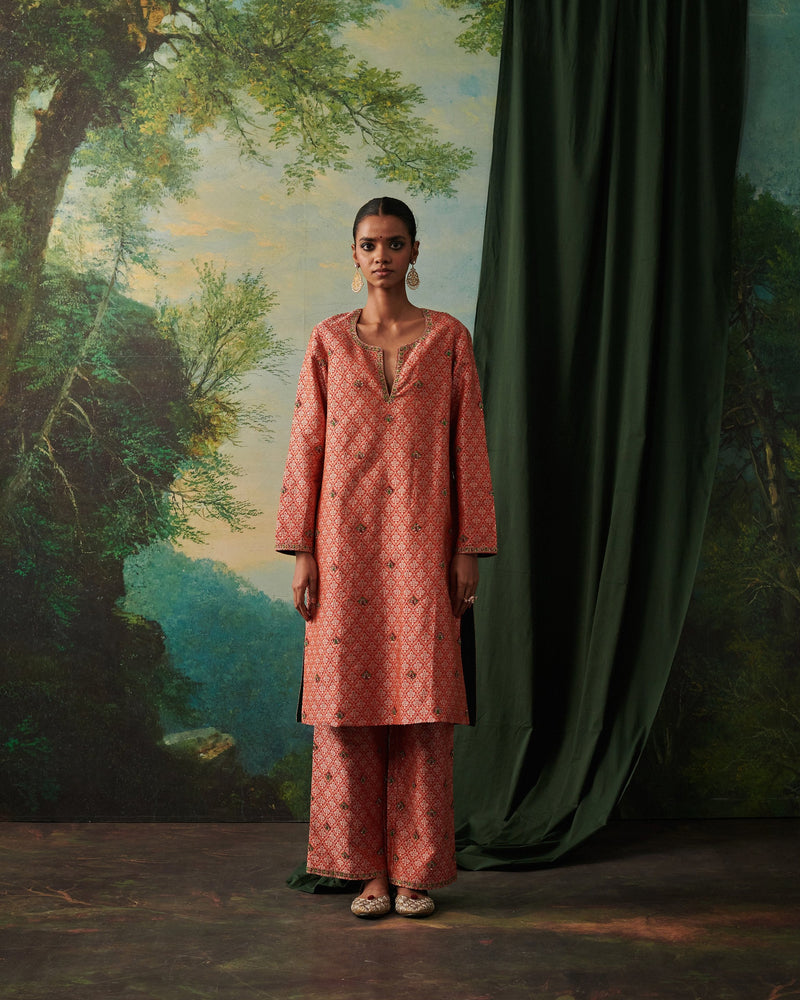
Ferozaan & Gulraaz (₹1,25,000) shows what that time buys: a floor-grazing fuchsia anarkali in Chanderi silk with aari and marodi vines running vertically, a hem hand-embroidered with gota appliqué, nakshi and sequins in floral medallions, and moti along the neckline and sleeve edges. Ruhaniyat & Amber (₹37,500) is a terracotta Chanderi kurta with a waistcoat-style overlay in fabric appliqué and gota, a bodice hand-embroidered in a marodi and aari trellis, and an ochre Chanderi churidaar. Naveli & Ruhi (₹38,500) is a dusty rose Chanderi kurta and pant with hand-embroidered aari, zardozi, sequin and thread detailing.


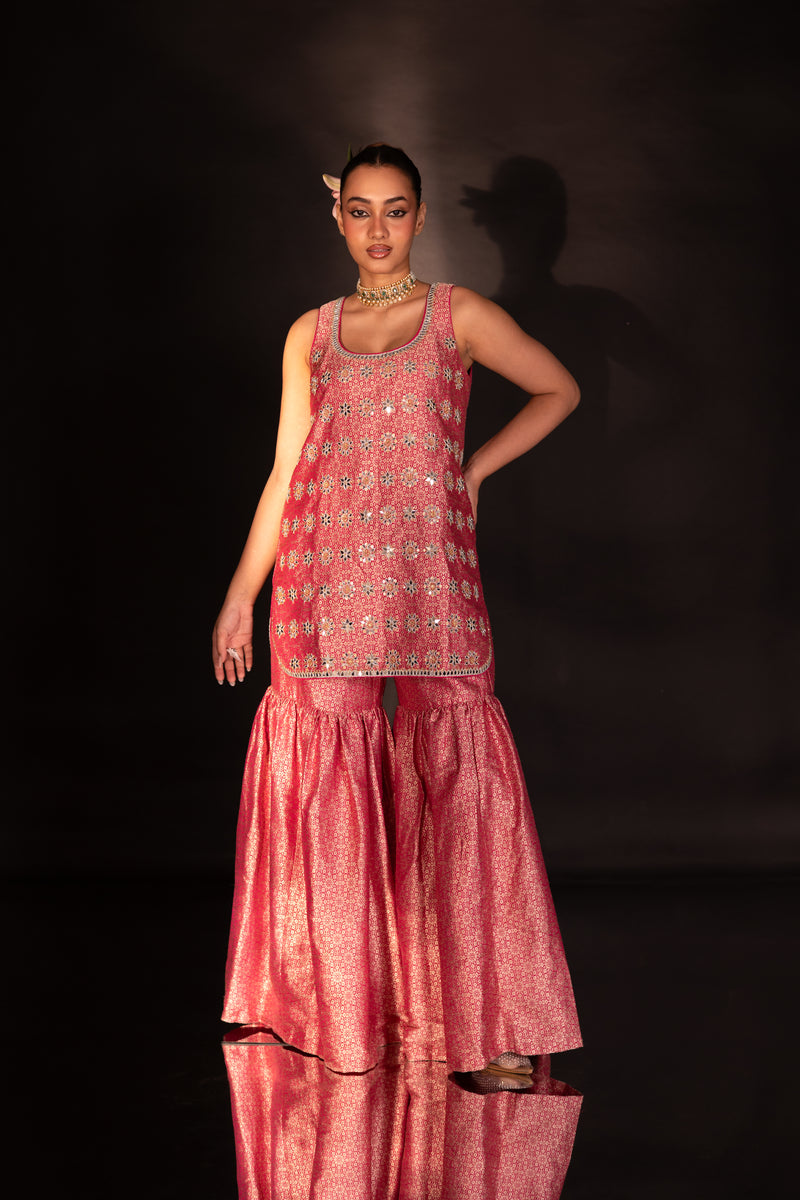
3. Celebration wear is moving beyond the bride. When the biggest wedding-wear company pushes stitched suits and sarees, and Masaba Gupta tells CNN she designs for "people around the wedding", that is a signal about guests and families. Jazabah & Saiyan (₹27,500) is a deep red Chanderi kurta and pant with gota patti, marodi, resham and bead work along the neckline, sleeves and hem. Rangmahal Sharara Set (₹32,500) pairs a sleeveless kurta with mirror work across the front and a voluminous sharara, both in berry pink pure handwoven brocade. Browse our kurta sets and sharara sets.
4. Timing matters more than totals. Wedding dates move every company's quarter, and karigars are busiest exactly when you want your outfit. An order placed today, 30 October, reaches you around the first week of December at the earliest: too late for Diwali on Sunday 8 November or anything in November, but comfortably in time for December to February weddings. We make lehengas, sarees, sharara sets, kurta sets, anarkalis, blouses and dupattas; we do not make menswear, jewellery or velvet. Design changes such as a different sleeve are not automatic, so ask us on WhatsApp what is possible on the design you like.
Sources: Technopak Advisors industry report, 13 March 2024 (Baazar Style Retail IPO documents); Wazir Advisors in Images Business of Fashion, 6 August 2024; Redseer, 7 July 2025; Jefferies via Business Standard, 24 June 2024; CAIT via Business Today, 14 October 2026; Vedant Fashions earnings calls, 11 May and 27 July 2026; ABFRL earnings call, 10 August 2026; CareEdge Ratings, 23 June 2026; Reliance Brands release, 31 January 2022, and Business Standard and BusinessToday, 2021–22; Business Standard, 7 October 2026; CNN, 30 July 2026; Ministry of Textiles (PIB), 16 March 2022; NCAER, 30 April 2025.
Handmade, at Atelier Scale
Every piece is hand-embroidered to order by karigars in our Jaipur atelier in 4–5 weeks, plus 3–7 days for shipping, and cut to your measurements at no extra charge. Orders placed now arrive from the first week of December, in good time for December to February celebrations. Express making is sometimes possible, depending on the piece and the month, so ask on WhatsApp. Shipping is free on domestic orders above ₹30,000.
Browse the CollectionMore from this series: India Couture Week 2026 · Indian designers in Paris · AI in Indian fashion · Wedding season in numbers
Frequently Asked Questions
How big is the Indian ethnic wear market?
Technopak, in a report dated 13 March 2024, estimated it at ₹1,62,898 crore in FY2023, about 30% of India's apparel market. Wazir Advisors put the same year at US$20.9 billion. No sourced estimate for 2026 itself had been published by October 2026.
What share of women's clothing in India is ethnic wear?
About 67% in FY2023, according to Technopak: ₹1,34,547 crore of a ₹2,00,859 crore womenswear market. For men it was about 6%.
Why do ethnic wear market estimates differ so much?
They use different definitions, years and exchange rates, and about 74% of the market (by Technopak's estimate) is unorganised, so it has to be modelled rather than counted. Many figures online come from websites that do not publish their method.
How are Manyavar's parent company and ABFRL's ethnic brands doing in 2026?
For April–June 2026, Vedant Fashions reported revenue of ₹301.4 crore, up 7.2%, and ABFRL's ethnic portfolio ₹454 crore, up 4%. ABFRL expects its ethnic segment to grow more than 20% for the full year.
How many handloom weavers are there in India?
The Fourth All India Handloom Census, 2019–20, counted 35.22 lakh handloom workers, including 26.74 lakh weavers; 72.29% of all workers were women. The 2009–10 census had counted 43.31 lakh.
Made to order in 4–5 weeks
Have an event date? We’ll tell you exactly when to order by.
We take a limited number of orders each month — secure your slot early.
WhatsApp me my order-by date + a shortlistNot sure where to start?
Tell us what you're dressing for and we'll help you choose — fabric, fit, colour, and timeline — over WhatsApp or on a video call.
Your Cart
Pieces from this story
All pieces →Not sure which piece, or need it by a date? Book a video consultation Ask us on WhatsApp




Keep reading
The journal →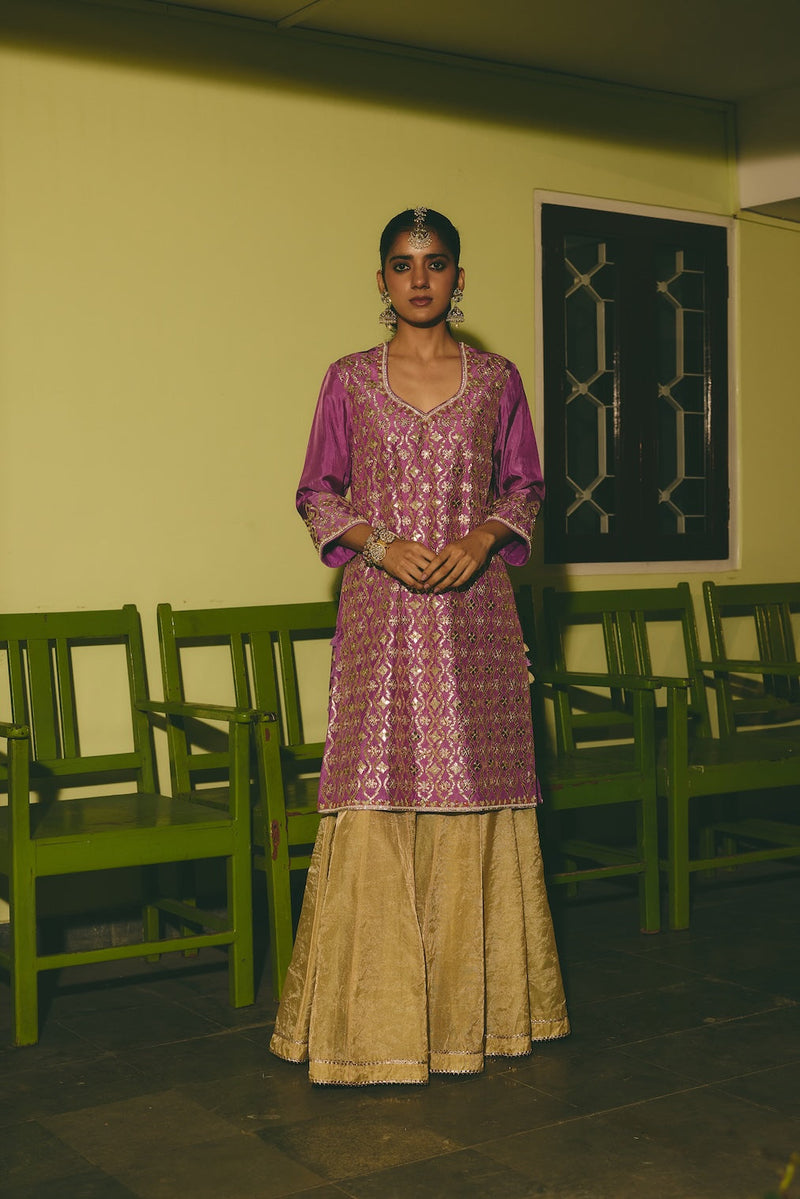
The 2026 Indian Wedding Season in Numbers: Dates, Spending and What the Data Actually Says
CAIT's latest wedding season estimate, where the money goes, the Nov–Dec 2026 muhurat dates, destination wedding data...
27 October 2026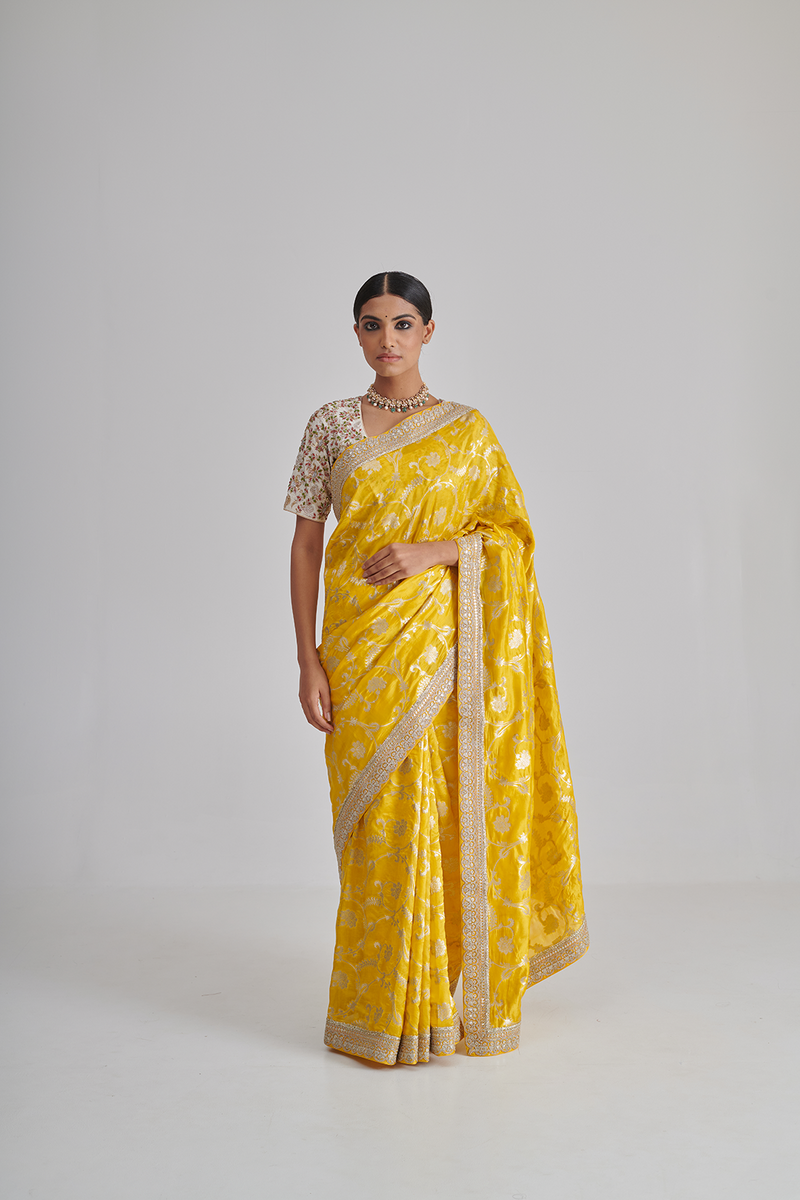
Best Banarasi Saree Brands in India 2026: Where to Buy an Authentic Banarasi
The best Banarasi saree brands in India 2026 — Varanasi weavers, heritage labels and designers, how to spot a real ha...
14 September 2026
India Couture Week 2026 Highlights: Every Show, From Hyderabad to the Devi Finale
India Couture Week 2026 recap: Anamika Khanna in Hyderabad, Masaba's first bridal line, Rohit Bal's Dastkar, Rahul Mi...
30 October 2026