

What to Wear to a Konkani Wedding: A Guest's Guide to GSB, Saraswat and Goan Hindu Weddings
The short answer: a Konkani wedding is a daytime affair. The rituals start early in the morning, the main ceremony runs through the late morning, and it ends with a long, seated lunch. So dress the way you would for a formal morning puja that turns into a feast. A silk sari or a silk kurta set, real colour, some gold at the border, fresh jasmine if you like it, and something you can sit comfortably in for two hours. Leave heavy evening glamour for the reception, if there is one.
Konkani is the language of Goa and of communities who have lived along the western coast for centuries. The Gaud Saraswat Brahmins (GSB), the Chitrapur Saraswats, the Daivajnas and several other Konkani-speaking Hindu communities now live in Goa, in Karwar, Kundapur, Udupi and Mangaluru on the Karnataka coast, and as far south as Kochi. Many families moved down the coast from Goa in the sixteenth century, when the Portuguese Inquisition made life there dangerous for Hindus, and took their customs with them. That is why a GSB wedding in Mangaluru and a Saraswat wedding in Goa feel related but are not identical. Rituals also differ between families, so treat this guide as a map rather than a rulebook, and ask the hosts which functions you are invited to.
One distinction first. This guide covers the community's own Hindu wedding. It is not about a destination wedding on a Goa beach, which has its own logic (see our Goa beach wedding guide). Konkani Catholic weddings in Goa and Mangaluru follow a church service and are different again. Our Christian wedding guest guide is the better starting point for those.
An Honest Note Before We Start
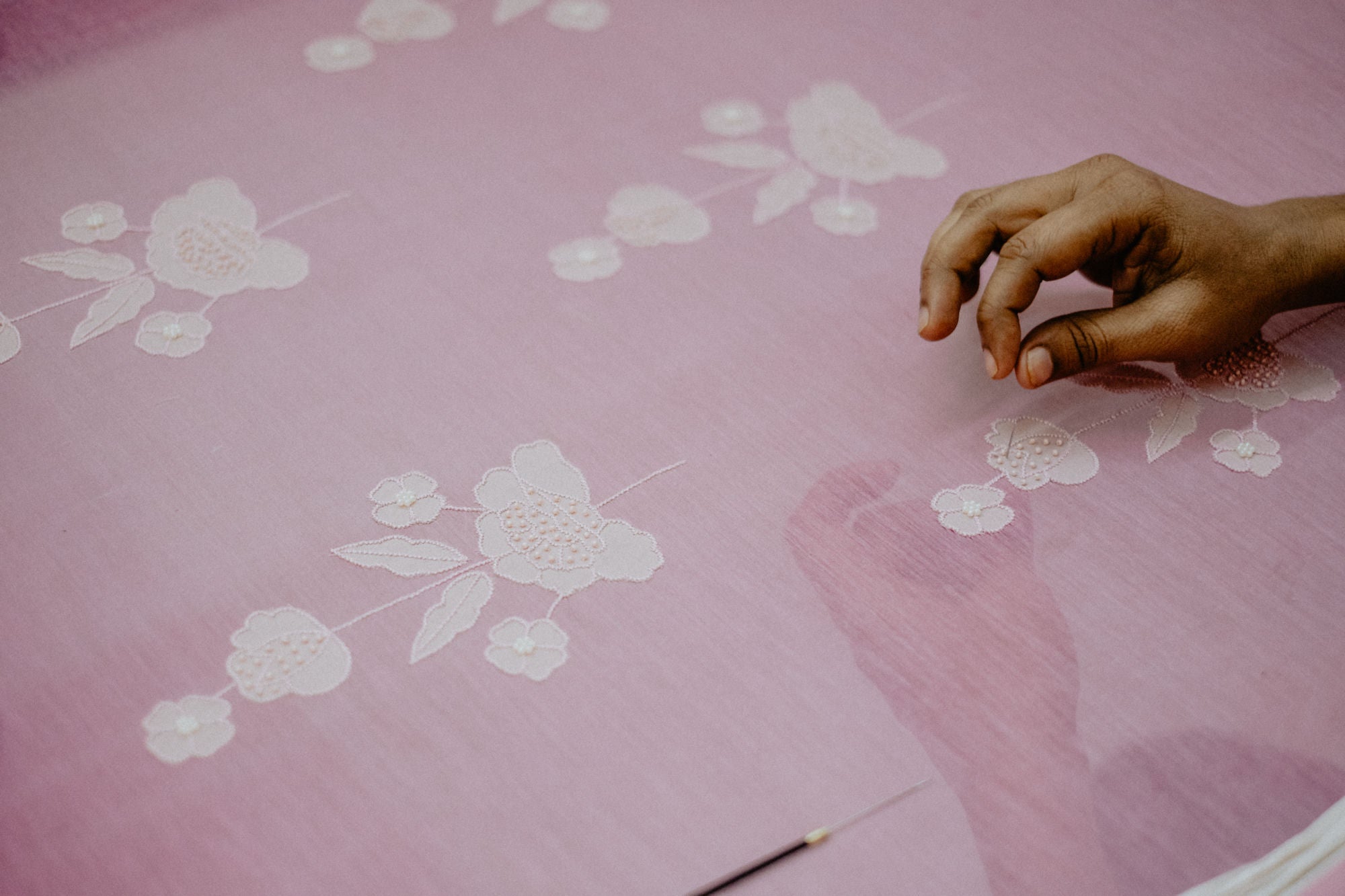
The Konkani bride wears a nine-yard sari, the navvari, draped in the tucked kaccha style that lets her move freely through the fire rituals. First-hand accounts describe her wearing a white cloth over it in place of the pallu. The sari, the gold, the black-bead dharemani and the coral-and-gold kasithali belong to her family and her community. We do not make nine-yard saris, and we do not weave silk. What we make is hand embroidery (zardozi, aari, marodi, gota patti, sequins and cutdana) on silk, Chanderi and handwoven Banarasi cloth that we buy. Everything below is chosen for guests.
Nandi and Devkarya: The Family Prayers
A Konkani wedding begins with prayers well before the wedding day. Among Mangalorean GSB families, the nandi is performed around ten days before the wedding to invoke the blessings of the gods and ancestors. Many Goan and Saraswat families also speak of a devkarya a day or two before, when each household worships its kuladevata, the family deity, and remembers its departed elders. Many GSB families trace their kuladevata to temples in Goa, such as Shantadurga, Mangeshi or Mahalasa, so the family may visit the temple or send offerings there.
These are small, at home and very much family occasions. If you are invited, dress as you would for a household puja: covered, soft in colour and not showy. The Faiza & Rida set (₹19,500) is a soft gold silk kurta with a gentle V neckline and three-quarter sleeves. Gota and thread work in rose and coral trails along the neckline, sleeves and hem, and the matching silk pant has a broad embroidered border. It is quiet enough for a prayer room and still clearly festive.
The Bangle Ceremony: Chuddo and Kankan
Glass bangles are one of the most recognisable moments of a coastal Konkani wedding. In Goa, the chuddo ceremony traditionally happens at the bride's maternal uncle's house. A local bangle seller slides a set of glass bangles onto her wrists, and one Goan wedding source describes them as green glass bangles with gold bangles set in between. Accounts differ by region: green is most often mentioned in North Goa, with red, yellow and green further south. In Mangalorean GSB homes, the bangle ritual is often called kankan. A bangle vendor comes to the house, the bride wears her bangles for several days, and the women of the family are often given bangles too.
So come ready to hold out your wrists, and wear sleeves that push up easily. Green is a lovely nod to the day. The Jhoomar & Shafaq set (₹22,500) is a green silk kurta embroidered by hand with marodi, sequins and bead work in floral vines and jaal motifs, with a vivid pink neckline and cuffs and a matching pant. If you already own a kurta you love, a green dupatta does the same job for much less. The Falak dupatta (₹6,500) is deep forest-green organza silk with a soft zari border and bootis in sequins, cutdana and thread.

Haldi (and Why It Is Not the Ros)
The Konkani haldi, called halad in Goa, is a turmeric paste applied to the bride and groom by married women of the family, usually in their own homes. It was traditionally small and domestic. Many families now make it a bigger daytime party with mehendi afterwards.
You may have heard of the ros (or roce), where the couple is drenched in coconut milk. That is chiefly a Goan Catholic ceremony. At a Hindu Konkani wedding, expect turmeric, not coconut milk. Either way, wear something light that you do not mind getting marked. The Ziya & Saaz set (₹14,500) is a bright sunflower-yellow silk kurta with side-slit sleeves and a hand-embroidered floral bel along the hem in marodi, sequins and thread work in pink and wine, over a matching churidaar. For something lighter still, the Afreen & Maahi set (₹15,875) is sunshine-yellow Chanderi with flowers hand-embroidered in cutdana and beads. Our haldi dress code guide covers alternatives to yellow.
Phool Muddi: The Evening Before
In Mangalorean GSB weddings, the evening before the wedding brings the phool muddi. The two families are formally welcomed and gifted, and the bride wears Mangaluru jasmine in her hair. Afterwards she changes into a sari given by her mother-in-law. Many families now pair it with a sangeet, so it is the most relaxed and most colourful event of the wedding.
This is the one evening where a flared silhouette makes sense. The Ruhma & Rabaab set (₹32,500) is a coral-pink silk kurta with marodi, resham and sequins in paisley and floral vines at the neckline, cuffs and scalloped hem, over a flared, fluid sharara. The Roshni & Nazreen set (₹31,800) pairs a mustard-yellow Chanderi kurta, covered in an aari trellis of vines with pink resham flowers, sequins, nakshi and moti, with a soft blossom-pink sharara. Tuck a string of jasmine into your hair; our gajra guide shows how to pin it so it lasts.


The Wedding Morning: Dress in Silk
The wedding day starts early, often around seven. In Mangalorean GSB weddings the first rituals are domestic ones. In the udida muhurat, the bride grinds urad dal on a stone grinder, and in the ghade udda she draws water with the women of the family. Then comes the kashi yatra, in which the groom pretends to leave for a life of study in Kashi and the bride's father persuades him to stay. At the mandap puja, the bride's mother ties the dharemani around her neck. The couple exchange garlands once a cloth held between them is lowered at the muhurat. The kanyadaan, which some families call the dhare, follows, and the groom ties the kasithali. In the laja homa, the bride's brothers and maternal uncles pass rice to the couple to offer into the fire. Then they take the seven steps of the saptapadi. The order varies from family to family, and between Mangaluru, Goa and Kochi.
For a guest, that means several hours in the daytime, much of it seated, with the most important moments late in the morning. Silk is the safe choice. Rich, clear colours photograph beautifully in daylight, and a gold border reads as festive without shouting. The Humrahi & Faridah sari (₹34,500) is green silk jacquard with an all-over jaal, hand-embroidered floral butas and a densely embroidered palla and border. It comes with a contrasting pink mulberry-silk brocade blouse, a green-and-pink pairing that sits naturally among coastal silks.
If you prefer Banarasi, the Rahi & Amara sari (₹24,500) is fuchsia-pink Banarasi silk with floral motifs woven in gold thread and a detailed gold lace border, paired with a champagne-stripe silk blouse embroidered with florals and sequins. The Phalgun & Myra sari (₹27,500) is yellow Banarasi silk with florals woven in silver thread and a rich lace border, with an ivory blouse scattered with embroidered floral butis. To be accurate, the Banarasi is handwoven cloth that we buy; our work is the blouse and its embroidery. If you are weighing Banarasi against a southern silk, our Banarasi vs Kanjivaram guide explains the difference.


The Lunch: Dress for Sitting Down
After the rituals, guests are served lunch, traditionally on a banana leaf. In many families the hosts eat last, after making sure every guest has been served. Depending on the venue, you may sit at long tables or on the floor. Either way, you will be seated for a while, and you will be eating with your hands in a sari you probably love. Pin your pallu securely before you sit down. If you would rather not manage a drape at all, a brocade kurta set is just as correct. The Rasiya & Misri set (₹12,500) is coral-pink mulberry brocade silk with floral motifs hand-embroidered in gold thread at the V neck, sleeves and hem, with matching embroidered pants. It has the sheen of silk without the yardage.

Weather on the Konkan Coast
Goa, Karwar, Udupi and Mangaluru are humid for most of the year, and the monsoon arrives heavily from June to September. Most weddings avoid those months, but even a winter morning on the coast is warm by north Indian standards. Pure silk and Chanderi breathe far better than synthetics, and a lighter sari will serve you better than a heavily embellished lehenga. Our guides to lightweight wedding outfits and monsoon wedding fabrics go into more detail.
Five Things Worth Knowing
- It is a morning wedding. Plan your hair, drape and travel for an early start, and do not wear evening sparkle to a 10am muhurat.
- Silk and gold are the vocabulary. Clear colours such as greens, pinks, yellows and oranges with a gold border are always right.
- Avoid all-black and all-white. Ivory with gold or colour is fine, but head-to-toe black or plain white is still avoided by many families at a wedding.
- Jasmine is welcome. Fresh flowers in the hair are part of the coastal look, for guests as well as the bride.
- Ask about the reception. If there is an evening reception, that is where the lehenga or the heavy embroidery belongs.
Going to a Konkani Wedding This Season?
Every piece is made to order in our Jaipur atelier in 4–5 weeks, plus 3–7 days for shipping, and cut to your measurements at no extra charge. Message us on WhatsApp with the wedding date and the functions you are attending, and we will tell you honestly what can reach you in time.
Browse the CollectionMore regional guides: Kannada · Tamil · Kodava · Kerala · Maharashtrian · South Indian
Frequently Asked Questions
What should a guest wear to a Konkani wedding?
A silk sari or a silk kurta set in a clear colour with some gold. Konkani weddings are daytime events with a morning muhurat and a seated lunch, so choose something covered, breathable and comfortable to sit in, and keep heavier evening wear for a reception.
What does a Konkani bride wear?
Traditionally a nine-yard navvari sari draped in the tucked kaccha style, with a white cloth worn in place of the pallu, plenty of gold, glass bangles, and jasmine in her hair. Her mother ties the black-bead dharemani during the ceremony, and the groom ties the kasithali. After the rituals she changes into a sari given by her mother-in-law.
What is the chuddo ceremony?
A Goan pre-wedding bangle ceremony, traditionally held at the bride's maternal uncle's house, where a bangle seller puts a set of glass bangles on the bride's wrists. Green is the colour most often described, especially in North Goa. Mangalorean Konkani families hold a similar bangle ritual, often called kankan.
Is the ros ceremony part of a Konkani Hindu wedding?
The ros or roce, in which the couple is anointed with coconut milk, is chiefly a Goan Catholic ceremony. Konkani Hindu families hold a haldi (halad) instead, with turmeric paste applied by married women of the family, usually at home.
Can I wear a lehenga to a Konkani wedding?
To the evening functions or a reception, yes. For the wedding morning, a sari or kurta set is more in keeping with a daytime, ritual-heavy ceremony and much easier to sit in through the rituals and the banana-leaf lunch.
Made to order in 4–5 weeks
Have an event date? We’ll tell you exactly when to order by.
We take a limited number of orders each month — secure your slot early.
WhatsApp me my order-by date + a shortlistNot sure where to start?
Tell us what you're dressing for and we'll help you choose — fabric, fit, colour, and timeline — over WhatsApp or on a video call.
Your Cart
Pieces from this story
All pieces →Not sure which piece, or need it by a date? Book a video consultation Ask us on WhatsApp




Keep reading
The journal →
Goa & Beach Wedding Outfit Ideas: What to Wear on Sand
What to wear to a beach wedding in Goa — humidity, sand, sea breeze and a sunset ceremony, with fabrics that survive ...
12 September 2026
What to Wear to an Indian Christian Wedding: A Guest's Guide
What to wear to an Indian Christian wedding as a guest — church ceremony etiquette, colours to avoid, and elegant sar...
8 July 2026
Haldi Ceremony Dress Code: Yellow Outfits, Alternatives & What to Wear
Complete haldi dress code guide - best yellow shades, alternative colours, outfit ideas for bride, sisters & guests, ...
19 May 2026