
Best Pearl Work Ethnic Wear Brands in India 2026: Designers, Hyderabad's Pearl Trade & How to Judge Moti
The short answer: for couture pearl work, the labels most associated with it are Seema Gujral and Tarun Tahiliani in Delhi, and Jayanti Reddy and Anushree Reddy in Hyderabad, India's old city of pearls. For loose pearls and pearl jewellery to wear with an outfit, Hyderabad's Pathergatti Road near Charminar is the historic market. And for moti used as a soft accent on chanderi and silk kurta sets, shararas, a dupatta and an anarkali, cut to your measurements, a made-to-order atelier like ours in Jaipur is a third route. Before you pay for any of them, it helps to know what the "pearl" actually is, so this guide covers that too.
Pearl work, or moti ka kaam, is the gentlest of India's embellishments: where zari flashes, a pearl glows. It is also where the label tells you least, because "pearl" can mean anything from a cultured freshwater pearl to a coated plastic bead.
First: What Moti Work Actually Is
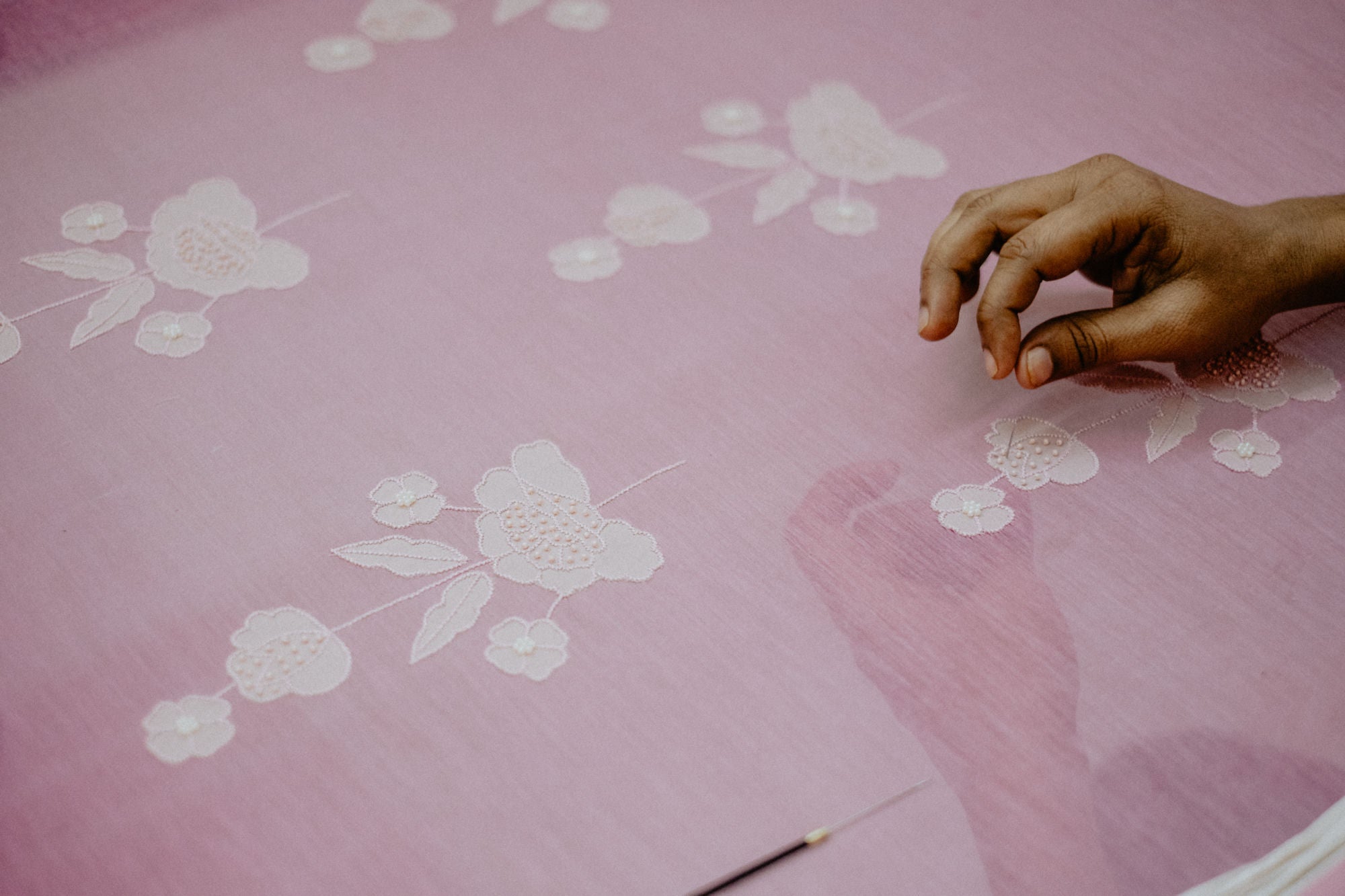
Moti simply means pearl. In embroidery, pearl beads are stitched on by hand, one at a time or couched in rows, usually alongside other techniques rather than alone: tracing a neckline, edging a vine, forming the heart of a flower, or finishing a medallion of zardozi or gota. Our moti work guide explains the stitching and the classic placements, and the hand embroidery materials glossary sets moti beside dabka, nakshi, cutdana and the rest. Moti is technically bead work, so the cutdana and bead embroidery guide is the natural companion: cutdana gives sparkle, moti gives softness, and the best pieces layer the two deliberately.
Natural, cultured, shell, glass and plastic
Five quite different things are all sold as "pearl":
- Natural pearls. Formed in a mollusc without human help. The famous Basra pearls of the Persian Gulf were natural, and today they are essentially antique.
- Cultured pearls. Real pearls, built up of nacre by a living oyster or mussel, but with the process started by a farmer. Freshwater cultured pearls, most of them from China, are now the most widely available real pearls in the world.
- Shell pearls. An imitation: a round bead of genuine shell coated, layer by layer, with a finish containing ground mother-of-pearl. Very uniform, very even in colour, and fairly hard-wearing.
- Glass pearls. A glass bead with a pearlescent coating. Heavier in the hand, and the coating can chip around the drill hole.
- Plastic (ABS, acrylic or resin) pearls. The lightest of all, which is exactly why they are used on garments: they do not drag fine fabric out of shape.
None of the imitations is dishonest in itself. The honest working assumption is this: unless a label tells you otherwise in writing, the moti on an embroidered outfit is a pearl bead, not a natural or cultured pearl. The question to ask is the same one you would ask of zardozi wire or gota ribbon: does the description match the price?
Designer Labels Known for Pearl Work
Seema Gujral
Founded in 1994 and based in the Delhi NCR, the label specialises in bridal and evening wear richly embellished with sequins, pearls, crystals and metallic thread. Pearl-embroidered lehengas, pearl tassels and scalloped edges recur across its collections, often in ivory, champagne and gold.
Best for: Glamorous, pearl-heavy bridal and cocktail lehengas.
Tarun Tahiliani
The Delhi couturier's tulle lehengas and sculpted corsets regularly combine pearls with crystals, sequins and resham, in his signature draped silhouettes. The pearls here are part of a wider sparkle rather than the whole story.
Best for: Contemporary, draped couture with pearl and crystal embellishment.
Jayanti Reddy
A Hyderabad label founded in 2012, known for an understated style built on handwoven textiles and hand embroidery. Her India Couture Week 2024 collection, Evocative Nawabi Canvas, drew on the Nizams and Nawabs of her city, and reviews described heavy zardozi adorned with beads and pearls, and tiny pearls at the edges of garments.
Best for: Hyderabadi heritage looks where pearls finish the zardozi.
Anushree Reddy
Another Hyderabad designer, whose label launched in 2010 and is known for pastel palettes, florals and delicate zardozi. Pearl embroidery appears across her lehengas, from ivory net sets to red bridal pieces in raw silk with cutdana and pearls.
Best for: Pastel mehendi and sangeet lehengas with soft pearl detailing.
Hyderabad: India's City of Pearls
If you are buying pearls to wear with an outfit, Hyderabad is where the trade lives. Its pearl history runs back to the Qutb Shahi kings and the Nizams who followed them; Basra pearls from the Persian Gulf were prized for their hardness, and the seventh Nizam, Mir Osman Ali Khan, is said to have kept sacks of pearls in his palace basements. When the Gulf's natural pearl beds declined in the twentieth century, much of the trade stayed and consolidated in Hyderabad. The village of Chandanpet, just outside the city, became known for pearl drilling.
Pathergatti Road and Laad Bazaar, near Charminar
Pathergatti Road, a short walk from Charminar, is lined with pearl shops; Laad Bazaar, the bangle street running off Charminar, sells pearls and pearl jewellery too. Know that the raw pearls are now imported (freshwater pearls largely from China, and Akoya and South Sea pearls from elsewhere) and then drilled, graded and strung in the city: "Hyderabad pearls" describes the craftsmanship, not where the pearl grew. Ask whether a strand is natural, cultured or imitation, and get the answer on the bill. If you are going for a wedding, our Hyderabadi wedding guest guide covers what to wear to each function.
Best for: Pearl jewellery and loose pearls, comparing in person.
Pernia's Pop-Up Shop, Aashni + Co and Aza
All three carry pearl-embroidered pieces from many labels (Pernia's and Aashni + Co stock us too, in full disclosure). Read the embellishment line: "pearl" and "faux pearl" are not the same thing.
Best for: Comparing many designers in one sitting.
Moti Work from Our Jaipur Atelier
We will state our interest plainly, and our limits. We are a small made-to-order label in Vaishali Nagar, Jaipur, and we use moti as an accent, never as all-over pearl encrustation: a traced neckline, the heart of a rose, a row along a vine, layered with gota, aari, marodi, nakshi, resham and sequins. We do not make a pearl-covered bridal lehenga or a pearl saree, and we do not make jewellery. Our product descriptions name moti as a technique but do not state the bead material, and we do not claim natural or cultured pearls, so if the material matters to you, ask us on WhatsApp before you order. Every piece below names moti or pearl work in its description; currently eight of our adult pieces do.
The neckline trace: an anarkali
The most classic use of pearls is a disciplined row following an edge, and the Ferozaan anarkali with Gulraaz pant (₹1,25,000) is our clearest example. A floor-grazing fuchsia chanderi silk anarkali with aari and marodi vines and a hem of gota appliqué, nakshi and sequin medallions, it is finished with a row of dainty moti tracing the neckline and sleeve edges, framing the work rather than competing with it. More in the anarkali collection.

Pearls as flowers: kurta sets
Moti can also become the motif itself. On the Ruhaniyat kurta with Amber churidaar (₹37,500), terracotta chanderi with a waistcoat-style overlay of fabric appliqué and gota, marodi and aari build a dense trellis of vines while rose-like motifs are worked in nakshi and moti, over an ochre chanderi churidaar with embroidered ankle borders. The Rangtara kurta with Jamuni pant (₹37,500) is rose pink silk with circular fabric appliqué medallions and floral sprays in resham and aari, enriched with sequins, fine nakshi and delicate moti, over a deep plum silk pant. See the full kurta collection.


Shararas: moti for movement
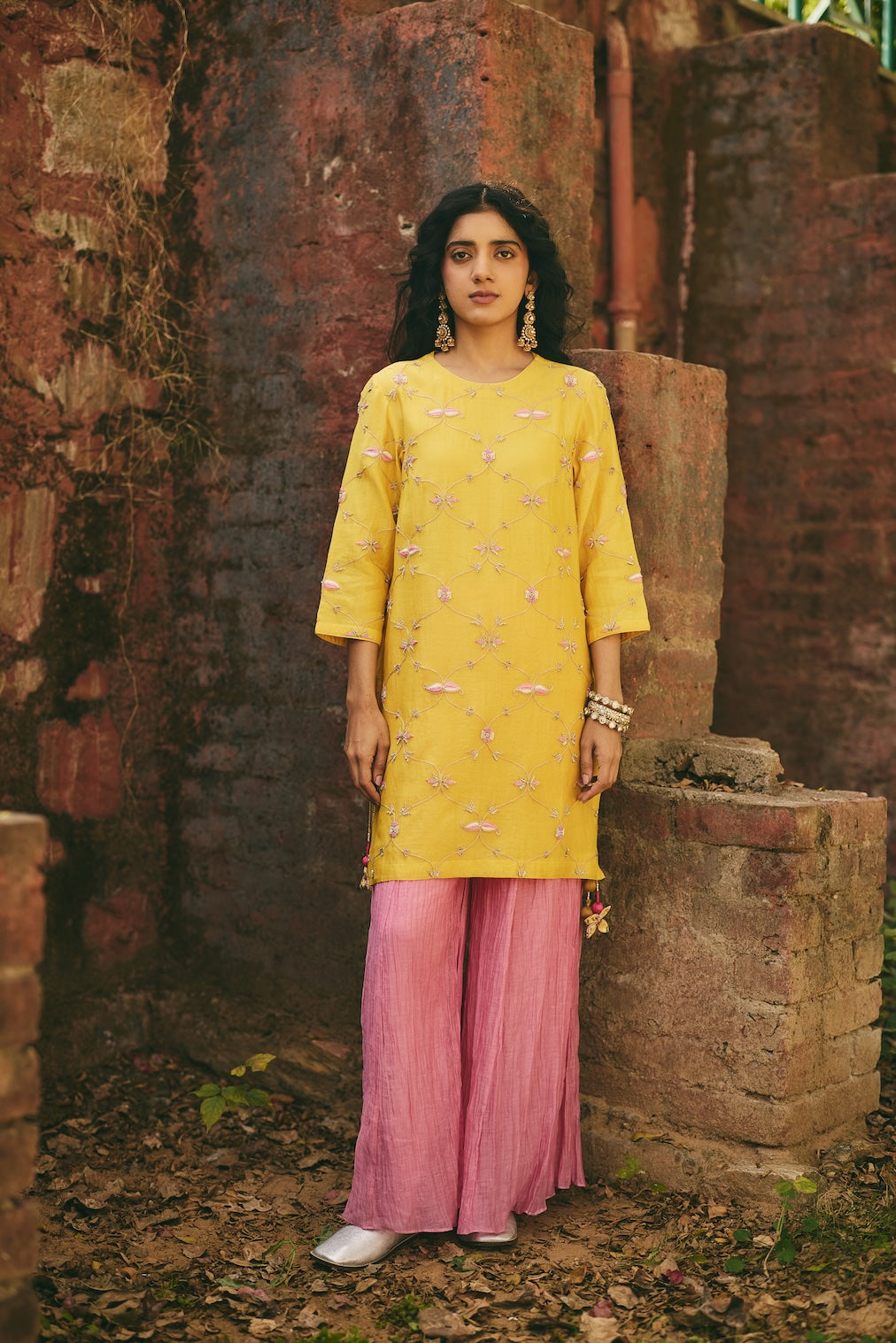
The Roshni kurta with Nazreen sharara (₹31,800) is the daytime one: mustard yellow chanderi with an all-over trellis of aari vines in golden thread and pink resham blossoms, enriched with tiny sequins, nakshi and delicate moti, over a soft pink chanderi sharara. The Gulrukh kurta with Leher sharara (₹37,500) is sleeveless pink chanderi with sequin and cutdana floral sprays and a row of medallions at the hem, while aari and moti give the bodice a jewel-like texture; the striped mustard and purple chanderi sharara ends in a wide lappa border. The dupatta in its photographs is not included.
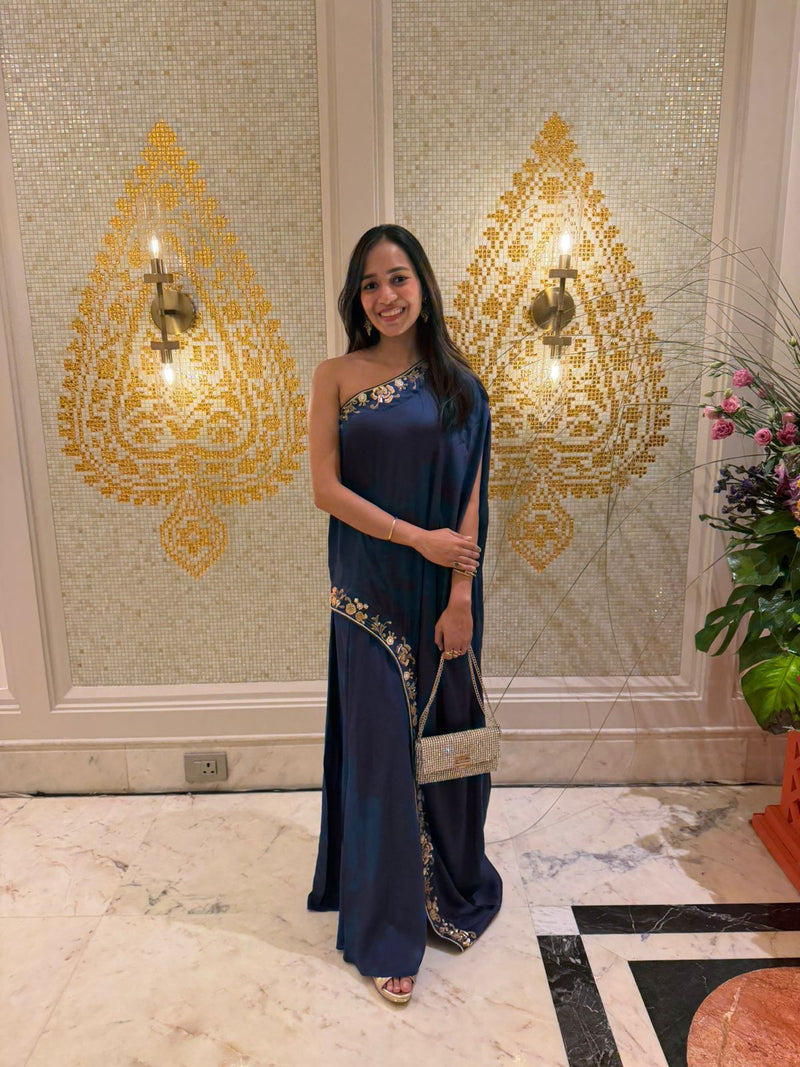
At the heavier end, the Zehan kurta with Aabha sharara (₹62,250) is majestic purple silk with a dense trellis of hand-folded gota appliqué, layered with sequins, resham and delicate moti along the borders and vines, over a gold tissue sharara. And the Shabnam kaftan and sharara (₹21,750) is the modern take: navy satin with a one-shoulder, saree-inspired drape, its neckline and curved edge embroidered in sequins, cutdana, moti and aari in gold and ivory. More in the sharara collection.


A dupatta: the easy way in
A pearl-worked dupatta brings moti to a plain suit. The Gulrooh dupatta (₹18,500) is deep plum chanderi with circular fabric appliqué medallions and floral sprays in resham and aari, enriched with sequins, fine nakshi and delicate moti. Its embroidery mirrors the Rangtara kurta's. More in the dupatta collection.
How to Judge Pearl Work Before You Pay
- Ask what the pearls are, in writing. Natural, cultured, shell, glass or plastic. Any honest seller can answer, and the price should follow the answer.
- Look at the drill holes. On coated imitation pearls, the coating often chips or flakes around the hole, showing the glass or plastic core. Fine on a garment; just not at a real-pearl price.
- Look at the lustre and uniformity. Real pearls have a soft sheen that shifts with the light and small surface irregularities; imitations tend to be perfectly uniform with a flatter shine.
- The tooth test is for loose pearls, not your outfit. Rubbed gently against a tooth, real nacre feels slightly gritty and an imitation smooth, though good imitations can fool it.
- Check the stitching. Each hand-sewn pearl should be anchored individually or firmly couched, with no glue and no long loose threads behind it. Our hand vs machine embroidery guide shows what to look for on the reverse.
- Match weight to the cloth. Glass pearls are noticeably heavier than plastic ones, and dense pearl work on fine net or chiffon can drag it over time. On light cloth, pearls work best as edges, flower centres and borders.
Caring for Pearl Work
Pearls dislike exactly what an Indian wedding is full of. The Gemological Institute of America lists hair spray, perfume, cosmetics and even perspiration among the things that can damage pearls, warns that high heat can discolour or crack them, and says they should never go in a steam cleaner. Those warnings are written for real pearls, but they are sensible for coated pearl beads too. So: perfume and hairspray before you dress; dry clean only, telling the cleaner about the pearls; press on the reverse over a cloth on low heat, never steaming directly over the moti. Store folded in muslin with soft cloth between the folds, and check anchor threads each season. Our guide to storing and caring for Indian clothes goes into more detail.
A timing note: made to order over 4–5 weeks plus 3–7 days shipping, anything ordered today arrives around the third or fourth week of November at the earliest. That is after Diwali (8 November), but in good time for the winter wedding season.
Moti Work, Made to Order in Jaipur
An anarkali, kurta sets, shararas, a kaftan set and a dupatta with hand-sewn moti, each made in our Jaipur atelier over 4–5 weeks, with custom measurements at no extra charge. Message us on WhatsApp with your dates and we will tell you honestly what is possible. Browse everything we make.
Shop the CollectionMore craft and brand guides: best zardozi work brands · best gota patti brands · cutdana and bead embroidery
Frequently Asked Questions
Which designers are best known for pearl work in India?
Seema Gujral is the name most associated with pearl-embroidered bridal and evening lehengas, and Tarun Tahiliani regularly combines pearls with crystals and sequins. In Hyderabad, Jayanti Reddy and Anushree Reddy both use pearl detailing. For moti as an accent on kurta sets, shararas and dupattas made to your measurements, made-to-order ateliers, ours in Jaipur included, are another route.
Are the pearls on embroidered Indian outfits real?
Usually not, unless the seller says so in writing. Embroidery moti is generally a pearl bead, shell, glass or plastic, chosen because it is light and consistent. That is perfectly legitimate; just ask what the pearls are and make sure the price matches the answer.
What is the difference between freshwater, shell and glass pearls?
A freshwater pearl is a real cultured pearl, built up of nacre by a living mussel. A shell pearl is an imitation: a shell bead coated with a finish containing ground mother-of-pearl, very uniform in size and colour. A glass pearl is a coated glass bead, heavier in the hand, whose coating can chip around the drill hole.
Why is Hyderabad called the City of Pearls?
Its pearl trade goes back to the Qutb Shahi kings and the Nizams, who prized Basra pearls from the Persian Gulf. Today raw pearls are imported, largely freshwater pearls from China, and drilled, graded and strung in the city, with Pathergatti Road near Charminar the best-known market.
How should I care for clothes with pearl work?
Put on perfume and hairspray before you dress, dry clean only and tell the cleaner about the pearls, and never steam directly over the moti, since heat can damage pearls and their coatings. Store folded in muslin with soft cloth between the folds, and check anchor threads each season.
Made to order in 4–5 weeks
Have an event date? We’ll tell you exactly when to order by.
We take a limited number of orders each month — secure your slot early.
WhatsApp me my order-by date + a shortlistNot sure where to start?
Tell us what you're dressing for and we'll help you choose — fabric, fit, colour, and timeline — over WhatsApp or on a video call.
Your Cart
Pieces from this story
All pieces →Not sure which piece, or need it by a date? Book a video consultation Ask us on WhatsApp



Keep reading
The journal →
Moti Work: The Pearl Embroidery Guide
A guide to moti (pearl) embroidery — how pearl work is done by hand, how it layers with gota, nakshi and resham, and ...
9 July 2026
Dabka, Nakshi, Cutdana: A Glossary of Hand Embroidery Materials
What dabka, nakshi, cutdana, resham, marodi, gota and moti actually are — a plain-English glossary of the materials b...
22 August 2026
Cutdana & Bead Embroidery in Indian Fashion: A Complete Guide
Guide to cutdana and bead embroidery in Indian fashion. Types of beadwork, styling tips, and care instructions for cu...
21 April 2026