

What to Wear to a Kutchi Wedding: A Guest's Guide from Bhuj to Mumbai and Mombasa
For a Kutchi wedding, wear festive colour in a silk kurta set, a sharara or a lehenga, and leave two things to the bride: the white-and-red panetar and the red bandhani gharchola. A touch of mirror work or bandhani is a lovely nod to Kutch's own crafts. In Kutch itself, dress for warm days and cool nights, and carry a shawl. If the family is Jain, leave leather shoes and bags at home. Beyond that, the right outfit depends on which Kutchi community you are celebrating with, so read on.
Kutch is the large, arid district in the far west of Gujarat, between the Rann and the Arabian Sea, and its people carry their own language, Kutchi, wherever they go. Many families left for Bombay, East Africa and beyond, so a Kutchi wedding might be near Bhuj, in Mumbai or in Mombasa. Customs vary between communities and families, so treat this as a map rather than a rulebook, and ask your host when in doubt.
First: Which Kutchi Wedding?
Kutchi is a regional identity, not a single community. Most Kutchis are Hindu, with Jain and Muslim minorities. You might be invited by:
- Kutchi Lohanas, Bhanushalis or Leva Patels. These are Hindu families whose weddings follow the broad Gujarati pattern, from mameru and pithi to the pheras. Many Kutchi Leva Patels follow the Swaminarayan tradition, and the community has a large presence in Kenya.
- Kutchi Visa Oswals. A Jain community whose ancestors settled in Kutch centuries ago. Many families moved to Bombay from the late nineteenth century onwards, so a Kutchi Jain wedding in Mumbai is common. Jain weddings follow their own vidhi, and they have one rule every guest should know (see below).
- Kutchi Memons and Khojas. These are Muslim communities with Kutchi roots and a long history in Mumbai and East Africa. Here the ceremony is a nikah, and modest dress matters most.
- Rabari, Ahir and other pastoral communities of rural Kutch. Their own dress and embroidery are among the most famous textiles in India. At a village wedding, dress simply and let their clothes be the spectacle.
If the wedding is broadly Gujarati Hindu, our Gujarati wedding guest guide covers the garba night, the ceremony and the reception in more depth. This one focuses on what is particular to Kutch.
An Honest Note on What We Make
We do not make panetars, gharcholas or bandhani sarees, and we do not weave. We buy handwoven cloth and embroider it by hand in our Jaipur atelier. Kutch embroidery belongs to the communities who made it famous, including the Rabari, Ahir and Jat traditions and the Mochi embroiderers who once worked for the court at Bhuj. If you want a piece made by them, buy it from the Kutch organisations that work directly with the craftswomen: Shrujan, Kala Raksha, Qasab and Khamir. Our mirror work brands guide and aari work brands guide explain where they are and what each does. What we make are hand-embroidered kurta sets, anarkalis, lehengas, blouses and dupattas. Some of them use mirror work and bandhani cloth, and everything below is described as it actually is.
The Bride's Two Sarees
In Hindu and Jain Gujarati weddings, Kutchi ones included, the bride traditionally wears two sarees, and a guest should steer clear of both looks.
The panetar is white or off-white with a red border, often richly worked. It is traditionally a gift from her maternal uncle, and she usually wears it for the first part of the wedding. The gharchola (or gharcholu) is the traditional wedding odhani of Gujarati Hindu and Jain brides. It is a red or maroon silk, usually checked in zari and filled with bandhani dots, and it traditionally comes from the groom's side as a sign of welcome. She often changes into it for the later rituals. In Kutch's Muslim families, the bandhani tradition has its own bridal piece too: the chandrokhani, a large red-and-black odhani with a moon-like medallion at its centre.
For a guest, the lesson is simple: avoid an outfit that reads as white with a red border, or as a red bandhani drape. Everything else in the colour box is open.
Mameru: The Maternal Uncle's Day
The mameru (also called mosalu) is one of the warmest functions of a Gujarati wedding. In the days before the wedding, often the day before, the bride's maternal uncle, her mama, arrives with his family. He brings trays of gifts: traditionally the panetar, jewellery, ivory or white bangles, sweets and dry fruit. Dress festive but not formal.
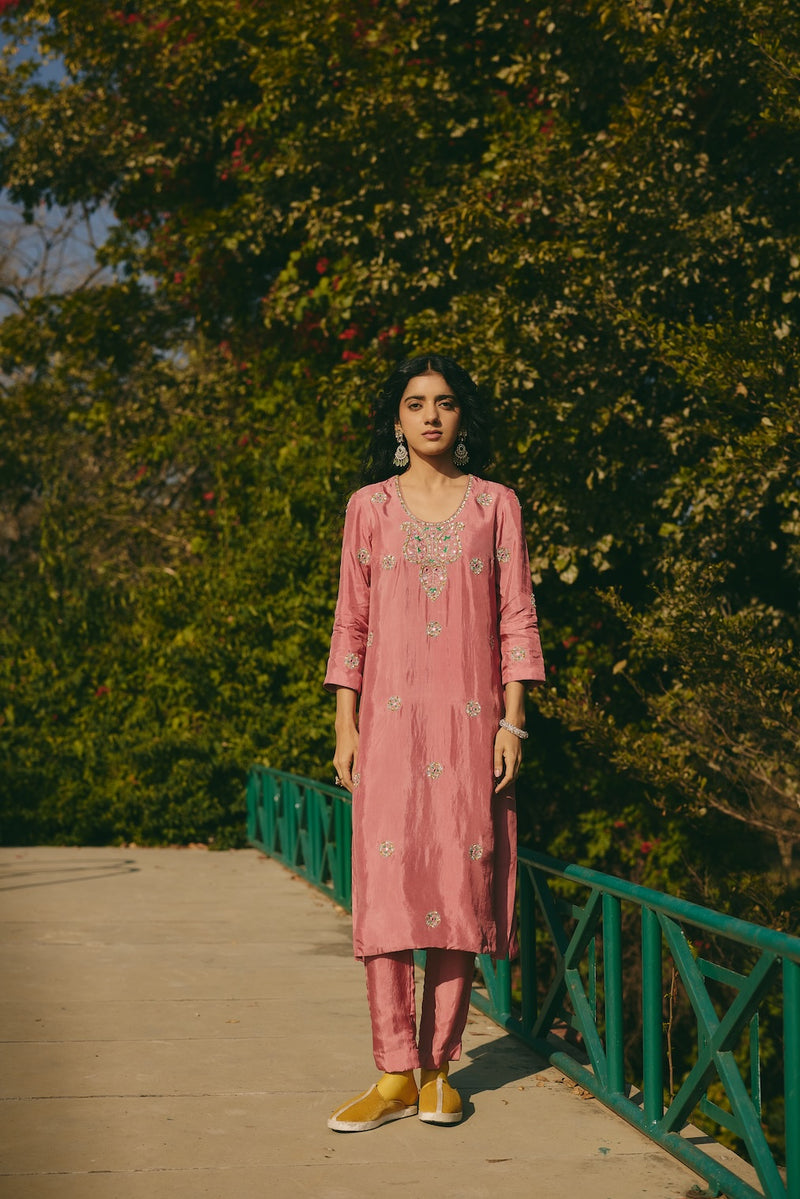
This is a natural place for a little mirror work. The Saher & Naazli set (₹32,500) is a soft rose-pink silk kurta with a scoop neckline and three-quarter sleeves. An ornate medallion sits on the bodice, and circular floral butis in green, orange and pink resham are scattered across it, accented with mirror work, sequins and fine bead work. The Oshani & Vritika set (₹23,500) is quieter: champagne-gold satin with a split V-neckline and an embroidered yoke of mirror work, nakshi, bead, cutdana and aari, with vibrant pink accents. The pant hem repeats the mirror work and aari.


Pithi
The pithi is the Gujarati haldi. A paste of gram flour, turmeric, sandalwood and rose water is applied to the bride and groom, usually separately at each family's home. It is yellow, intimate and a little messy, so wear something light that you do not mind marking.
The Ziya & Saaz set (₹14,500) is a sunflower-yellow silk kurta with a minimal neckline and side-slit sleeves. A floral bel in marodi, sequins and thread runs along the hem in pink and wine tones, with a matching churidaar. Our haldi outfit guide has more ideas.
The Garba or Raas Night
If the family holds a garba or dandiya raas night, this is the evening to wear the most colour and the most swing. Choose a full flare and pin your dupatta crosswise. The Ishq-e-Gul & Inara set (₹37,500) is made for this. It is a multi-hued panelled lehenga in soft tissue jacquard, in strokes of pink, gold, peach, ivory and green. Each panel is edged with sequin-lined gota and finished with a gota-patti and marodi border in gold, over an antique-gold blouse.
If you want bandhani, this is the night for it. The Suroor anarkali (₹22,775) is cut from bandhej Banarasi silk with woven gold bootis. Its neckline and sleeves are embroidered with sequin work inspired by vintage temple jewellery, and its full-length gathers move beautifully in a circle.

Our garba and dandiya outfit guide covers what dances well. For the story behind the dots, read our bandhani guide. Kutch is one of the craft's great centres, with clusters around Bhuj, Mandvi and Mundra, and the Khatri community has long been its master dyers.
The Wedding: Colour, Not Red-and-White
For the ceremony itself, dress up: silk, rich colour and your best handwork. Saffron, marigold, pink, green and gold are all at home at a Kutchi wedding. The Raanisa & Mahira set (₹35,500) is a vibrant sindoori-orange lehenga in woven booti silk, finished at the hem with gota, marodi, bead and thread work. Its matching blouse is hand-embroidered at the neckline, sleeves and waist, and a pleated lining under the lehenga gives it volume.
If you would rather wear a saree, choose one that is clearly not a gharchola. The Zohra saree (₹39,550) is soft tissue with a gentle shimmer. Its borders are hand-embroidered in mirror work, cutdana, sequins and zardozi, tracing floral bel patterns from vintage heirloom textiles. It is designed to go with the Haseena blouse (₹15,475), an ivory silk halter with mirror work, cutdana, sequins and zardozi at the neckline. If you would prefer more coverage than a halter, ask us on WhatsApp what is possible before you order. Every adult piece is cut to your measurements at no extra charge.

Already own a bandhani saree that is not red? The Abeer blouse (₹11,495) is cut from bandhani Banarasi silk, with a wide V-neck and short sleeves, and hand-embroidered paisleys and florals in sequins, cutdana and resham.
If the Wedding Is Kutchi Jain
At a Kutchi Visa Oswal or other Jain wedding, the first rule has nothing to do with the outfit. Ahimsa means leather is unwelcome, so plan fabric juttis and a fabric potli rather than leather shoes and a bag. Some observant Jain families also avoid silk. If yours does, ask us what any piece is made of before you order. The Naina & Ahalya set (₹12,500) is ivory cotton with delicate hand-embroidered florals at the neckline, cuffs and pant hem, and suits a daytime vidhi without raising the question. Add a coloured dupatta so ivory reads as festive. Our Jain wedding guest guide goes through the functions and the silk question in full.
If the Wedding Is Kutchi Memon or Khoja
Here the ceremony is a nikah, and coverage matters more than anything else. Wear sleeves, an ankle-length hem and a dupatta you can lift over your hair. Kutch and Sindh share a long history, and the Heeriye & Reva set (₹19,500) has a quiet echo of it. It is a cinnamon-brown Chanderi anarkali with resham, cutdana and sequin florals on the yoke, finished with a contrast border in scarlet and ivory reminiscent of vintage Sindhi motifs. Our nikah outfit guide has more.
The Dupatta: Where Kutch Can Show
If you would rather keep the outfit simple, let the dupatta carry the mirror work or the bandhani.
- The Gulnaaz dupatta (₹8,500) is bandhani silk in a muted brown, hand-embroidered with zardozi, sequins and cutdana, with bold paisleys at the corners. It sits well with pinks, rusts and neutrals.
- The Amoli dupatta (₹18,500) is deep earth-toned organza with a scalloped border of vibrant pink mirror work and gold aari on all four sides, and hand-embroidered floral butis across the body.


Browse all our dupattas to match one to your outfit.
Dressing for Kutch's Weather
Kutch is arid, and its winter is the comfortable season. In Bhuj, average highs in December and January are around 27–29°C and average lows are around 11–13°C. In November, days are closer to 33°C. Nights from November to February are cool, and occasionally cold when the wind comes from the north. That swing shapes a wedding weekend:
- Daytime functions: Chanderi, cotton and lighter silks.
- Evenings: heavier silk, tissue or a lehenga, with a shawl you will actually wear. Sleeves are your friend after dark.
- Travel: the Rann Utsav tent city at Dhordo runs from 1 November 2026 to 7 March 2027, and Kutch gets busy in that season. Book rooms early if you are flying in.
In Mumbai, Nairobi or Mombasa, dress for the venue rather than the desert. Many Mumbai Kutchi weddings take place at community halls run by the communities themselves. If you are shopping locally, our guides to wedding shopping in Mumbai and Indian clothes in East Africa list the areas to try. For colder evenings anywhere, our winter wedding guide covers layering.
Going to a Kutchi Wedding This Season?
Every piece is made to order in our Jaipur atelier in 4–5 weeks, plus 3–7 days for shipping. We cut it to your measurements at no extra charge, so you can ask for sleeves, a higher neckline or a longer hem. An order placed today will reach you in the third or fourth week of November at the earliest, which puts a December, January or February wedding comfortably in range. Shipping is free on domestic orders above ₹30,000. Message us on WhatsApp with the date and the functions you are attending, and we will tell you honestly what can reach you in time.
Browse the CollectionMore wedding guides: Gujarati weddings · Jain weddings · Sindhi and Marwari weddings · Nikah
Frequently Asked Questions
What should a guest wear to a Kutchi wedding?
Festive colour in a silk kurta set, anarkali, sharara or lehenga, with a dupatta. Mirror work or bandhani is a nice nod to Kutch. Avoid white with a red border and red bandhani drapes, which recall the bride's panetar and gharchola. At a Jain wedding, skip leather; at a Memon or Khoja nikah, choose full coverage.
What is the difference between a panetar and a gharchola?
Both are bridal sarees in Gujarati Hindu and Jain weddings. The panetar is white or off-white with a red border and is traditionally a gift from the bride's maternal uncle. The gharchola is red or maroon silk with zari checks and bandhani dots, traditionally given by the groom's side. The bride often wears the panetar first and the gharchola for later rituals.
What is the mameru ceremony?
The mameru, or mosalu, is when the bride's maternal uncle and his family arrive with gifts before the wedding, often the day before. The trays traditionally hold the panetar saree, jewellery, ivory or white bangles, sweets and dry fruit.
Can I wear bandhani to a Kutchi wedding?
Yes. Kutch is one of the great centres of bandhani, and a bandhani anarkali, blouse or dupatta is a warm nod to the region. Just avoid a red bandhani drape that could be mistaken for the bride's gharchola, and choose another colour or let the bandhani sit in your dupatta.
How cold is Kutch during wedding season?
Days are warm and nights are cool. In Bhuj, December and January average highs of about 27–29°C and lows of about 11–13°C, and nights from November to February can occasionally turn cold. Carry a shawl for the evenings.
Made to order in 4–5 weeks
Have an event date? We’ll tell you exactly when to order by.
We take a limited number of orders each month — secure your slot early.
WhatsApp me my order-by date + a shortlistNot sure where to start?
Tell us what you're dressing for and we'll help you choose — fabric, fit, colour, and timeline — over WhatsApp or on a video call.
Your Cart
Pieces from this story
All pieces →Not sure which piece, or need it by a date? Book a video consultation Ask us on WhatsApp


Keep reading
The journal →
Gujarati Wedding Outfit Ideas: What to Wear as a Guest
What to wear to a Gujarati wedding — garba night, ceremony, vidhi, and reception. Outfit ideas, colour guide, bandhan...
20 March 2026
Best Mirror Work Ethnic Wear Brands in India 2026: Designers, Kutch Craft & How to Judge Shisha
Where to buy mirror work (shisha) ethnic wear in India: designer labels, Kutch craft collectives and Jaipur ateliers,...
1 October 2026
Best Aari Work Brands in India 2026: Designers, Kashmir & Kutch Traditions, and Hand vs Machine
Where to buy aari work in India: designer labels, Kashmir and Kutch traditions and a Jaipur atelier, plus how to tell...
7 October 2026