

Best Mirror Work Ethnic Wear Brands in India 2026: Designers, Kutch Craft & How to Judge Shisha
The short answer: for designer mirror work, Arpita Mehta and Abhinav Mishra are the two labels most closely identified with it. For authentic Kutch shisha embroidery made by the communities who originated it, buy from the Kutch craft organisations: Shrujan, Kala Raksha, Qasab and Khamir. For Navratri-ready chaniya cholis on a budget, Ahmedabad's Law Garden stalls. And for mirror work set into hand-embroidered sarees, blouses, dupattas and kurta sets cut to your measurements, a made-to-order atelier like ours in Jaipur.
Mirror work is the embroidery that answers back: every small mirror throws the light around the room, which is why it belongs to garba nights, mehendis and anything held after dark. It is also one of the easiest crafts to imitate, so this guide covers how to tell a stitched glass mirror from a glued acrylic disc, as well as where to buy.
First: What Mirror Work Actually Is
Mirror work, called shisha (from the Persian word for glass) or abhla in Gujarat, is the craft of holding small pieces of mirror onto cloth with a framework of stitches, with no glue and no drilled hole. The earliest work used mica; later, blown glass was broken into small reflective pieces. Each mirror is caught in a lattice of thread and then ringed with buttonhole or chain stitch, so the embroidery is both decoration and fastening. In Kutch it belongs to many communities, among them the Rabari, Ahir, Jat and Sodha, each with its own motifs, colours and stitch vocabulary. Our sequin and mirror work guide covers how the two shimmer techniques differ in wear.
Real mirror work vs mirror-look
- Hand-stitched glass mirrors. Small, often slightly irregular pieces, held entirely by thread. The reflection is sharp and clear.
- Acrylic or plastic "mirrors". Perfectly round, machine-cut discs, very often glued rather than stitched. The reflection is hazy or slightly coloured.
- Mirror-look embellishment. Sequins, cutdana or foil arranged to evoke mirrors. Lovely in its own right, but it is not mirror work and should not be sold as such.
Designer Labels Known for Mirror Work
Arpita Mehta
Started in 2009, the label is practically synonymous with hand-embroidered mirror work in contemporary cuts: cape sets, fluid drapes and pastel palettes, with mirror work on lehengas and mirror borders on sarees. Widely stocked at multi-designer stores, so easy to see in person.
Best for: Modern, wearable mirror work for sangeet, cocktail and festive evenings.
Abhinav Mishra
Launched in 2014, the label made larger-than-life mirror work its signature at a time when much of the market leaned toward heavy zardozi, pairing mirrors with gota patti, whimsical florals, pastel palettes and bold colour play. It is wedding-function wear first.
Best for: Statement lehengas for mehendi and sangeet.
Kutch Craft Organisations: Buying from the Source
If you want shisha embroidery made by the women whose communities originated it, buy from the Kutch organisations that work directly with them. Five of them (Shrujan, Kala Raksha, Qasab, Khamir and VRDI) have come together as the Kutch Craft Collective.
Shrujan
Founded by Chanda Shroff in 1969 to sustain women embroiderers across Kutch, Shrujan works with thousands of women from around a dozen traditional communities. Its Living and Learning Design Centre at Ajrakhpur, near Bhuj, is a craft museum worth the trip in its own right.
Best for: Authentic community embroidery, from stoles to garments.
Kala Raksha, Qasab and Khamir
Kala Raksha, based at Sumrasar Sheikh near Bhuj, works to preserve traditional Kutch embroidery and sells artisans' work directly. Qasab is a producer company of Kutch craftswomen drawn from many communities and villages. Khamir, at Kukma, is an umbrella organisation for Kachchh crafts in general, from weaving to embroidery.
Best for: Buying where the money reaches the maker.
Markets: Ahmedabad and Jaipur
Law Garden, Ahmedabad
The roadside stalls opposite the law college come fully alive in the weeks before Navratri, with chaniya cholis and kediyus heavy with mirrors, beads and embroidery, plus oxidised jewellery. Quality varies stall to stall, and most of it is made for a season of garba rather than for decades, which is exactly the point.
Best for: Budget garba outfits, a whole look in one evening.
Bapu Bazaar and the walled city, Jaipur
Rajasthan has its own mirror tradition, and Jaipur's old-city markets sell dupattas and sarees worked in mirror and gota alongside bandhej. Handle several pieces side by side and look at the back. Our Jaipur shopping guide maps the markets.
Best for: Rajasthani pieces, comparing in person.
Pernia's Pop-Up Shop and Aza
Both multi-designer retailers carry mirror work from dozens of designers. Zoom right in on the photographs: stitched glass mirrors show a ring of thread around each piece; glued discs do not.
Best for: Comparing designer labels in one sitting.
Mirror Work from Our Jaipur Atelier
We will state our interest plainly, and our limits. We are a small made-to-order label in Jaipur. Our mirror work is atelier embroidery: mirrors combined with resham, cutdana, aari, zardozi or beads on silk, chiffon, tissue, satin and organza. It is not Kutch community embroidery, and if that is what you want, the organisations above are where to go. Only nine of our current pieces use mirror work, and all nine are below. Our product pages say "mirror work" without specifying glass or acrylic; if that matters to you, ask us on WhatsApp before ordering and we will tell you what that piece uses.
Sarees and blouses
The Sarmaya saree (₹35,100) is the purest expression of the craft we make: black chiffon framed by a continuous mirror work border along every edge, with statement floral mirror-embroidered bootas on the pallu and scattered mirror accents across the body. Mirrors on black are the classic for a reason; the base disappears and the light does the work. The Shafaq blouse (₹15,650) goes further still: black raw silk covered in mirror work set in geometric grids, each mirror individually secured and outlined by hand with resham, cutdana and beads, on delicate straps with a sculpted neckline.

For a softer register, the Zohra saree (₹39,550) is soft tissue with borders hand-embroidered in mirror work, cutdana, sequins and zardozi in a floral bel, and it is designed to pair with the Haseena blouse (₹15,475), ivory silk cut as a structured halter with a neckline of floral mirror work, cutdana, sequins and zardozi. As with all our sarees, the blouse is sold separately. Our saree blouse roundup covers other options.


Kurta sets and dupattas
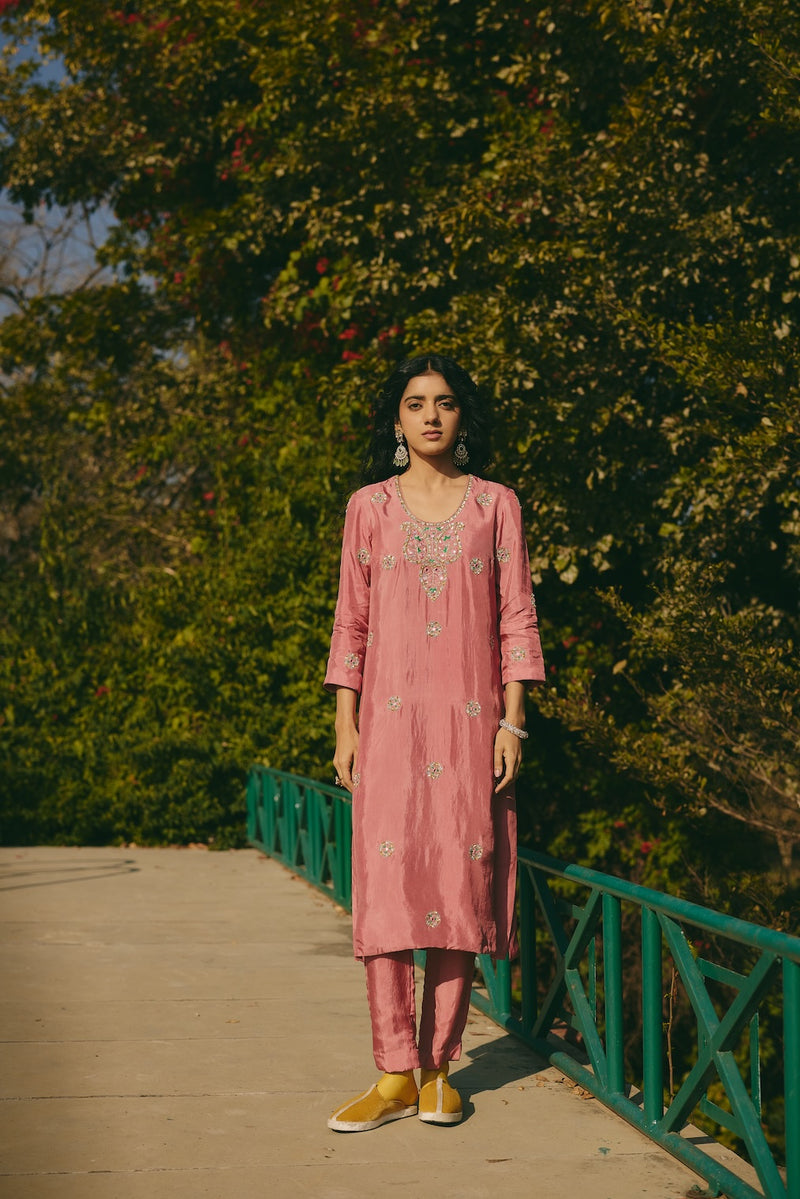
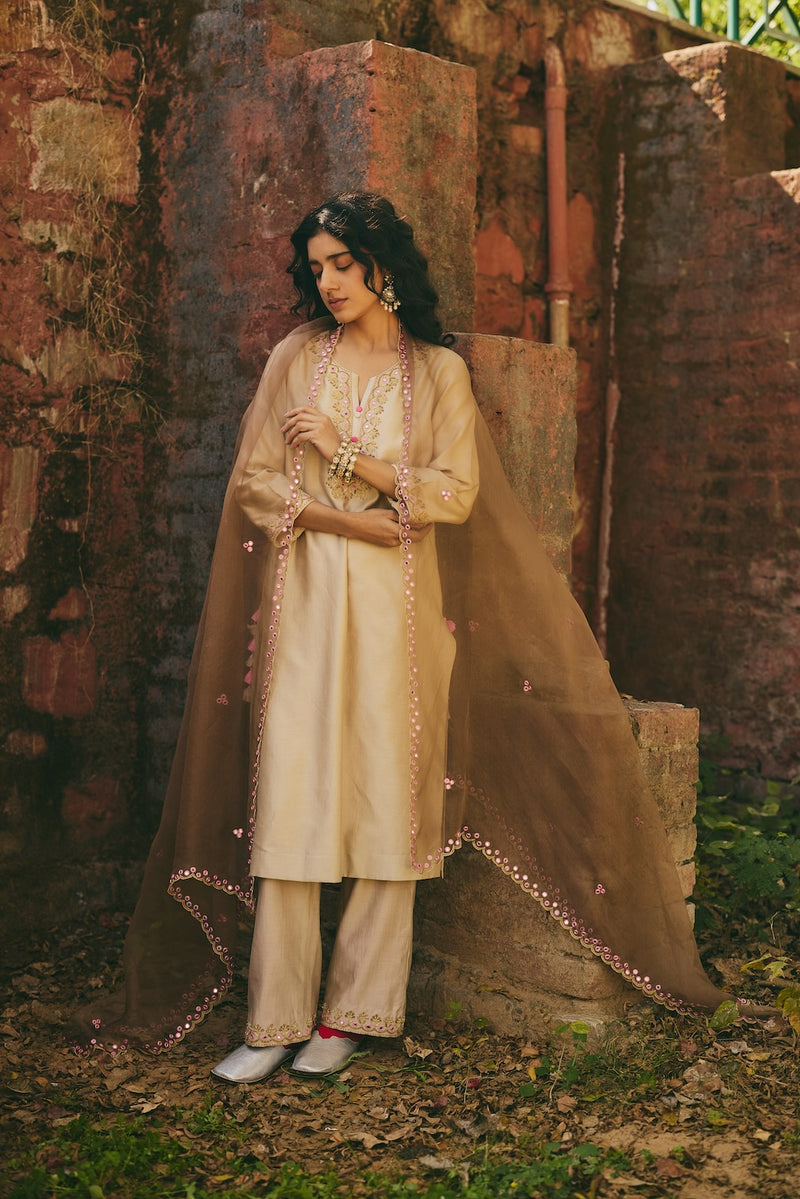
The Saher kurta with Naazli pant (₹32,500) is rose pink silk with an ornate medallion on the bodice and circular floral butis throughout in green, orange and pink resham, accented with mirror work, sequins and beads. The Miraal dupatta (₹15,500) carries the same circular buti language on sage green tissue, finished with a shimmering trim and tassels. The Oshani kurta with Vritika pant (₹23,500) is champagne gold satin with an embroidered yoke of mirror work, nakshi, beads, cutdana and aari, and a chanderi pant whose hem border repeats the mirror work.


Two organza dupattas complete the edit. The Amoli dupatta (₹18,500) is a deep earth tone with a scalloped border on all four sides worked in vibrant pink mirror work and gold aari. The Adhira dupatta (₹4,500) is ivory organza with mirror work and delicate resham, and the easiest way to bring mirrors to a plain suit. More in the dupatta collection.
And one honest exception: the Shahana blouse (₹6,250) in tangerine silk is often mistaken for mirror work, but its neckline is sequins and cutdana arranged like tiny mirror-flowers. It is mirror-look, not mirror work, and the lighter choice if you want the sparkle without the weight.
How to Judge Mirror Work Before You Pay
- Look into a mirror. Glass gives a sharp, clear reflection; acrylic gives a hazy or tinted one.
- Look around it. Real shisha is held by a visible ring of stitches. No stitching means glue, and glued mirrors eventually lift.
- Check the shapes. Hand-cut mirrors vary slightly; a field of identical perfect circles is usually machine-cut.
- Turn it over. Hand embroidery shows thread paths and small irregularities on the reverse. Our hand vs machine embroidery guide covers the tells.
- Run a finger along the edges. Good work covers the glass edge completely, with nothing sharp to catch silk or skin.
- Weigh it against the cloth. Dense mirrors on fine chiffon or organza work best as borders and bootas; all-over grids need a firmer base like raw silk.
Caring for Mirror Work
Dry clean only, and tell the cleaner it is mirror work. Never scrub or wring it: vigorous washing can crack or loosen the mirrors. Keep it dry, because damp can tarnish the backing of glass mirrors and turn them dark. Store it folded in muslin with a soft cloth between layers so mirrors do not press into the fabric, and do not stack heavy pieces on top. To press it, steam or iron on the reverse over a cloth and never directly on the mirrors. Our guides to steaming embroidered clothes and storing Indian clothes have more detail.
A timing note: Sharad Navratri runs 11–19 October this year, and our pieces are made to order over 4–5 weeks plus 3–7 days shipping, so anything ordered now will arrive after garba. For Navratri itself, our garba outfit guide helps you work with what is already in your wardrobe; for the wedding season after Diwali, now is the right time to order.
Mirror Work, Made to Order in Jaipur
Sarees, blouses, kurta sets and dupattas with hand-embroidered mirror work, each made in our Jaipur atelier over 4–5 weeks, with custom measurements at no extra charge. Message us on WhatsApp with your dates and we will tell you honestly what is possible. Browse everything we make.
Shop the CollectionMore craft and brand guides: best gota patti brands · best dupatta brands · Gujarati wedding guest guide
Frequently Asked Questions
Which brand is best for mirror work in India?
For designer mirror work, Arpita Mehta and Abhinav Mishra are the best-known labels. For authentic Kutch shisha embroidery, buy from Shrujan, Kala Raksha, Qasab or Khamir, which work directly with the craftswomen. For budget Navratri wear, Law Garden in Ahmedabad. For mirror work on hand-embroidered sarees, blouses and kurta sets made to your measurements, made-to-order ateliers, ours included, are another route.
How can I tell real mirror work from fake?
Real shisha uses glass held entirely by a ring of stitches, with a sharp, clear reflection and slightly irregular shapes. Imitation work usually uses perfectly round machine-cut acrylic discs, often glued, with a hazy reflection. Sequins and cutdana arranged to look like mirrors are mirror-look, not mirror work.
What is mirror work called in Gujarat?
It is called abhla, or abhla bharat, and more widely shisha, from the Persian word for glass. In Kutch it is practised by many communities, including the Rabari, Ahir, Jat and Sodha, each with its own motifs and stitches.
Can mirror work be washed at home?
For occasion wear, no: dry clean only. Vigorous washing can crack or loosen mirrors, and damp can darken the backing of glass mirrors. Store it dry, folded in muslin with a soft layer between folds, and press only on the reverse over a cloth.
Is mirror work only for Navratri?
Not at all. It is the classic for garba, but it works for any evening function: mehendi, sangeet, cocktail and Diwali parties. A black saree with a mirror border, or a mirror-worked blouse under a plain drape, carries well beyond the festive season.
Made to order in 4–5 weeks
Have an event date? We’ll tell you exactly when to order by.
We take a limited number of orders each month — secure your slot early.
WhatsApp me my order-by date + a shortlistNot sure where to start?
Tell us what you're dressing for and we'll help you choose — fabric, fit, colour, and timeline — over WhatsApp or on a video call.
Your Cart
Pieces from this story
All pieces →Not sure which piece, or need it by a date? Book a video consultation Ask us on WhatsApp




Keep reading
The journal →
Sequin & Mirror Work in Indian Fashion: A Complete Guide
Everything about sequin and mirror work in Indian fashion — mukaish, shisha, cutdana techniques. How to wear, style, ...
3 April 2026
Where to Shop for Wedding & Festive Clothes in Jaipur: A Complete Guide
A complete Jaipur shopping guide for wedding and festive clothes — Johari Bazaar, Bapu Bazaar, Sanganer and Bagru blo...
21 August 2026
Best Saree Blouse Brands in India 2026: Ready-Made to Couture
The best saree blouse brands and designers in India 2026 — ready-made labels, custom studios and couture, with prices...
31 August 2026