

Best Aari Work Brands in India 2026: Designers, Kashmir & Kutch Traditions, and Hand vs Machine
The short answer: among designers, Manish Malhotra and Rahul Mishra are two of the names most associated with aari work, Malhotra through his Kashmiri-embroidery collections and Mishra through hand embroidery made in village workshops. For aari at its roots, look to Kashmir, where chain stitch worked with a hook is a core craft, and to Kutch, home of the historic Mochi embroidery. And for aari combined with resham, marodi and sequins on chanderi, silk and satin, cut to your measurements, a made-to-order atelier like ours in Jaipur is a third route. Because aari is also widely machine-made, this guide covers how to tell the difference too.
First: What Aari Actually Is
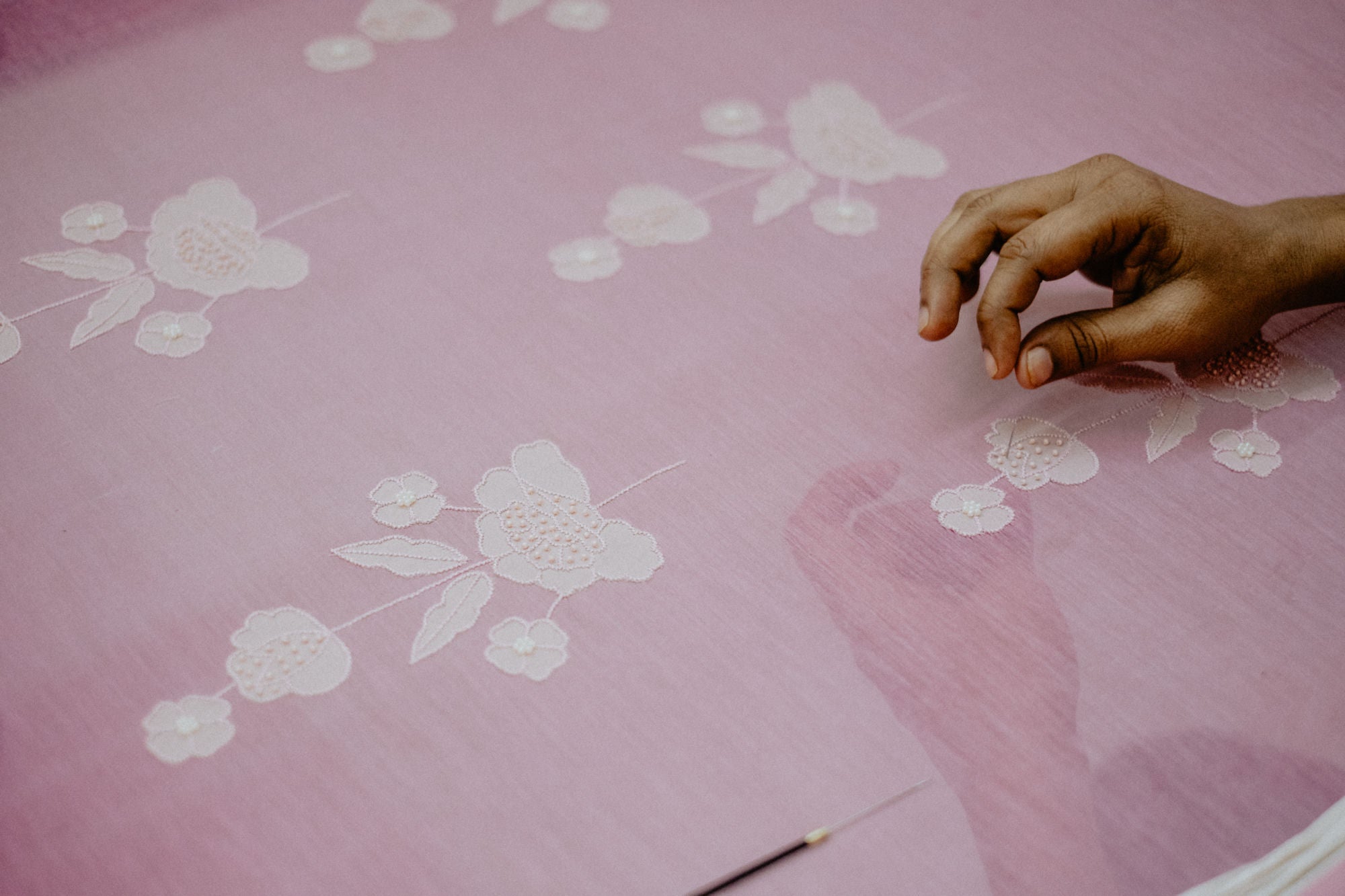
Aari is chain stitch made with a hook instead of a needle. The cloth is stretched tight on a frame (an adda or khatli); the karigar holds the hooked needle above the fabric and feeds the thread from below with the other hand. The hook goes in, catches the thread, and pulls a loop up through the last one, so a line of chain forms on the surface while the reverse shows a line of straight stitches. It is far quicker than chain stitch with an ordinary needle, which is why aari can cover a whole kurta in vines or a dupatta in florals. The same hook can slide sequins and beads onto the thread one at a time, which is why aari so often travels with sequin and bead work. Our aari embroidery guide covers the craft in more depth.
Hand aari vs hand-needle chain stitch vs machine
- Hand-needle chain stitch. The same stitch made loop by loop with an ordinary needle. Beautiful, but much slower to work.
- Hand aari. Made with the hook on a frame. Fine, continuous lines that follow curves fluidly, with tiny variations in loop size that you only see up close.
- Machine chain stitch. Chain-stitch embroidery machines have existed since the Cornely machine appeared in Paris in the 1860s, and multi-head machines sold as "aari machines" are common today. The result is perfectly even and much cheaper. Some makers combine a machine base with hand-finished details. None of this is wrong; it only becomes a problem when machine work is sold, and priced, as hand aari.
Designer Labels Known for Aari
Manish Malhotra
The designer has returned to Kashmiri embroidery again and again, drawing on sozni, tilla and resham and working with craftsmen on Kashmiri aari, and keeps a dedicated Kashmiri line of lehenga sets. It is bridal and occasion wear first.
Best for: Kashmir-inspired bridal and festive aari.
Rahul Mishra
Known for intricate, three-dimensional hand embroidery drawn from the natural world, Mishra runs workshops in the villages of Bandpur and Bargachia in Bengal's Howrah district, where artisans specialise in techniques including aari and zardozi. He is a well-known advocate of "reverse migration", encouraging embroiderers to work from their home villages rather than cramped city workshops, and he shows on the Paris couture calendar.
Best for: Couture aari as fine art.
Pernia's Pop-Up Shop and Aza
Both multi-designer retailers carry aari from dozens of labels (Pernia's stocks us too, in full disclosure). Zoom in on the photographs: hand aari shows fine, slightly irregular loops; a perfectly uniform chain is usually machine work.
Best for: Comparing many designers in one sitting.
Aari Traditions: Kashmir, Kutch and Rajasthan
Kashmir: chain stitch and crewel
In Kashmir the hook itself is called the aari, and chain stitch (zalakdozi) is one of the valley's core embroideries, worked mostly in wool on cotton or linen for crewel, with creepers and stylised flowers that can cover the whole cloth. Crewel is traditionally used on furnishings, while finer work appears on pherans and shawls. For certified pieces at fixed prices, the government-run Kashmir Government Arts Emporium on Residency Road in Srinagar sells aari and crewel work (it is generally closed on Sundays). Our guide to Kashmiri chain stitch goes deeper, and the Kashmiri wedding guest guide shows how it is worn.
Best for: Crewel, pherans, shawls and furnishings.
Kutch: Mochi bharat
In Kutch, the most celebrated aari was made by the Mochi community, leatherworkers and shoemakers whose hook was adapted, the story goes, from the cobbler's awl (aar). The craft probably reached Kutch from Sindh in the 18th century, and the Mochis became professional silk embroiderers to the court at Bhuj. Their multicoloured silk chain-stitch is now held by museums such as the V&A in London, while the living tradition has shrunk to a handful of families, with a small revival under way. If you visit, the Hiralaxmi Memorial Craft Park at Bhujodi hosts artisans from across Kutch; ask there who still works aari. Our mirror work brands guide lists the Kutch craft organisations.
Best for: Collectors and craft travellers.
Rajasthan: aari-tari
In Jodhpur and Jaipur you will hear "aari-tari" for hand embroidery in metallic thread, beads and sequins, once made for royal families and now seen on Rajputi poshaks and bridal wear. Sources use the term loosely, sometimes for gota-and-zari work, so ask exactly what a piece has. Our Jaipur shopping guide maps the markets.
Best for: Poshaks and Rajasthani bridal wear.
Aari from Our Jaipur Atelier
We will state our interest plainly, and our limits. Aari is one of the techniques our karigars use most: more than thirty of our current pieces name it, nearly always layered with resham, marodi, nakshi, sequins or moti on chanderi, silk, satin, georgette, organza or tissue. It is atelier aari, made in Vaishali Nagar, Jaipur. It is not Kashmiri crewel or Kutch Mochi embroidery, and if you want those, the sources above are where to go. Every piece below names aari in its description; pieces that are only "aari-inspired" are left out. All are made to order over 4–5 weeks, with custom measurements at no extra charge.
A black saree and a black blouse
The Gulmohar saree (₹45,500) is jet black georgette scattered with floral bootis in dull gold and soft pink, finished with a wavy scalloped border, all in aari, sequins and resham. The blouse in the photograph is not included. For a blouse with the same quiet palette, the Roop blouse (₹12,500) is deep black silk with a cutout back, entirely hand-embroidered in aari, sequins and thread, with florals in pastel pinks and ivory along the sleeves, neckline and back edge.

Sharara sets: aari as an all-over jaal
The Roshni kurta with Nazreen sharara (₹31,800) is aari at its most characteristic: yellow chanderi covered in an all-over trellis of vines in fine aari and golden thread, punctuated by pink resham florals, sequins, nakshi and moti, over a soft pink chanderi sharara. The Chanbeli kurta with Badli sharara (₹32,850) is the evening version: ivory satin with a floral jaal of aari vines and blooms, multicolour resham, French knots, sequins and cutdana, over a sheer organza sharara. See more in the sharara collection.


Kurta sets: aari with marodi and appliqué
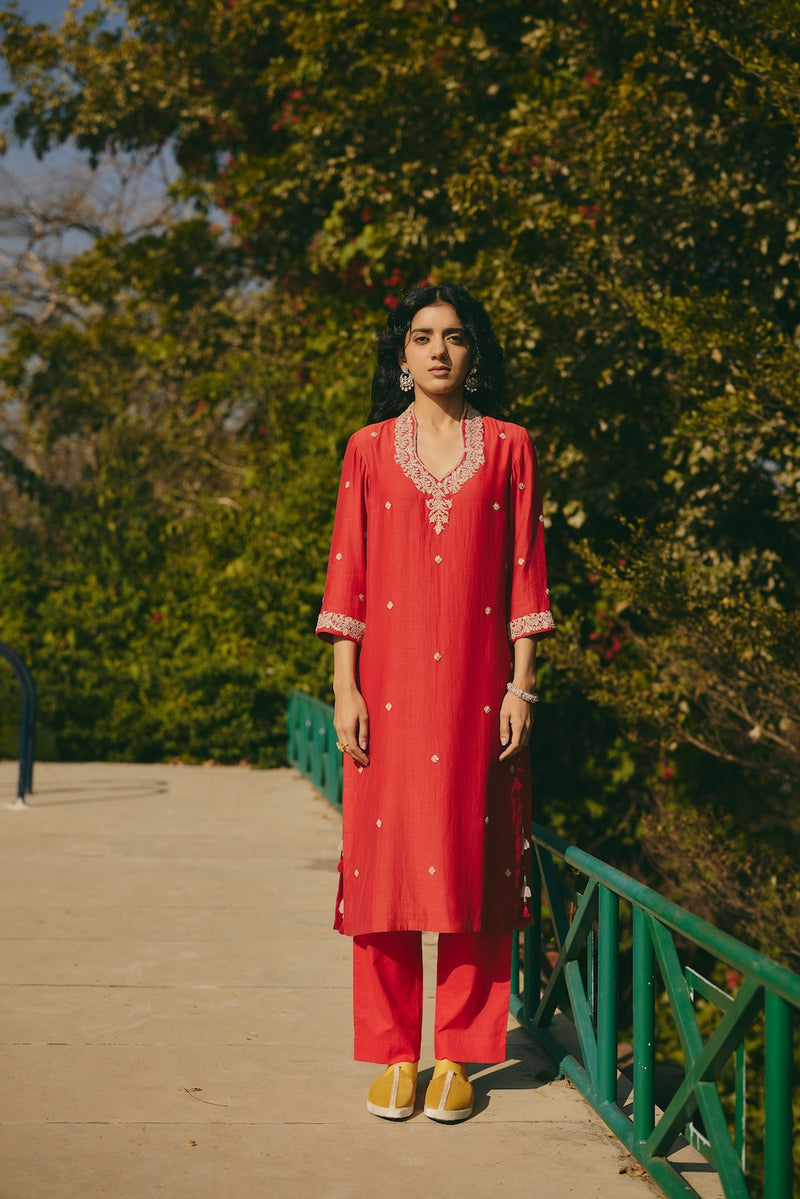
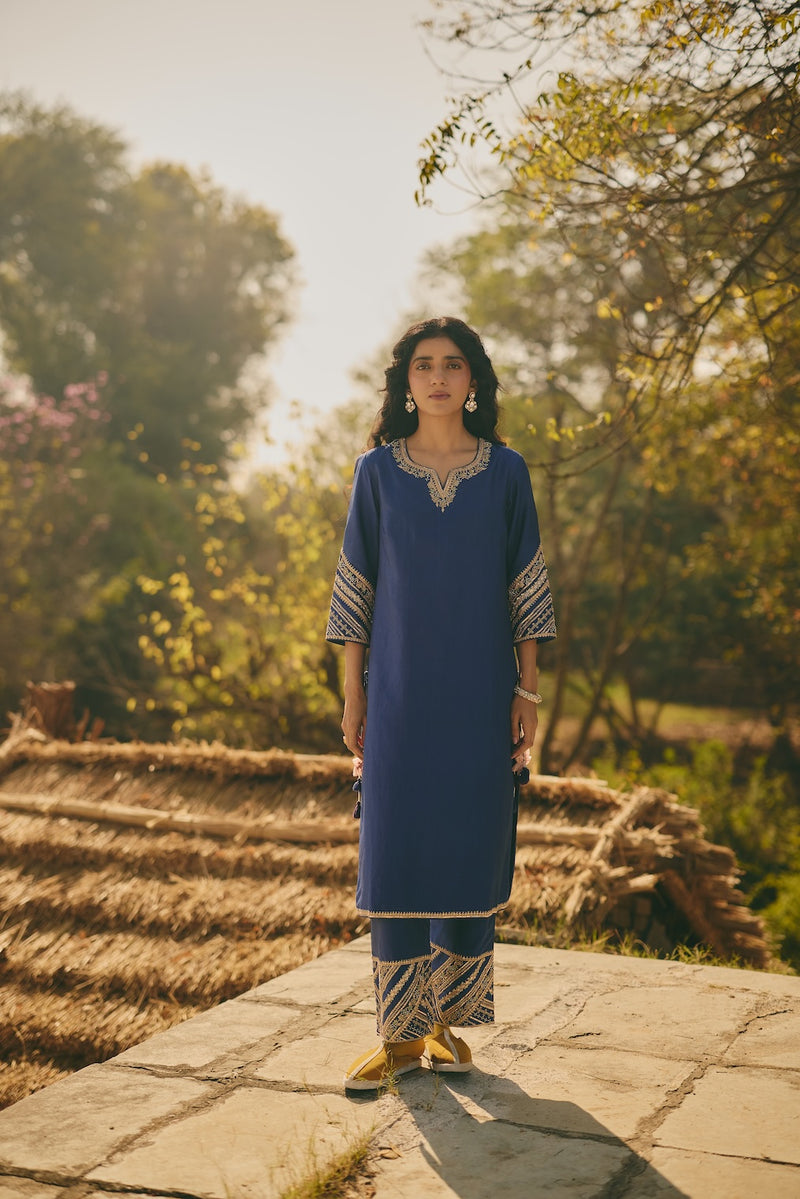
Aari draws the fine lines; other techniques add weight. The Fariha kurta with Nazeera pant (₹28,395) is crimson chanderi with a deep V-neck and an expansive yoke of fine aari and marodi in golden vines, broad borders on the sleeves and a wide embroidered hem on the pant. The Ameera kurta with Hoorain pant (₹32,500) is deep sapphire silk with floral accents at the neckline and geometric, linear patterns on the sleeves and pant hem, in marodi, resham, sequins, cutdana, beads and aari. The Rangtara kurta with Jamuni pant (₹37,500) is rose pink silk with circular fabric appliqué medallions and floral sprays defined in resham and aari, enriched with sequins, nakshi and moti, over a deep plum pant.


The Iraaday shirt with Raya pant (₹11,500) is the lightest way in: a woven shirt hand-embroidered in zardozi and aari in gold and silver threads, with silk cotton zari-stripe pants. For more zardozi pieces, see our zardozi brands guide. The full range is in the kurta collection.
Anarkalis and a lehenga
The Rafia anarkali (₹28,500) is classic black silk with a square neckline, pink and peach resham florals and dense gold marodi borders accented with aari and sequins. At the grand end, the Ferozaan anarkali with Gulraaz pant (₹1,25,000) is a floor-grazing jewel-toned fuchsia in chanderi silk, with aari and marodi vines running vertically to elongate the line and a hem of gota appliqué, nakshi and sequin medallions. The Nyassa blouse with Elina lehenga (₹1,75,000) is rose tissue with large vertical bootas across the skirt in zari, marodi, gota patti, sequins, cutdana, beads and aari, and a blouse embroidered all over.
Dupattas and a kids' set
The Bageecha dupatta (₹12,500) is organza silk in wide colour-blocked panels of yellow and rani pink with a silver zari border and aari and sequin flowers, a nod to the phoolon ki chaadar. The Gulrooh dupatta (₹18,500) is deep plum chanderi with the same appliqué medallions and resham-and-aari florals as Rangtara, so the two make a natural pairing. More in the dupatta collection.


For children, the Roshni and Nazreen kids set (₹21,500) is the kids' version of the yellow aari-trellis sharara set, in chanderi with a shantone lining, from 0–3 months to 15–16 years; a custom size adds ₹2,000. See the kidswear collection.
How to Judge Aari Before You Pay
- Look at the loops. Hand aari has tiny variations in loop size, especially on tight curves. A chain so even it looks printed is usually machine work.
- Compare repeats. Hand-worked motifs differ slightly from one to the next; identical repeats across a dupatta suggest a machine.
- Do not rely on the reverse alone. With most embroidery, the back is the giveaway. With aari it is less decisive, since hand aari also shows a neat line of straight stitches underneath. Look for thread ends tied off where colours change. Our hand vs machine embroidery guide covers the other tells.
- Check how sequins and beads sit. Hand aari beadwork is caught into the chain one or two at a time; glued or loosely tacked embellishment lifts at the edges.
- Ask directly. "Hand aari or machine?" is a fair question, and any honest seller will answer it plainly.
- Match density to the cloth. Aari is light, which suits chanderi, georgette and organza; heavy metal add-ons on a fine base need a lining.
Caring for Aari
Dry clean only for occasion wear. A chain stitch can unravel along its length if a loop is pulled, so keep jewellery, hooks and Velcro away, and never pull a snagged thread; ask a tailor to secure it. Store folded in muslin with soft cloth between the folds, and press on the reverse over a cloth. Our guide to storing Indian clothes has more.
A timing note: made to order over 4–5 weeks plus 3–7 days shipping, anything ordered today arrives mid-to-late November at the earliest: after Diwali (8 November), but in time for the winter wedding season.
Aari Work, Made to Order in Jaipur
Sarees, blouses, kurta sets, shararas, anarkalis, lehengas, dupattas and kids' sets with hand-embroidered aari, each made in our Jaipur atelier over 4–5 weeks, with custom measurements at no extra charge. Message us on WhatsApp with your dates and we will tell you honestly what is possible. Browse everything we make.
Shop the CollectionMore craft and brand guides: best zardozi work brands · best gota patti brands · best mirror work brands
Frequently Asked Questions
Which brand is best for aari work in India?
Among designers, Manish Malhotra is known for Kashmiri-embroidery collections that use aari, and Rahul Mishra for couture hand embroidery made in village workshops in Howrah. For aari at its roots, look to Kashmir's chain-stitch tradition and Kutch's Mochi embroidery. For aari with resham and marodi on kurta sets, shararas and sarees made to your measurements, made-to-order ateliers, ours in Jaipur included, are another route.
What is aari work?
Aari is chain-stitch embroidery made with a fine hooked needle on fabric stretched over a frame. The hook works from above while the thread is fed from below, forming a chain on the surface. It is much faster than needle chain stitch and is often combined with sequins and beads, which the hook can attach as it stitches.
How can I tell hand aari from machine aari?
Hand aari has small variations in loop size, especially on curves, and motifs differ slightly from one another. Machine chain stitch is perfectly even, with identical repeats. The reverse is less telling than with other embroidery, because hand aari also shows a line of straight stitches underneath, so look at the evenness of the face and ask the seller directly.
Where does aari embroidery come from?
It has deep roots in Kashmir, where chain stitch worked with a hook is a core craft, and in Kutch, where the Mochi community of leatherworkers became court embroiderers at Bhuj, using a hook said to be adapted from the cobbler's awl. Today aari is worked by karigars in many cities, including Jaipur.
How should I care for aari embroidery?
Dry clean occasion pieces. Keep jewellery and hooks away, since a pulled chain stitch can unravel, and never tug a loose thread; have a tailor secure it. Store folded in muslin and press only on the reverse over a cloth.
Made to order in 4–5 weeks
Have an event date? We’ll tell you exactly when to order by.
We take a limited number of orders each month — secure your slot early.
WhatsApp me my order-by date + a shortlistNot sure where to start?
Tell us what you're dressing for and we'll help you choose — fabric, fit, colour, and timeline — over WhatsApp or on a video call.
Your Cart
Pieces from this story
All pieces →Not sure which piece, or need it by a date? Book a video consultation Ask us on WhatsApp




Keep reading
The journal →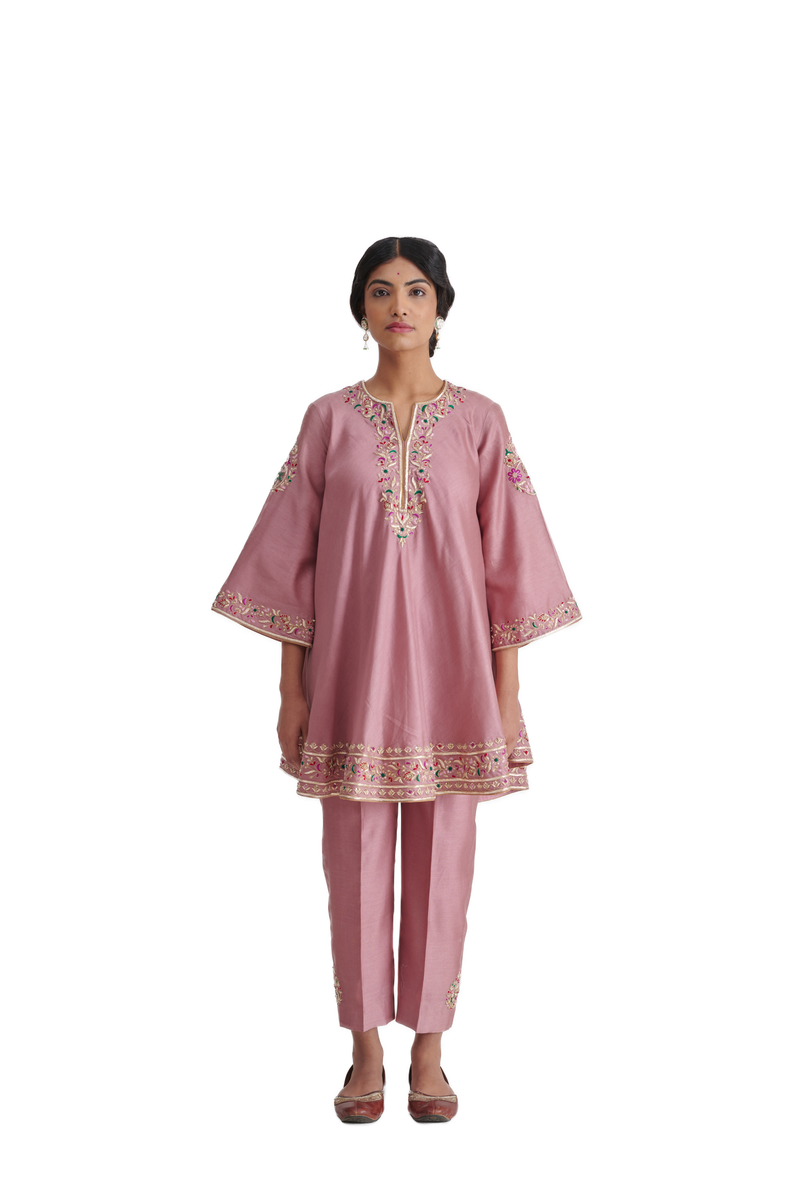
Aari Embroidery: The Ancient Hook Technique Behind Luxury Indian Fashion
Learn about aari embroidery — the ancient Indian hook technique used in luxury fashion. How it works, how to identify...
8 March 2026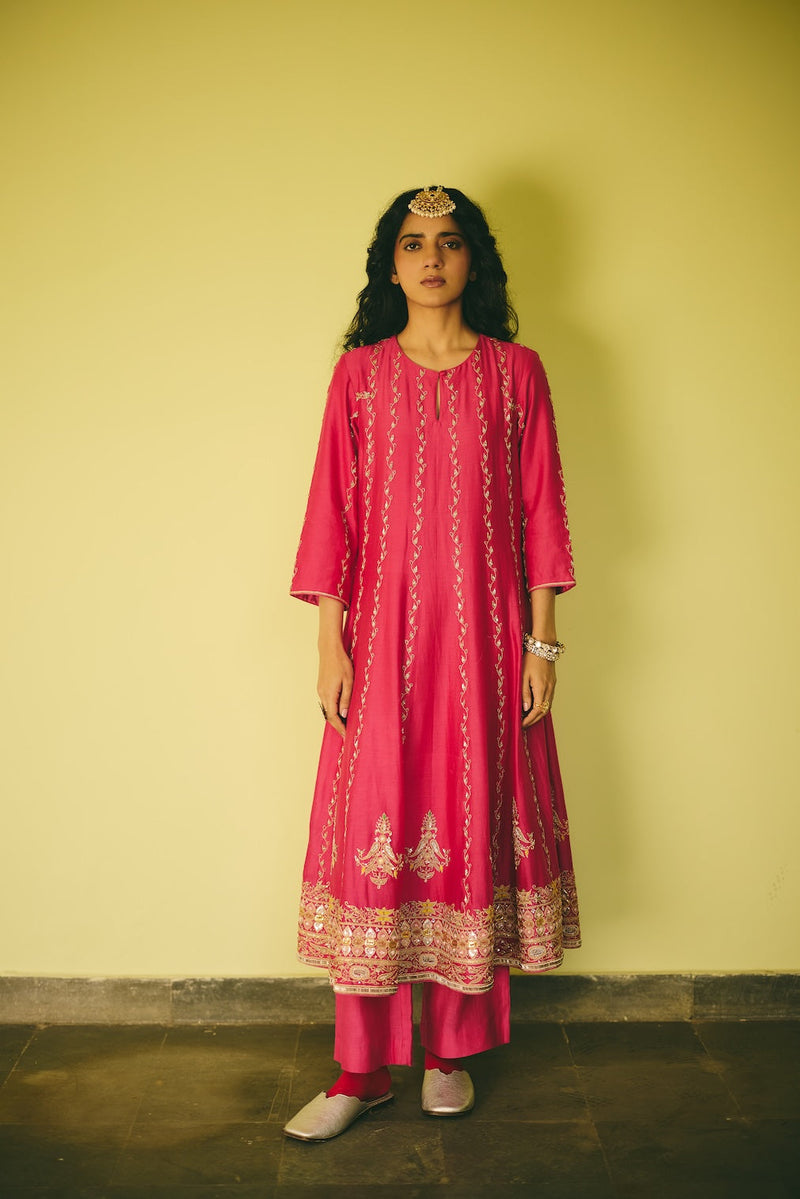
Aari Embroidery: The Ancient Chain Stitch Craft from Kashmir
Complete guide to Aari embroidery - Kashmiri origins, chain stitch technique, how to identify quality handwork vs mac...
25 May 2026
What to Wear to a Kashmiri Wedding: A Guest's Guide
What to wear to a Kashmiri wedding — a guest guide to Pandit and Kashmiri Muslim functions, the pheran and tilla trad...
31 August 2026