

What to Wear to a Chettinad Wedding: A Guest's Guide to a Nagarathar Celebration
If you have been invited to a Chettiar wedding in Chettinad, the short answer is this: wear a silk saree in a rich, clear colour, wear your gold, and be ready early. A Nattukottai Chettiar (Nagarathar) wedding day starts well before dawn. It is often held in the bride's family's ancestral house, one of the great mansions of the Karaikudi region, and the meals are served on banana leaves, usually with guests sitting down. That means you want silk that photographs well in a pillared courtyard, a drape you can sit cross-legged in, and nothing that looks bridal.
This guide takes a guest through the days of a Nagarathar wedding, from the muhurtha kaal to the tying of the kazhuthiru and the feast, with what to wear at each stage. Families differ, and plenty of Chettiar couples now marry in a city hall rather than in the home village, so treat this as a map rather than a rulebook. For a Tamil wedding more generally, see our Tamil wedding guest guide.
Who the Nagarathars Are, and Why the Setting Matters
The Nattukottai Chettiars, who call themselves Nagarathars, are a Tamil merchant and banking community whose homeland is Chettinad, roughly the area where Sivaganga and Pudukkottai districts meet, around Karaikudi. In the nineteenth and early twentieth centuries their banking houses spread across Ceylon, Burma, Malaya, Singapore and Vietnam, and the money came home as architecture. Between about 1850 and the Second World War the community built more than ten thousand mansions in its villages, using Burma teak, Ceylon satinwood, Italian and Belgian marble and tiles from Europe and Japan. The community once counted 96 villages; 73 survive, and the region is on UNESCO's tentative list as the village clusters of the Tamil merchants.
The community is organised around nine clan temples, and marriage inside your own temple group is not allowed, so a wedding is, among other things, a meeting of two temple lineages. The houses are built around courtyards, and the central courtyard and main hall are where the family's ceremonies happen. Practically, that means stone floors, sitting on mats and moving between bright courtyard and shaded hall, often in serious heat.
An Honest Note About Kandangi and Kanjivaram
Chettinad has its own sari. The kandangi is a handloom cotton sari from the Chettinad region, recognised with a geographical indication in 2019–20. It is woven in and around Karaikudi, coarse and hard-wearing, with a checked or striped body and broad contrasting borders, often in earthy colours; the tradition was patronised by the Nagarathars themselves for well over a century. Community accounts of weddings also describe guests in pattu kandangi, the silk version. The other sari you will see everywhere is, of course, Kanjivaram silk.
We do not weave kandangi or Kanjivaram, and we would not pretend to. If you want a kandangi, buy it from the weavers of Karaikudi; for a Kanjivaram, go to a weaver or a shop you trust, and our guide to telling pure silk from imitation will help. Our work is different: we buy handwoven cloth, Banarasi and other silks, and embroider it by hand in our Jaipur atelier. Where we are genuinely useful at a Chettiar wedding is the blouse for a sari you already own, and a handful of silk pieces that sit comfortably alongside Kanjivarams in the photographs.
The Days Before: Muhurtha Kaal and Padaippu
Once the date is fixed, relatives gather four or five days before the wedding for the muhurtha kaal unrudhal. A bamboo pole is topped with mango leaves, a puja is performed, close relatives mark it with turmeric and kumkum at five points, and it is planted at the house to tell the neighbourhood that a wedding is coming. Families then make offerings to their ancestors at the ancestral home (veetu padaippu), and the wider clan gathers for a joint prayer, podhu padaippu, with paniyaram made from rice flour and palm jaggery. The day before the wedding, relatives draw the nadu veetu kolam in wet rice flour on the floors of both houses.
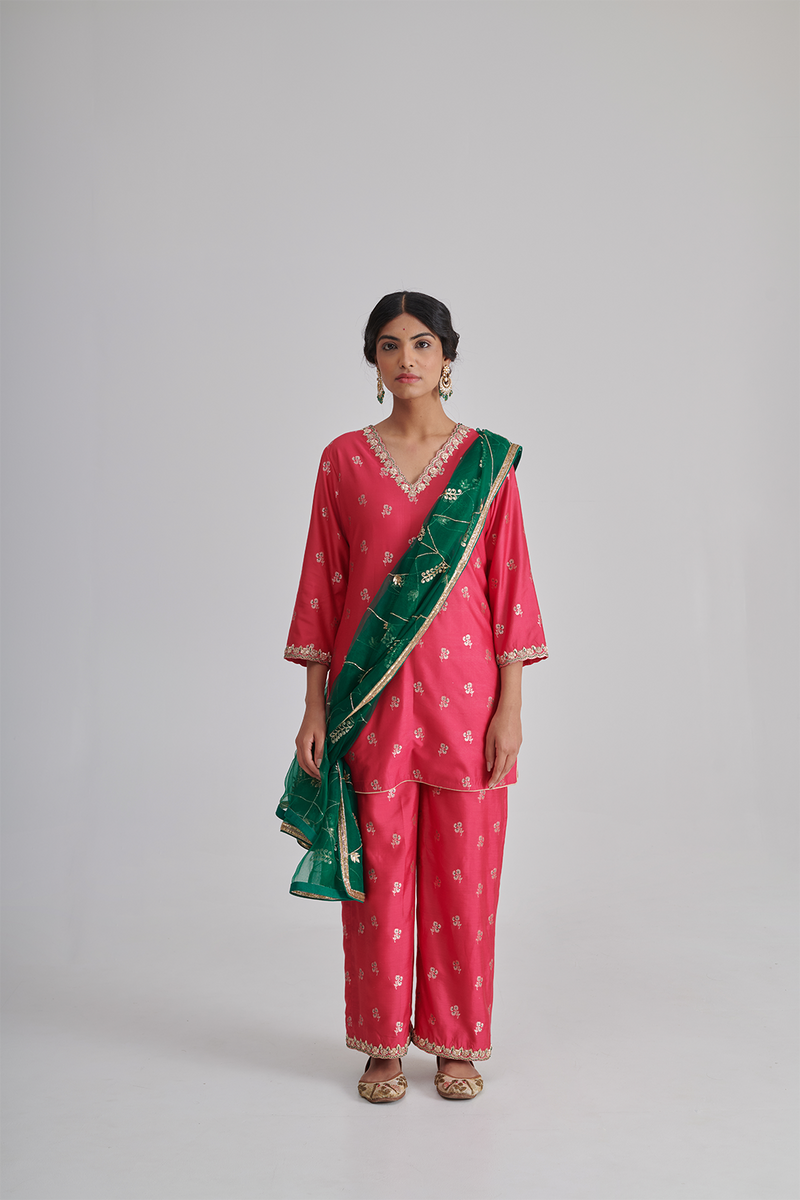
If you are close enough to the family to be there for these, dress as for a festive family puja: silk or a good handloom, colour, covered shoulders, comfortable for sitting on the floor. This is where a cotton kandangi is entirely at home. A kurta set works too. The Rasiya & Misri set (₹12,500) is coral-pink mulberry brocade silk with floral motifs hand-embroidered in gold thread at the V-neck, sleeves and hem, and it reads festive without competing with anyone. For the heat, the Haniya & Mithila set (₹21,000) is a magenta Chanderi A-line kurta with gold thread, sequin and multicolour thread work at the sleeves and hem, over matching Chanderi pants.
The Wedding Morning: Mappillai Azhaippu and the Kazhuthiru
The wedding day starts in the dark. Before the muhurtham, the groom's party arrives in the bride's village but does not enter her house; they wait at a temple or community hall until the bride's family comes to welcome them, the mappillai azhaippu. The bride is then brought to the door and shown to the groom.
The central rite is the thirupootuthal. The couple's maternal uncles act as the wedding's honoured felicitators, and community accounts describe them wrapped in a bright pink silk towel called the mamakara pattu. The bride's maternal uncle brings her to the groom, and the groom ties the kazhuthiru (also written kaluthiru or kazhuththu uru), the marriage necklace unique to the Nagarathar community. It is an extraordinary piece of gold: around thirty-five components strung on twenty-one twisted threads smeared with turmeric, with a central pendant whose four sharp spikes are said to represent the four Vedas, beneath an image of Murugan (Subrahmanya) with Shiva and Parvati seated on Nandi. The bride wears it on the wedding day and on special occasions; a simpler gold thali is worn day to day.
This is the moment for your best silk. Deep greens, pinks, oranges, purples and golds all look right, and plenty of gold jewellery is entirely normal. Leave red with heavy gold zari to the bride unless the family tells you otherwise, and avoid black and plain white, which many Tamil families still avoid at weddings.
The Humrahi & Faridah saree (₹34,500) is green silk jacquard with an all-over jaal, hand-embroidered floral butas and a densely embroidered palla and border, worn with a contrasting pink mulberry silk brocade blouse.

The Rahi & Amara saree (₹24,500) is fuchsia-pink Banarasi silk with floral motifs woven in gold thread and a gold lace border, with a champagne-stripe silk blouse embroidered with florals and sequins. For a softer palette in daylight, the Phalgun & Myra saree (₹27,500) is yellow Banarasi silk with florals woven in silver thread and a rich lace border, paired with an ivory blouse scattered with embroidered floral butis. And the Zariya saree (₹22,595) is a lighter choice: a soft mint-green Banarasi base with diagonal bands of sequins and gota in antique gold and a fine pink selvedge (the blouse is ordered separately). Our Banarasi vs Kanjeevaram guide explains how the two weaves differ.


After the Thali: Blessings, Turmeric Water and the Seer
The rest of the wedding day is a sequence of smaller rites, most of them done seated. In vaevu irakkuthal, grain and vegetables from the bride's family are carried, traditionally in baskets on the head, to the groom's side. In poo manam choridhal, male elders dip their hands in a bowl of flower petals and place them on the couple's folded legs and shoulders as a blessing. In manjal neeru aduthal, cousins wash the couple's feet with turmeric water. And in saman parappudhal, the seer, the household gifts the bride's family is sending with her, is laid out for the relatives to see, traditionally a measure of the family's standing. Later comes the farewell, when the bride takes leave of her family, and the food packed for the journey, kattu soru.
For guests, this is a long morning of sitting, standing and sitting again, often on the floor, so pre-pleat or pin your sari properly. If you are family and likely to be asked to help with the turmeric water, avoid pale silk that will show a yellow mark.
The Feast
Chettinad cooking is famous across India for its pepper, fennel, star anise and kalpasi, and for dishes like chicken Chettinad. But the Chettiars have traditionally been vegetarian, and the feasts at their ritual functions remain vegetarian. Wedding meals are served on banana leaves, with each dish placed in a fixed spot on the leaf, and guests sit down to eat. Kavuni arisi, the heirloom rice the region is known for, often appears as a payasam.
Dress for it: no trailing dupatta, no sleeves so wide they end up in the sambar, and a sari or kurta set you can sit down in comfortably.
Already Own a Kanjivaram or Kandangi? Change the Blouse
Many guests will wear a sari they already own, often an heirloom silk, and that is exactly right. The quickest way to make it feel new is the blouse. Every blouse below is made to order and cut to your measurements at no extra charge.
- The Ojasvi blouse (₹18,500) is champagne-gold brocade with a V-neck and a square tie-up back with oversized tassels, hand-embroidered with florals in marodi, gold zari, resham and beadwork. It works with almost any gold-bordered silk.
- The Gulzaib blouse (₹19,250) is rani-pink silk with broad straps, covered front and back in multicolour resham florals, paisleys and leafy trails. Wear it against a green, orange or purple Kanjivaram.
- The Dua blouse (₹9,500) is deep red silk with all-over floral bootis in sequins, cutdana and gota. Red with a checked kandangi in mustard, green or black is a very Chettinad colour story.
- The Abeer blouse (₹11,495) is Bandhani Banarasi silk with a wide V-neck and short sleeves, embroidered with paisleys and florals in sequins, cutdana and resham.


Our guides to custom saree blouses and styling heirloom sarees go further. Browse all our blouses.
The Reception
If there is a reception, this is where evening dressing belongs. The Teya saree (₹32,500) is fuchsia chiffon with fine horizontal lines of hand embroidery in zari, resham and beadwork, and an ornate scalloped border at the pallu and hem (the blouse is ordered separately). If you would rather wear a lehenga, the Raanisa & Mahira lehenga (₹35,500) is sindoori-orange woven booti silk with gota, marodi, bead and thread work at the hem, and a pleated lining for movement. Browse our sarees for more.
Five Practical Things for a Wedding in Chettinad
- It is hot, and October–November is wet. Karaikudi is warm to hot all year, and October and November bring the heaviest rain and humidity. Silk is still the dress code, but choose lighter silks for the daytime and see our monsoon wedding fabric guide if you are going in the rains.
- Plan the journey. The nearest airports are Tiruchirappalli, about 90 km from Karaikudi, and Madurai, a little further.
- Get ready in the dark. Lay out your sari and jewellery the night before. Our daytime wedding guide helps with the light.
- Wear flowers. Jasmine in the hair is everywhere at a Tamil wedding; see our gajra guide.
- Order with honest timing. Our pieces are made to order in 4–5 weeks, plus 3–7 days for shipping. Ordered today, 7 October, a piece reaches you in mid-to-late November at the earliest, so it suits a wedding in late November, December or the January–February season, not one this month.
Dressing for a Chettiar Wedding This Season?
Every piece is made to order in our Jaipur atelier in 4–5 weeks, plus 3–7 days for shipping, and cut to your measurements at no extra charge. That includes blouses for a Kanjivaram or kandangi you already own. Message us on WhatsApp with the wedding dates and which functions you are attending, and we will tell you honestly what can reach you in time.
Browse the CollectionMore regional guides: Tamil · South Indian · Telugu · Kerala · Kannada
Frequently Asked Questions
What should a guest wear to a Chettiar wedding?
A silk saree in a rich colour, such as green, pink, orange, purple or gold, with gold jewellery is the classic choice for the wedding morning. Avoid anything that looks bridal, and black or plain white unless the family says otherwise. Choose a drape you can sit on the floor in.
What is the kazhuthiru?
The kazhuthiru (also kaluthiru) is the marriage necklace of the Nattukottai Chettiar community, tied by the groom around the bride's neck. It is made of around thirty-five gold components strung on twenty-one turmeric-smeared threads, with a spiked central pendant. The bride wears it on the wedding day and special occasions, and a simpler gold thali every day.
What is a kandangi saree?
A handloom cotton sari from the Chettinad region of Tamil Nadu, woven around Karaikudi and recognised with a geographical indication in 2019–20. It is known for a checked or striped body, broad contrasting borders and a coarse, durable weave, and the tradition was long patronised by the Nagarathar community.
Is the food at a Chettiar wedding vegetarian?
Traditionally, yes. Chettinad is famous for its meat dishes, but the feasts at Chettiar ritual functions have remained vegetarian. The wedding meal is served on banana leaves, with each dish in a fixed place on the leaf, and guests often sit to eat.
Where are Chettiar weddings held?
Traditionally at the bride's family's ancestral house in one of the Chettinad villages around Karaikudi, many of them grand mansions built between about 1850 and the Second World War. Many families now also marry in city wedding halls.
Made to order in 4–5 weeks
Have an event date? We’ll tell you exactly when to order by.
We take a limited number of orders each month — secure your slot early.
WhatsApp me my order-by date + a shortlistNot sure where to start?
Tell us what you're dressing for and we'll help you choose — fabric, fit, colour, and timeline — over WhatsApp or on a video call.
Your Cart
Pieces from this story
All pieces →Not sure which piece, or need it by a date? Book a video consultation Ask us on WhatsApp


Keep reading
The journal →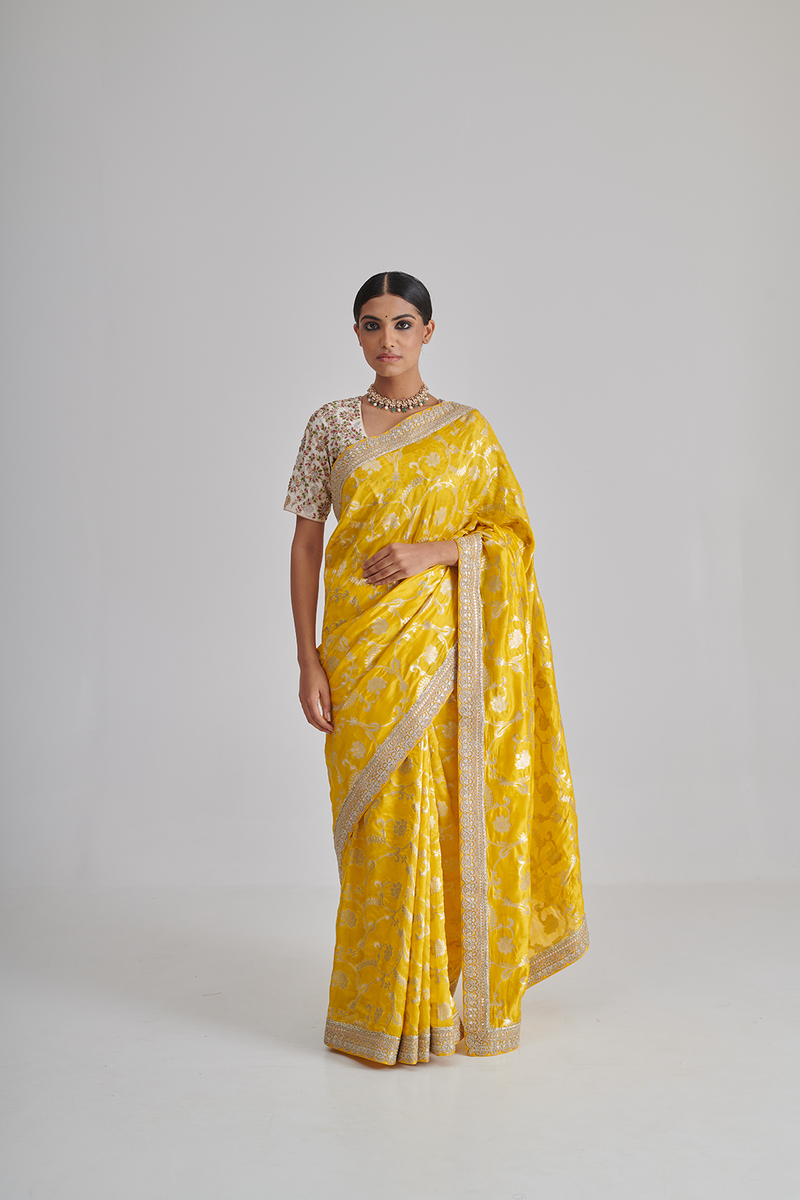
What to Wear to a Tamil Wedding: A Guest's Guide
What to wear to a Tamil wedding — muhurtham, nichayathartham, reception and nalangu, plus the colours to avoid and wh...
5 September 2026
How to Identify a Pure Silk Saree: 8 Tests That Work (and 2 That Don't)
How to check if a saree is pure silk before you pay — the burn test, Silk Mark, lustre, touch and weave checks, plus ...
20 September 2026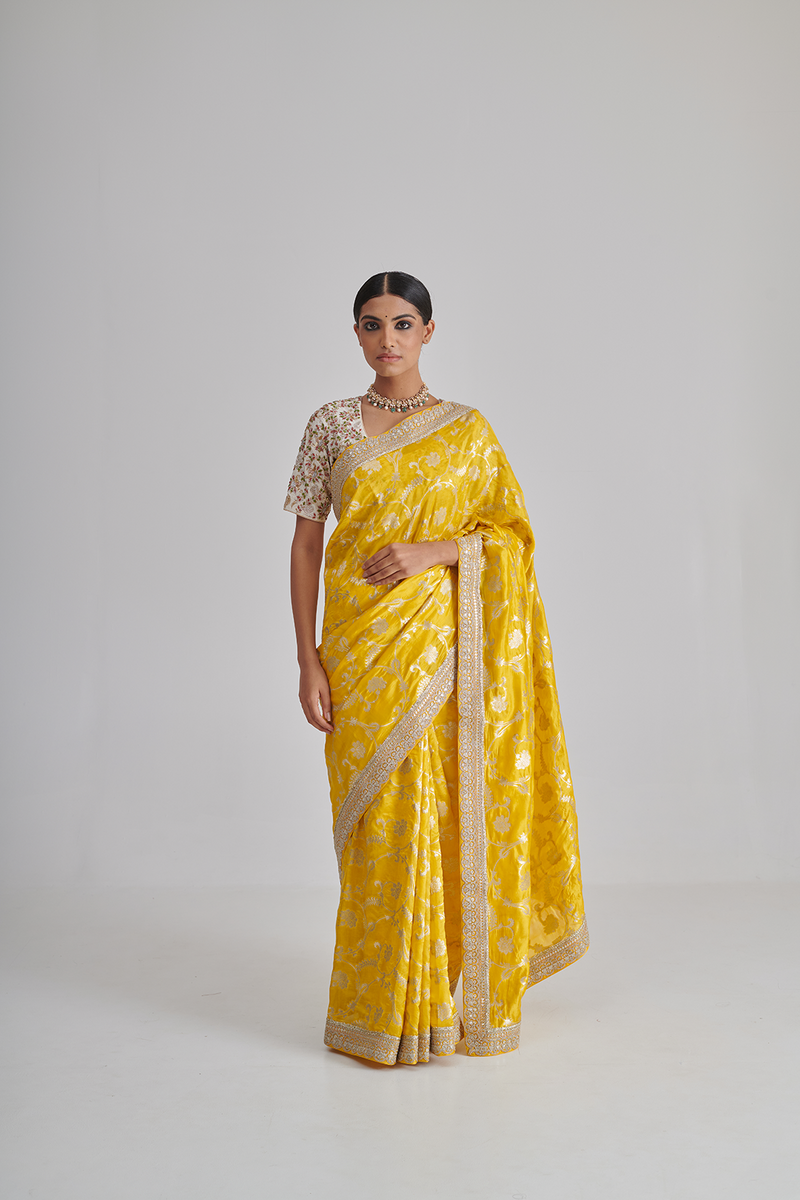
Banarasi vs Kanjeevaram: Which Silk Saree Is Right for You?
They are the crown jewels of Indian silk — the Banarasi of the north and the Kanjeevaram of the south. Both are heirl...
19 June 2026