

What to Wear to a Garhwali or Kumaoni Wedding: A Guest's Guide to Pahadi Weddings in Uttarakhand
If you are going to a Garhwali or Kumaoni wedding, the short answer is: wear warm, rich colour, keep your arms covered and plan for the cold. A silk or Banarasi kurta set, or a silk saree with a sleeved blouse, in deep pinks, saffron, gold, green or maroon is right for the wedding itself. Yellow suits the haldi. Whatever you choose has to work under a shawl, because the most important moments of a Pahadi wedding, the baraat's arrival at dusk and the pheras that follow, happen after the mountain sun has gone.
Uttarakhand has two regions, Garhwal in the west and Kumaon in the east. Their weddings share the Ganesh puja, the turmeric, the women's songs and the dhol and damau, but each has its own names, rituals and jewellery, and customs change from valley to valley. Treat this as a map rather than a rulebook. This guide is about a Pahadi family's own wedding, whether it is in a village above Almora or a banquet hall in Dehradun. A destination wedding on the Ganga is a different occasion, covered in our Rishikesh and Haridwar wedding guide. The neighbouring hill state has its own guide too: what to wear to a Himachali wedding.
What the Family Wears, and What We Don't Make
Two things will catch your eye at almost any Uttarakhand wedding, and neither is ours.
- The rangwali pichora. This is Kumaon's ceremonial veil, a long length of cloth in saffron-yellow with red dots and sacred motifs: a central swastik, the sun and moon, the conch and bell. Red stands for energy and married happiness, and saffron for the sacred. It is worn by the bride and by the married women of the family at weddings, naming ceremonies and festivals, usually over a saree or lehenga. Women once dyed it at home with turmeric or the root of the kilmora shrub and stamped the dots with a coin; today it is made in georgette, chiffon and silk.
- The nath. The bride's large gold nose ring, the nathuli or Tehri nath of Garhwal, is shaped like a crescent moon, often set with pearls and held up by a chain to the hair or ear. By tradition it is a gift from her maternal uncle. Its size was once a sign of the family's standing, and some modern brides choose a lighter one. Expect heirloom necklaces too, such as the galobandh and hansuli.
We make none of these. The pichora is a Kumaoni craft and a married woman's ritual garment; if you want one, buy it from Kumaoni makers. We do not make jewellery, shawls or woollens, and we do not make velvet. What we can do is make the outfit that goes underneath: silk and Banarasi kurta sets, sarees and blouses, cut to your measurements with room for a warm layer.
Before the Wedding: Sweets, Songs and Family
In Garhwal, families gather to make arsa, a sweet of soaked and ground rice fried with jaggery, over several days. Women hold a kirtan of devotional songs. In Kumaon, the suwal pathai brings the women of the family together to make suwal, rice-flour papads, and laddoos of black sesame. Accounts describe them wearing their rangwali pichoras even for this. Through all of it you will hear the mangal geet, the auspicious wedding songs sung by the women of both families. In Kumaon these are the shakunakhar, literally "auspicious words", and many cast the couple as Shiva and Parvati.
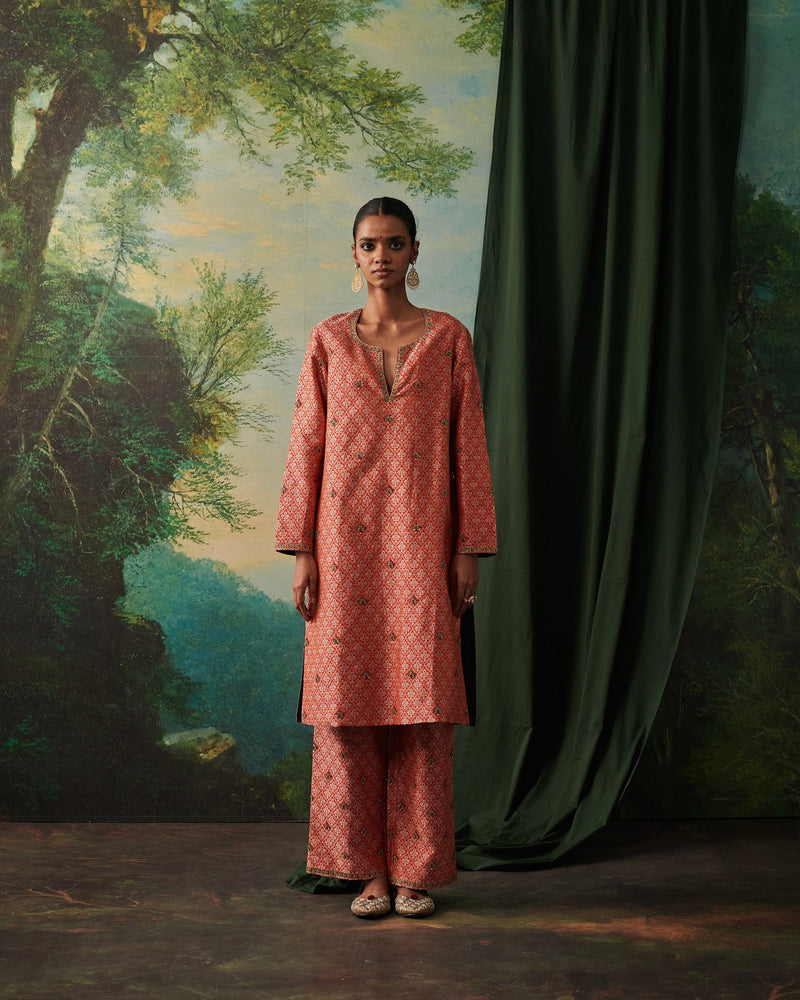
If you are invited into the house for these, dress as you would for a festive day at home with your elders: warm, covered and easy to sit in. The Shaista & Sufi set (₹18,750) is a rich burnt-orange silk kurta and pant detailed at the neckline, sleeves and hem in marodi, sequins and beads. Its own description says it is made for long evenings and intimate gatherings.
Haldi Haath and the Ganesh Puja
In Garhwal, the haldi haath, also called the baand snaan, marks the official start of the wedding. Close relatives grind homemade turmeric. Everyone applies it to the bride, or the groom at his own home, before a ritual bath and a puja with the women of the family. In Kumaon, the wedding day itself opens with the Ganesh puja, when the couple are anointed with turmeric and a kankan is tied on. This is a small bundle of betel nut, turmeric, rice and coins wrapped in yellow cloth.
Yellow is the obvious colour, and you should still wear something you do not mind being marked. The Zuhra & Reha set (₹28,450) is a sunshine-yellow Chanderi kurta with a relaxed silhouette and scoop neckline, covered in floral bouquets of hot-pink and orange resham with aari, sequins, beads and nakshi, over a matching yellow Chanderi pant. Our haldi outfit guide has more, including what to do about the stains.

The Baraat: Dhol, Damau and the Sword Dancers
You will hear a Pahadi baraat before you see it. The dhol and damau are the drums of Uttarakhand weddings, joined by the long brass ransingh and turi and the masakbeen, the bagpipe, which arrived with the British and stayed. In Garhwal, the groom's sehra is tied on before he leaves, and in many families guests garland him with notes before the procession sets off. In Kumaon, especially around Almora, Bageshwar, Champawat and Pithoragarh, the baraat may be led by chholiya dancers. They are men with swords and brass shields whose dance once protected the wedding party from evil spirits on the road.
If you walk with the baraat, you will be on hill roads and probably dancing. Wear something with sleeves that moves, and shoes that grip. The Jiya & Eshna set (₹29,500) is a vibrant fuchsia silk kurta with a marodi yoke, gold floral butis and three-quarter sleeves. Its side slits are faced in papaya-orange silk with fuchsia tassels, and it comes over a papaya-orange straight pant.
Dhuliargh: The Welcome at Twilight
The Kumaoni baraat traditionally reaches the bride's door at godhuli, the dusk hour when cattle come home and raise the dust. The welcome is called dhuliargh, from the old custom of washing the dust from the feet of a groom who had walked to his wedding. Young unmarried girls of the bride's family greet the baraat carrying water-filled kalash on their heads. The bride's father washes the groom's feet as he stands on a chowki painted with aipan, Kumaon's ritual floor art, and the women sing their welcome songs.
This is when the temperature drops, and you will be standing outside. Wear your layer, do not just carry it. The Ruhaniyat & Amber set (₹37,500) is a terracotta Chanderi kurta with a waistcoat-style overlay of fabric appliqué and gota. Its bodice is a dense trellis of marodi and aari vines with nakshi and moti roses, over a contrasting ochre Chanderi churidaar with embroidered ankle borders. Finished at the edges, it still looks complete half under a shawl.

Kanyadaan and the Pheras
The wedding proper follows. In Kumaon, the bride's father places her hand on his palm as her mother and family pour water from a small brass gaduwa, a ritual called gaduve ki dhaar. The couple's garments are joined in the aanchal bandhan with a long yellow cloth, and they walk the saptapadi around the fire while the bride's brother gives her roasted rice, kheel, to scatter. In Garhwal, after the jaimala and pheras, guests come forward to give the bride their gifts and shagun.
For a guest, this is the long, seated, coldest part of the night. Silk and Banarasi are warmer than they look. The Alfia & Ruhab set (₹33,750) is handwoven Banarasi with gold floral bootis, cut in a relaxed kurta with a wide rounded neckline. Green-and-gold sequin, cutdana and thread embroidery runs at the neckline, cuffs and back yoke, over a pant in the same weave. Its description pairs it with the Falak dupatta (₹6,500), forest-green organza silk with a soft zari border and star-like bootis. If you prefer a saree, the Phalgun & Myra sari (₹27,500) is yellow Banarasi silk with florals woven in silver thread and a rich lace border. It comes with an ivory blouse covered in embroidered floral butis, and its yellow is a quiet nod to the colour of the day. To be accurate: we do not weave Banarasi; the cloth is handwoven, and our work is the cut and the embroidery.


If You Will Be Wearing a Pichora
If you are a married woman of the family, you may well be wearing a rangwali pichora yourself, or be handed one on the day. Then the question is what goes underneath. The pichora's saffron and red are strong, so give them a plain, deep background. Silk sarees in green, magenta or maroon work beautifully, and busy prints fight it. The Humrahi & Faridah sari (₹34,500) is green silk jacquard with an all-over jaal, hand-embroidered floral butas and a densely embroidered palla and border, with a contrasting pink mulberry silk brocade blouse. Green under saffron and red is a classic combination.
For a cold night, change the blouse rather than adding another layer. The Zehraat blouse (₹25,500) is deep wine-maroon silk with full-length sleeves and a bib-style neckline of navy silk bands worked in gold zari, with orange and fuchsia florals and heavy banded cuffs. Worn with a silk saree you already own, it keeps your arms covered under the pichora and looks finished when the veil slips.


The Reception
Garhwali families often hold a reception after the wedding, where the bride is introduced to the wider family and friends of her new home. It is the one function where you can turn the glamour up. The Rangtara & Jamuni set (₹37,500) is a rose-pink silk kurta with appliqué medallions and floral sprays in resham and aari, sequins, nakshi and moti on the bodice and sleeves, over a deep plum silk pant.
The Cold: Plan for It
In Kumaon, the busiest wedding months are commonly given as April to June and September to November. Even then, evenings in the hills are cold, and winter is colder still: Almora's average December low is around 5°C, and January's is under 4°C. Dehradun, lower down, averages lows of about 6°C in December and January, with fog.
- Thermals are allowed. Nobody can see them. Tell us when you order, and we will cut with room for a thin layer underneath. Our guide to what to wear under Indian outfits covers the practical side.
- Let the shawl do the work. Choose outfits with embroidery at the edges and cuffs, so they still look finished when covered. Our winter wedding guide and hill-station wedding guide go further.
- Shoes with grip. Hill roads, stone steps and dew. Leave the stilettos behind, and see our footwear guide.
Colour: What to Wear and What to Leave
Warm, deep colours suit both the hills and the occasion: saffron, mustard, magenta, fuchsia, maroon, forest green, rust and gold. Leave the saffron-and-red of the pichora to the bride and the married women who wear it, and keep true bridal red for the family. As at most Hindu weddings, many families still avoid all-white and all-black. Keep a dupatta or your saree pallu ready to cover your head during the pujas if the women around you do.
Going to a Wedding in the Hills?
Every piece is made to order in our Jaipur atelier in 4–5 weeks, plus 3–7 days for shipping. It is cut to your measurements at no extra charge, including room for a thermal layer if you want it. An order placed today reaches you in mid-to-late November at the earliest. That makes an early-November wedding too tight, but a December or winter wedding comfortable. Tell us the dates, the town and the functions on WhatsApp, and we will be honest about what can reach you in time.
Browse Kurta SetsMore regional guides: Himachali · Nepali · Kashmiri · Uttar Pradesh · Punjabi
Frequently Asked Questions
What should a guest wear to a Garhwali or Kumaoni wedding?
A silk or Banarasi kurta set, or a silk saree with a sleeved blouse, in warm, rich colours such as saffron, magenta, maroon, green or gold. Yellow suits the haldi. Plan for cold evenings with sleeves, a shawl and, if you like, a thin thermal layer, and wear shoes with grip for hill roads.
What is the rangwali pichora?
A Kumaoni ceremonial veil in saffron-yellow with red dots and sacred motifs such as the swastik, sun, moon, conch and bell. It is worn by the bride and by married women of the family at weddings and other auspicious occasions, usually over a saree or lehenga.
What is the Tehri nath?
The large, crescent-shaped gold nose ring worn by Garhwali brides, often set with pearls and supported by a chain. It is traditionally a gift from the bride's maternal uncle, and its size once reflected the standing of her family.
What is dhuliargh in a Kumaoni wedding?
The welcome of the baraat at the bride's home, traditionally at dusk. Unmarried girls of the family greet the procession with water-filled kalash on their heads, and the bride's father washes the groom's feet as he stands on a chowki decorated with aipan, while the women sing mangal geet.
Should a guest wear a pichora to a Kumaoni wedding?
It is traditionally worn by the bride and the married women of the family, so a guest from outside the family is not expected to wear one. If the family offers you one, wear it gladly over a plain, deep-coloured silk saree so its saffron and red can show.
Made to order in 4–5 weeks
Have an event date? We’ll tell you exactly when to order by.
We take a limited number of orders each month — secure your slot early.
WhatsApp me my order-by date + a shortlistNot sure where to start?
Tell us what you're dressing for and we'll help you choose — fabric, fit, colour, and timeline — over WhatsApp or on a video call.
Your Cart
Pieces from this story
All pieces →Not sure which piece, or need it by a date? Book a video consultation Ask us on WhatsApp




Keep reading
The journal →
Rishikesh & Haridwar Wedding Outfit Ideas: What to Wear to a Ganga-Side Wedding
What to wear to a Rishikesh or Haridwar wedding — Ganga aarti, riverside haldi, the pheras and cold winter evenings, ...
25 September 2026
What to Wear to a Himachali Wedding: A Guest's Guide to Pahari Customs, Cold Evenings and the Kullu Shawl
A guest's guide to a Himachali wedding: the dham on the floor, nati in the courtyard, cold pheras, and how to wear an...
25 September 2026
Haldi Outfit Ideas: What to Wear to a Haldi Ceremony
The best haldi ceremony outfits — yellow kurtas, sarees, and lehengas for brides, sisters, and guests. Styling tips, ...
5 March 2026