
India Couture Week 2026 Highlights: Every Show, From Hyderabad to the Devi Finale
Hyundai India Couture Week 2026, the Fashion Design Council of India's 19th couture week, ran from 23 to 29 July. For the first time it opened outside Delhi, with Anamika Khanna's "Moonlit Palace" at Taj Falaknuma Palace in Hyderabad, before moving to the Taj Palace in New Delhi. The headlines: House of Masaba showed its first bridal collection, Chardi Kala; the House of Rohit Bal dedicated "Dastkar" to its artisans; JJ Valaya, Tarun Tahiliani and Rimzim Dadu each tried something new; and Rahul Mishra closed the week with "Devi", first seen in Paris, with Sobhita Dhulipala as showstopper. Below is the show-by-show recap, then seven bridal and occasionwear takeaways for the 2026–27 wedding season.
We are a small handmade label in Jaipur and had no part in the week; our pieces appear only where a runway idea matches what a piece already is. For our forecast of next year's brides, see bridal lehenga trends 2027. This post is the record of what was shown.
The Shows, Night by Night
Anamika Khanna, "Moonlit Palace" (23 July, Hyderabad). The opening show moved through chapters: the palace setting, then Barmer, then Kolkata. Harper's Bazaar India (30 July) described fluid drapes, mirrorwork, gold-foil detailing and hand embroidery. The Barmer textiles were developed with women's craft communities there and reworked through dyeing, embroidery and hand-painting. Open magazine (31 July) noted references to Kalighat painting. Elle India's front-row report (3 August) noted that there were no predictable saris or lehengas: instead came Victorian-inspired skirts, sheer tulle and black jodhpurs, and, for men, tailcoats with tulle peeking out from sherwanis.
Falguni Shane Peacock, "Le Grand Voyage", and House of Rohit Bal, "Dastkar" (first night in Delhi). Falguni Shane Peacock's travelogue, made with Kohler, drew on Byzantine mosaics, Belle Époque Paris, Strasbourg, Bavarian palaces and the Taj Mahal, according to ANI: hand-beaded jackets and lehengas, embroidered sherwanis, corsetry and capes. The House of Rohit Bal followed. Bal died on 1 November 2024 (FashionNetwork), and the house returned to couture week in 2025 under creative director Fraze Tasnim, per FDCI's Manifest magazine. This year's Dastkar was dedicated to the embroiderers, weavers, dyers, pattern makers and karigars who have worked with the house for over thirty years: silks and velvets, French-tapestry ideas and Bal's lotus, peacock, rose and chinar motifs, per ANI. Elle India's reviewer, using the nickname Bal was known by, put the room's mood simply: "Gudda, we missed you."
House of Masaba, "Chardi Kala" (25 July). The label's first bridal collection, and its first couture-week show in six years, according to Luxebook. Chardi kala is the Punjabi idea of rising optimism. Open magazine (28 July) described supersized, gold-heavy patterns, pastels to jewel tones, pineapple and tropical-plant motifs, and a shift into resort looks drawn from Masaba's Antiguan roots. Open (31 July) also noted shorter lehengas and lehenga-and-corset pairings. "For me, optimism is in the hemlines. Optimism is when your lehenga can finally become shorter," Masaba told the magazine. Madhu Sapre, back on the runway, closed in what The Telegraph's t2 called "her flowy red look, statement accessories and headgear".
JJ Valaya, "SIDDI" (25 July). Valaya's Autumn/Winter 2026 collection took its name from the Siddi community, Indians of East African descent. India TV (26 July) listed lehengas, contemporary saris, anarkalis, sherwanis and bandhgalas in antique gold, ivory, noir, champagne, jewel tones and earth hues. "For me, there is no difference between an artist and an artisan," he told Open.
Tarun Tahiliani, "Navaratna" (26 July, Bikaner House). Tahiliani skipped the runway: Navaratna, "nine jewels", was a walk-through exhibition with projection mapping, per the Deccan Chronicle's preview and Harper's Bazaar India. Open (28 July) described single solid colours (ivory, golden beige, bright red, green), corsetry and draping, beside archive Ajrakh and Pichhwai work. A conceptual section called Ang, "body", carved collarbones and shoulder blades into the garments.
Roseroom and Rimzim Dadu (26 July). Isha Jajodia's Roseroom debuted with "Softly, Strong": lace, clay florals, pearls, crystals and sculptural corsetry across more than 50 looks (Harper's Bazaar India). Rimzim Dadu's "INLAE" set hand-cut mother-of-pearl, after Mughal inlay, into her signature steel-wire textiles across around 45 looks, from sculptural saris to cropped bandhgalas (Apparel Resources). "When I started looking closely at inlay work, what really fascinated me wasn't just how beautiful it is, but the process behind it," she told Open.
Arpita Mehta, "Ceremonial", and Kunal Rawal, "Rawalgarh" (27 July). Debutant Arpita Mehta added bandhani, Banarasi, tissue and kantha to her mirror work: mermaid lehengas, corseted blouses and pre-stitched saris, per Open and Harper's Bazaar India. Kunal Rawal marked 15 years with more than 150 menswear looks.
Dolly J, "BRĀHM", and Jayanti Reddy, "The Gilded Era" (28 July). Dolly J traced a Himalayan day in crimson, antique gold, ivory, silver and copper, and Vaani Kapoor closed in a burgundy lehenga, The Tribune reported. Jayanti Reddy turned to Hyderabad's Nizami-era embroidery; Aditi Rao Hydari and Siddharth closed together, she in a gold-and-beige peplum bodice over a sharara worked in zardozi, beads and sequins, he in an embroidered sherwani.
Aisha Rao, "Priyasi", and Rahul Mishra, "Devi" (29 July, finale). Aisha Rao used polychromatic appliqué and bio-based bio-resham and bio-badla (Harper's Bazaar India). Rahul Mishra closed with Devi, inspired by ancient South Indian temple sculpture and first shown at Paris Haute Couture Week earlier in July, per ANI. Elle India described zardozi, dabka, crystals and bugle beads built into carved-looking surfaces, plus a small bridal capsule; a Festive Couture line added zardozi and hand-painted textiles. Sobhita Dhulipala entered in a Devi bodysuit; then, as Open described it, dancers wrapped a lehenga around her on the runway. For Mishra's Paris story, see our recap of Indian designers in Paris in 2026.
Seven Takeaways for the 2026–27 Wedding Season
1. Red took back the bridal centre
On the runway: Madhu Sapre's red at Masaba, Dolly J's crimson and Vaani Kapoor's burgundy, Tahiliani's bright red. ETV Bharat's round-up (31 July) called it bridal reds replacing pastels.
In a handmade wardrobe: red does not have to mean heavy. The Rangrez saree (₹22,500) is deep red chiffon, dyed in a colour like alta on a bride's feet, with floral bootis hand-embroidered in sequins and bead work in ivory, saffron, plum and rose, and a softly shimmering border. The blouse is separate.

2. Mirror work and regional cloth went couture
On the runway: the opening show put Barmer's mirrorwork and craft communities on the most glamorous stage of the week, and Arpita Mehta's debut was built on mirror work with bandhani and Banarasi.
In a handmade wardrobe: mirror work at its best is placed with intent. The Shafaq blouse (₹15,650) is black raw silk covered in mirrors set in a geometric grid, each outlined by hand in resham, cutdana and beads, with delicate straps and a sculpted neckline. The Sarmaya saree (₹35,100) is black chiffon with a continuous mirror-work border on every edge and floral mirror-embroidered bootas on the pallu. Our mirror-work brands roundup covers the wider field. A note: we don't make kantha, and we don't weave; we buy handwoven cloth and embroider it in Jaipur.


3. The corset is now couture's default
On the runway: t2's couture guide (2 August) put corsets first in its trend list. They appeared at Falguni Shane Peacock, Roseroom and Jayanti Reddy, in Arpita Mehta's corseted blouses, in Masaba's lehenga-and-corset pairings and in Tahiliani's body-shaped Ang pieces.
In a handmade wardrobe: our closest equivalent is the bustier, worn over a saree or sharara. The Veda & Tishya set (₹18,500) pairs a yellow silk bustier (sweetheart neckline, noodle straps, vertical lines of gold zari, resham and beadwork) with an open-front silver-grey silk cape worked in gold marodi and zari. The Mastani, Leyla & Nalini set (₹21,500) is emerald cheniya bandhani jacquard silk with gold and silver woven florals: a strap bustier, a one-shoulder cape with a hand-embroidered border, and a sharara. We cut to your measurements at no extra charge; for design changes, ask us on WhatsApp what is possible. More in our corset blouse guide.
4. The bride doesn't need a floor-sweeping lehenga
On the runway: Aditi Rao Hydari closed Jayanti Reddy's show in a zardozi sharara, not a lehenga, and Masaba openly argued for shorter hems.
In a handmade wardrobe: the Rohi & Zoey sharara set (₹25,795) is tissue silk, a luminous yellow kurta with rose-gold and pistachio embroidery at the neck and sleeves over a pale mint sharara in wide pleats, hand-embroidered in zardozi, sequins, cutdana and beads. For something grander, the Zehan & Aabha set (₹62,250) pairs a purple silk kurta covered in a trellis of hand-folded gota appliqué, with sequins, resham and moti, with a gold tissue sharara. See our sharara vs lehenga guide or browse our sharara sets.


5. Mughal and Nizami heritage was the shared reference
On the runway: Rimzim Dadu built a collection on Mughal inlay, Jayanti Reddy on Nizami Hyderabad, and the week opened in a Nizam's palace.
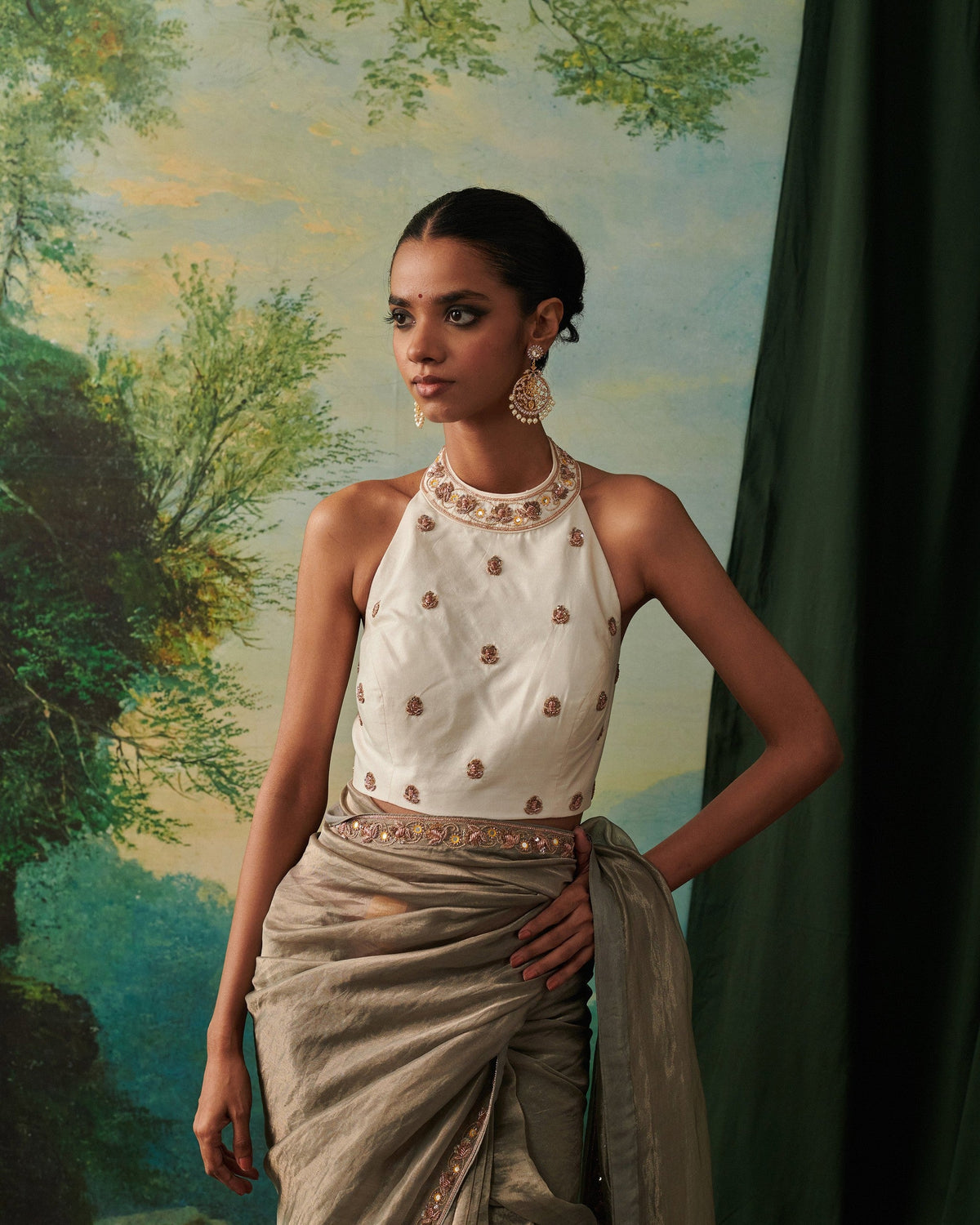
In a handmade wardrobe: the Rehmat & Vasl lehenga (₹42,500) is rich red Varanasi silk brocade with florals drawn from the inlay designs of Rajputana and Mughal architecture, gold zari work all over and a broad gold border; the dupatta is not included. The Haseena blouse (₹15,475), from our new Haseena collection, is ivory silk in a structured halter, its neckline hand-embroidered in mirror work, cutdana, sequins and zardozi after Mughal motifs from royal collars and borders. We don't work in mother-of-pearl, and moti in our pieces means pearl beads, not real pearls.

6. Bridal can be playful
On the runway: Masaba's pineapples and tropical prints, a resort chapter inside a bridal show, and colour from pastel to jewel tone. For mehendi, sangeet or a destination function, the week gave permission for fun.
In a handmade wardrobe: the Rumi, Akira & Vihana set (₹16,500) pairs a rani pink dupion silk blouse with an orange ombre cheniya bandhani brocade draped skirt and a sheer organza cape that shades from pink to orange, embroidered with florals in sequins, beads and aari.
7. The artisan took the bow
On the runway: Dastkar was dedicated to karigars by name, the opening show credited Barmer's women's craft communities, Harper's Bazaar India headlined its recap as a celebration of "the artisans, the atelier, and the art of couture", and Valaya called artist and artisan one and the same.
What it means for you: ask who made your outfit, and how long it took. Every piece of ours is hand-embroidered by karigars in our Jaipur atelier; our karigars piece introduces the people and our hand vs machine embroidery guide shows how to tell the difference.
An Honest Note on Couture and on Us
Couture week is made-to-measure at the very top. We work at a very different scale: we have eight lehengas in our lehenga collection, so for brides our offer is made-to-measure handwork, not a big bridal range. Our made-to-order bridal guide explains how it works, and bridal lehenga trends 2026 is useful background. We don't make velvet, kantha, steel-wire or mother-of-pearl textiles, jewellery or menswear. For the season's prêt side, see our Lakmé Fashion Week x FDCI 2026 recap.
Timing: everything above is made to order in 4–5 weeks plus 3–7 days of shipping. Ordered today, 30 October 2026, a piece arrives around the first week of December at the earliest: too late for Diwali on 8 November, comfortable for weddings from mid-December to February. For an early-December date, ask on WhatsApp; express is sometimes possible, depending on the piece and the month.
Sources: ANI schedule (15 July 2026) and show reports (25, 26 and 30 July); The Telegraph t2 (23 July and 2 August); Outlook Luxe (24 and 30 July); India TV (26 July); Luxebook (27 July); Deccan Chronicle (17 July); Open magazine (28 and 31 July); The Tribune (29 July); Harper's Bazaar India (30 July); ETV Bharat (31 July); Elle India (3 August); Apparel Resources (July); Manifest magazine, FDCI (2025); FashionNetwork (November 2024).
Loved Something From Couture Week?
Send us the look and your wedding date on WhatsApp, and we'll tell you honestly which of our pieces comes close, whether that's red, mirror work, a bustier or a sharara. Every piece is hand-embroidered by karigars in Jaipur, made to order in 4–5 weeks, and cut to your measurements at no extra charge.
Shop the CollectionMore runway recaps: Indian designers in Paris 2026 · Lakmé Fashion Week 2026 · Bridal lehenga trends 2027 · Indian fashion trends 2027
Frequently Asked Questions
When and where was India Couture Week 2026?
Hyundai India Couture Week 2026, FDCI's 19th edition, ran from 23 to 29 July 2026. It opened with Anamika Khanna at Taj Falaknuma Palace in Hyderabad, the first time the week opened outside Delhi, and then moved to the Taj Palace in New Delhi.
Who opened and closed India Couture Week 2026?
Anamika Khanna opened with Moonlit Palace in Hyderabad on 23 July. Rahul Mishra closed the week on 29 July with Devi, a collection first shown at Paris Haute Couture Week, with Sobhita Dhulipala as his showstopper.
What was Masaba Gupta's Chardi Kala collection?
House of Masaba's first bridal collection, shown on 25 July: wedding wear mixed with resort looks, gold-heavy patterns, tropical motifs and shorter lehengas. Madhu Sapre closed in red.
What were the biggest trends at India Couture Week 2026?
Bridal red, mirror work and regional textiles, corsets, shararas and shorter hems, Mughal and Nizami heritage, playful resort bridal, and artisans credited by name.
Can I get a couture-inspired outfit made for a December wedding?
From us, yes for mid-December onwards: 4 to 5 weeks of making plus 3 to 7 days of shipping means a late-October order arrives around the first week of December at the earliest. For an earlier date, ask us on WhatsApp about express.
Made to order in 4–5 weeks
Have an event date? We’ll tell you exactly when to order by.
We take a limited number of orders each month — secure your slot early.
WhatsApp me my order-by date + a shortlistNot sure where to start?
Tell us what you're dressing for and we'll help you choose — fabric, fit, colour, and timeline — over WhatsApp or on a video call.
Your Cart
Pieces from this story
All pieces →Not sure which piece, or need it by a date? Book a video consultation Ask us on WhatsApp


Keep reading
The journal →
Bridal Lehenga Trends 2027: What the 2026 Runways Tell Us About Next Year's Brides
Our 2027 bridal forecast from India Couture Week and Lakmé Fashion Week 2026: lighter lehengas, deeper reds, saree br...
27 October 2026
Indian Designers in Paris, 2026: Rahul Mishra's Devi, Manish Malhotra's Couture Debut, and What It Signals
Rahul Mishra's Devi, Manish Malhotra's couture debut, Vaishali S's handloom Swayam, AFEW and AK|OK in Paris: what Ind...
30 October 2026
Best Mirror Work Ethnic Wear Brands in India 2026: Designers, Kutch Craft & How to Judge Shisha
Where to buy mirror work (shisha) ethnic wear in India: designer labels, Kutch craft collectives and Jaipur ateliers,...
1 October 2026