

Where to Shop for Indian Clothes in Europe: The Hague, Paris, Germany & Beyond
If you have ever shopped for a wedding outfit in London, New Jersey or Dubai, continental Europe comes as a shock. There is no Southall here. There are a few genuinely good streets — one in The Hague, one in Paris — and a scattering of single boutiques across Germany, Italy, Belgium and Scandinavia. For many families on the continent, the nearest serious lehenga shopping is a train ride or a flight away. That makes Europe the part of the diaspora where ordering directly from India matters most.
This guide covers the places that are worth the trip, what each is good and not so good for, and how to order from India without being surprised by customs. As with our other city guides, we name areas and streets rather than individual shops, which open and close faster than any guide can keep up with.
The Netherlands
The Hague — Paul Krugerlaan and the Transvaal Quarter
The best Indian-clothes street in continental Europe is not where most people expect. Paul Krugerlaan and Paul Krugerplein, in The Hague's Transvaalkwartier near the Haagse Markt, are known for Hindustani bridal fashion, with sari shops lining the street in both directions alongside Hindu religious-goods stores, jewellers and Surinamese roti shops.
The reason is history. Most Hindus in the Netherlands trace their roots to Suriname, where Indian indentured workers were taken from the 1870s, and many of their descendants moved to the Netherlands around and after Surinamese independence. So the style here has its own accent — Hindustani wedding traditions that are Indian in origin but a century and a half removed from India. It is excellent for bridal sarees, lehengas, puja items and wedding accessories. If you are shopping for a contemporary Jaipur or Delhi look, go with a clear picture of what you want.
Indian families elsewhere in the Netherlands — including the large community of Indian professionals around Amsterdam and Amstelveen — tend either to make the trip to The Hague or to order online.
France
Paris — Rue du Faubourg Saint-Denis, Passage Brady and La Chapelle
Paris's "Little India" runs through the 10th arrondissement. Passage Brady, a covered arcade built in 1828 and split in two by the Boulevard de Strasbourg, is lined with Indian, Pakistani, Sri Lankan, Mauritian and Réunionese restaurants and shops. From there, the shops follow Rue du Faubourg Saint-Denis north towards the Gare du Nord and on to La Chapelle — often called Little Jaffna for its Sri Lankan Tamil community — where you will find sari shops, jewellers and fabric sellers side by side with grocers.
It is a lively afternoon and a good place for sarees, blouse fabric, bangles and puja essentials. Because the community is largely Sri Lankan Tamil, Pakistani and Mauritian, the styles lean that way; North Indian occasion wear is thinner on the ground. One practical note for Paris: the Eurostar reaches London in a little over two hours, and plenty of Parisian families save the big wedding shop for a day in Southall — our London guide covers it.
Germany
Frankfurt — around the Hauptbahnhof
Germany's Indian community has grown quickly, but it is spread across many cities, and there is no single Indian shopping street to match The Hague or Paris. Frankfurt comes closest: a handful of sari and ethnic-wear boutiques sit in the Bahnhofsviertel near the main station, on and around Kaiserstraße and Taunusstraße.
Munich, Berlin and elsewhere
Munich and Berlin each have individual Indian boutiques and grocers that carry some clothing, but not a concentration you could spend an afternoon in. Many German-based families rely on community groups for recommendations and, above all, on online orders — which is why the customs section below matters more here than almost anywhere.
The Rest of Europe
In Belgium, Ireland, Italy, Switzerland and the Nordic countries you will find individual boutiques in the larger cities, but no shopping district we could confidently send you to. From Brussels, as from Paris, London is close enough by Eurostar that a day in Southall or on Green Street is realistic before a big wedding.
What Local Shopping Is Good For — and What It Isn't
- Good for: puja items, bangles and accessories; a saree needed this week; blouse fabric; seeing colour in person; Hindustani and Sri Lankan Tamil wedding traditions, which The Hague and Paris serve very well.
- Less good for: range — even the best streets are a fraction of Southall; price, because every piece has travelled and carries a mark-up; genuine hand embroidery, which is rarer on the rack than the labels suggest; and fit, since ready-made stock runs to standard sizes and a good alteration tailor who understands a lehenga is hard to find outside those two cities.
Ordering From India: Customs, VAT and Timing
For a wedding or any piece you want to keep, ordering from a designer or atelier in India usually gets you better fabric, real handwork and a cut to your own measurements — and in most of Europe it is simply the more realistic option. A few things to plan for:
- Expect import VAT. Since July 2021 the EU charges import VAT on goods from outside the EU from the first euro — the old small-parcel exemption is gone. Customs duty can also apply, and the EU has been changing its rules for low-value parcels, so check the current position with your courier or national customs authority before you order.
- Ask how duties are paid. Some shipments arrive with duties to be settled on delivery; knowing that in advance saves a parcel sitting in a depot. Ask the seller how the parcel will be declared.
- Allow eight to ten weeks. Made-to-order takes 4–5 weeks, international shipping adds time, and you want a cushion before the event.
- Measure once, carefully. Our measurement guide shows how, and a video consultation removes most of the guesswork. When the piece is cut to your measurements, you are not depending on finding a local tailor for alterations.
Our guides to international custom orders and Indian brands that ship internationally go further.
Dressing for a European Winter
Diwali on 8 November 2026 will be a cold, dark evening almost everywhere in Europe, and a winter wedding party usually means an overcoat on the way from the car. That favours richer, heavier cloth — brocade, velvet, silk — and pieces with structure. (Our guide to Diwali abroad goes through office dinners, house parties and temple visits.)
The Raat Rani, Vani & Kiyara set (₹16,500) is the most European piece we make: a fitted blazer with a hand-embroidered collar and wide-leg pants in black Varanasi silk brocade, with an all-over jaal of gold motifs, worn over a dupion silk bustier. It works for a Diwali dinner, and it is also our answer to the Indian guest at a European church or civil wedding — see our guide to wearing Indian clothes to a Western wedding.

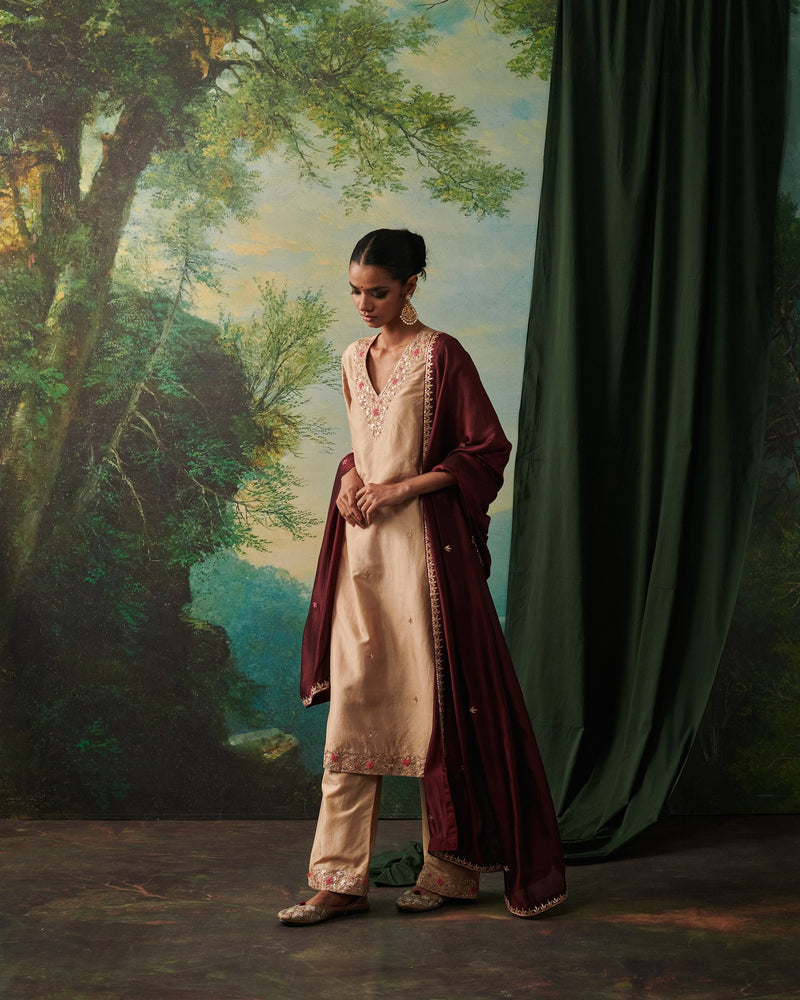
For real cold, the Manisha Deorah in Sahiba set (₹27,500) is deep maroon velvet, hand-embroidered in antique gold with kasab dori, metal sequins and zardozi, with a matching velvet palazzo and a sheer maroon organza dupatta. The Rangrez & Aliza set (₹18,750) pairs a moonga silk brocade kurta woven with gold motifs with silk pants in a floral jaal print, finished with aari and zardozi.


For a wedding, the Humrahi & Faridah saree (₹34,500) is green silk jacquard with hand-embroidered floral butas and a densely embroidered palla, paired with a pink mulberry silk brocade blouse. And the Rehmat & Vasl lehenga (₹42,500) is rich red Varanasi silk brocade with gold zari work all over and a broad gold border at the hem — weight that looks right under candlelight in December (the matching dupatta is sold separately).
If you only want one thing, a dupatta travels best. The Aftaab dupatta (₹9,500), in maroon organza silk with a hand-embroidered gota and thread border, lifts a plain suit or a black dress you already own. Browse all our dupattas and lehengas. Once your pieces arrive, our guide to caring for Indian clothes abroad covers central heating, damp and finding a cleaner who will handle zardozi.
Ordering From Europe?
Message us on WhatsApp with your event date and city. We will tell you honestly whether a piece can reach you in time, walk you through measurements on a video call, and cut it to fit at no extra charge.
Browse the CollectionMore city guides: London · USA & Canada · Dubai & the Gulf · Australia & New Zealand · Singapore & Malaysia · South Africa · East Africa
Frequently Asked Questions
Where can I buy Indian clothes in the Netherlands?
Paul Krugerlaan and Paul Krugerplein in The Hague's Transvaal quarter, near the Haagse Markt, have the largest concentration of sari and Hindustani bridal-wear shops in the country. Families elsewhere in the Netherlands usually travel there or order online.
Where is Little India in Paris?
In the 10th arrondissement: Passage Brady, Rue du Faubourg Saint-Denis and the streets around La Chapelle metro, north of the Gare du Nord. You will find sari shops, jewellers and fabric sellers alongside Indian, Pakistani and Sri Lankan restaurants.
Where can I buy Indian clothes in Germany?
Germany has no single Indian shopping street. Frankfurt has a few boutiques in the Bahnhofsviertel near the main station, and Munich and Berlin have individual boutiques. Most families order online for weddings and major festivals.
Do I pay VAT or customs duty on Indian clothes shipped to Europe?
Usually, yes. Since July 2021 the EU charges import VAT on goods from outside the EU from the first euro, and customs duty can also apply. The rules for low-value parcels have been changing, so check the current position with your courier or customs authority and ask the seller how the parcel will be declared.
How early should I order an Indian outfit from India for an event in Europe?
Allow eight to ten weeks. Made-to-order pieces take 4–5 weeks to make, international shipping and customs clearance add time, and a small cushion before the event takes the stress out.
Made to order in 4–5 weeks
Have an event date? We’ll tell you exactly when to order by.
We take a limited number of orders each month — secure your slot early.
WhatsApp me my order-by date + a shortlistNot sure where to start?
Tell us what you're dressing for and we'll help you choose — fabric, fit, colour, and timeline — over WhatsApp or on a video call.
Your Cart
Pieces from this story
All pieces →Not sure which piece, or need it by a date? Book a video consultation Ask us on WhatsApp



Keep reading
The journal →
Where to Shop for Indian Clothes in London: A Complete Guide
A London guide to buying Indian wedding and festive clothes — Southall, Green Street, Wembley, Ealing Road and the de...
12 September 2026
How to Measure Yourself for Indian Clothes: A Complete Guide
Learn how to take accurate measurements for Indian clothes: blouses, kurtas, lehengas, and more. Step-by-step measuri...
13 April 2026
Virtual Consultation Guide: How Remote Custom Ordering Works
How to order custom Indian wear remotely. Step-by-step virtual consultation process—from first contact to delivery, w...
18 May 2026