
Best Sustainable Indian Ethnic Wear Brands in 2026: Handloom, Natural Dye and Slow-Made Labels
The short answer: for handloom, look at Raw Mango, Anavila, Eka and Injiri. For natural dyes and hand-spun cotton, 11.11/eleven eleven and Anokhi. For upcycling and waste, Ka-Sha and Péro. For craft at a larger scale and lower prices, Fabindia and Jaypore. Each label below is listed for one specific practice we could confirm from its own pages or from reporting, not for using the word "sustainable". We are a small Jaipur label ourselves, and we have added ourselves at the end, clearly marked, with an honest account of what we do and do not do.
"Sustainable" is the most overused word in Indian fashion, and on its own it tells you nothing. So this guide does two things: it names labels for what they actually do, and it gives you the questions that separate a real practice from a nice caption. If you want the bigger argument for why handmade matters, our essays on why handmade is the future of Indian fashion and handmade fashion and Earth Day make it. This one is a shopping guide.
What to Actually Check Before You Pay
- Is it handloom, or "handloom-look"? The government's Handloom Mark, run by the Textiles Committee since 2006, is a label for genuinely handwoven textiles. Newer labels carry a QR code you can scan with the Handloom Mark app or check on hlm.gov.in to see the weaver and place of origin. The separate India Handloom Brand, launched on the first National Handloom Day in August 2015, goes further: it endorses quality and social and environmental compliance in production. Plenty of honest handloom is sold without either mark, but if a seller claims one, ask to see it.
- Is the craft certified? Craftmark, run by the non-profit All India Artisans and Craftworkers Welfare Association, certifies genuine Indian handmade products made in a socially responsible manner, including minimum wages for artisans.
- Natural dye or synthetic? "Natural fabric" and "natural dye" are different claims; cotton or silk can be dyed with anything. India banned the handling of 42 benzidine-based dyes in 1993 and 70 more azo dyes in 1997, so the worst are already illegal. Beyond that, if a label says natural dyes, ask which plants (indigo, pomegranate, madder) and whether that covers the whole garment or one print.
- Made to order or made for stock? Unsold seasons are fashion's quietest waste. A piece made after you order it, in your size, avoids that.
- Who made it, and where? Look for named clusters, towns or communities. "Made by artisans" with no place attached is a caption, not information.
- Can it be altered or repaired? The most sustainable outfit is the one you wear for twenty years. Ask about alterations, spare embellishment and care before you buy. Our guide to caring for Indian fabrics covers the rest.
Signs of greenwashing: "eco" or "conscious" with no material, place or number behind it; organic claims with no certificate to check; one recycled-fibre capsule used to sell an entire synthetic range; and "handcrafted" on pieces that are machine embroidered. Our hand vs machine embroidery guide shows how to tell from the reverse.
Handloom-First Labels
Raw Mango
Sanjay Garg founded Raw Mango in 2008, starting with a handful of Chanderi weavers in Madhya Pradesh and, unusually for the time, working only with handloom. The label now creates its textiles with weavers across Rajasthan, Madhya Pradesh, West Bengal, Andhra Pradesh and Varanasi, and describes a decentralised model built on minimum extraction and minimum waste, with nothing mass-produced. It is luxury pricing, and you are paying for the weave itself.
Best for: Handloom sarees where the textile is the whole point.
Anavila
Anavila Misra, a NIFT graduate who spent years in the handloom sector through government rural development work, launched her label in 2011 and is credited with bringing the handwoven linen saree into Indian fashion, made with weaving communities in West Bengal. The label has also made small Busa dolls from leftover fabric.
Best for: Linen sarees for daytime, work and summer weddings.
Eka
Rina Singh launched Eka in 2011 after a decade in mainstream fashion. Her Delhi studio produces small batches in mostly handwoven and handspun fabrics, including khadi, jamdani, linen, cotton and silk, in quiet, wearable shapes.
Best for: Everyday handwoven separates and easy kurtas.
Injiri
Founded in 2009 by textile designer Chinar Farooqui, Injiri (the name means "real India") designs alongside weavers at their looms, working from her Jaipur studio with a network of handloom collectives from Gujarat to West Bengal. The clothes are built around the cloth, and there is a home textile line too.
Best for: Regional handwoven textiles in simple, modern cuts.
For the fabric story behind all four, see our guide to khadi and handloom as slow fashion.
Natural Dyes and Hand-Spun Cotton
11.11/eleven eleven
The pret label of CellDSGN, run by Shani Himanshu and Mia Morikawa, is one of the most open about its supply chain. It works with indigenous cotton, including rain-fed kala cotton from Gujarat, uses hand spinning and hand-loom weaving, and says it uses 100% natural dyes, from indigo leaves, pomegranate shell and similar sources. Its own description is "seed to stitch" and small-batch. The aesthetic leans contemporary rather than festive.
Best for: Khadi, indigo and anyone who wants to know where the cotton grew.
Anokhi
Founded in Jaipur in 1970 by John and Faith Singh to revive Rajasthani hand block printing and natural vegetable dyes at a time when both were giving way to synthetic, factory methods. It still works directly with Rajasthani craftspeople, and its Anokhi Museum of Hand Printing in Amber is the best introduction to the craft you will find. Our Jaipur designer labels guide covers it alongside the city's other block-print names.
Best for: Block-printed cotton at accessible prices.
Upcycling and Waste
Ka-Sha
Karishma Shahani Khan launched Ka-Sha in Pune after studying at the London College of Fashion. Its sister line, Heart to Haat, is built on upcycling: Ka-Sha's own cutting scraps, and fabric waste from others, become patchwork clothing, accessories and homeware. The label also says it mends and restores pieces with minor defects rather than discarding them.
Best for: Colourful, craft-heavy pieces with a genuine waste practice behind them.
Péro
Aneeth Arora started Péro in 2009, and handwoven fabrics, layered embroidery and small-batch making are its signature. Its sub-line, Upcycled by Péro, takes customers' own worn garments and reworks them with the label's embroidery, tassels and crochet buttons. It is selective, so ask first.
Best for: Giving a loved old piece a second life.
One more name, though it is not ethnic wear: Doodlage, Kriti Tula's Delhi label, has made contemporary clothing from factory-discarded fabric since 2012.
Craft at Scale
Fabindia
The largest name here, and the most structurally interesting. From 2007 Fabindia set up supply-region companies in which the artisans who supply it hold shares, a 26% collective stake when the model was set up, alongside the company's own microfinance arm. It sources handwoven and handmade goods from tens of thousands of craftspeople. It is a large range, so read each product's fabric line.
Best for: Everyday kurtas and sarees from named crafts at high-street prices.
Jaypore
Founded in 2012 and part of Aditya Birla Fashion and Retail since 2019, Jaypore curates handmade and handwoven clothing from more than 70 craft clusters, including Chanderi, Jamdani, Kanjivaram, Banarasi, Bhujodi and Maheshwari weaves. It is a good way to compare regional handlooms in one place.
Best for: Exploring many regional weaves before committing to one.
Rashika Mittal: What We Do, and What We Don't
We will state our interest plainly, and without the usual adjectives. We are a small label with our atelier in Vaishali Nagar, Jaipur. Four things are true of how we work:
- Everything is made to order. We cut and embroider a piece after it is ordered, over 4–5 weeks, so we do not carry racks of unsold seasonal stock.
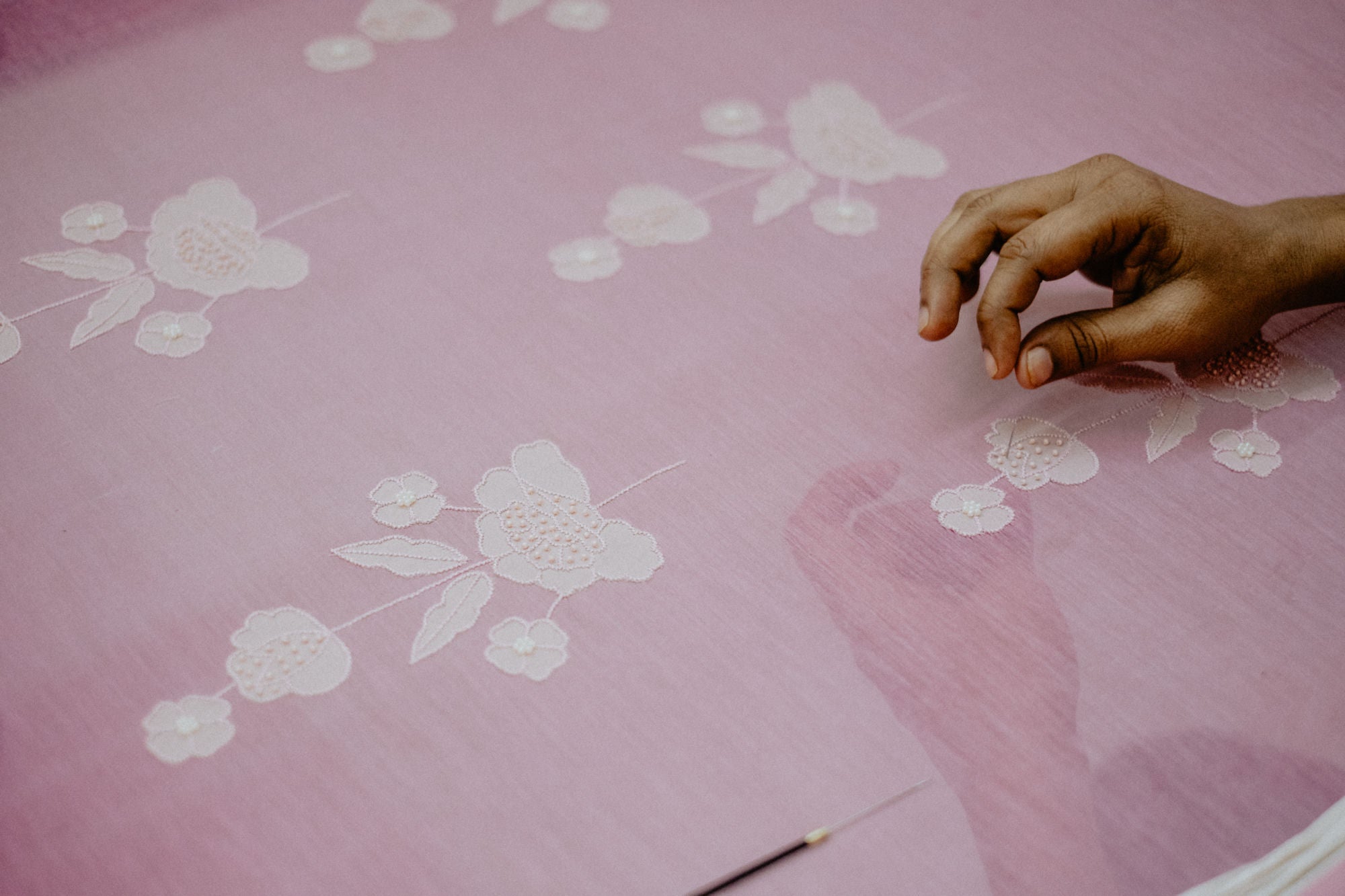
- The embroidery is done by hand by karigars in our own atelier: zari, aari, zardozi, gota, marodi, resham, sequins and cutdana. Our piece on the karigars behind Indian embroidery explains the work.
- We do not weave. We buy handwoven cloth such as chanderi, Banarasi and brocade and embroider it. Not every fabric we use is handwoven, so check the product page or ask us.
- Custom measurements cost nothing extra, so the piece fits the first time and does not need heavy alteration.
Just as plainly, here is what we do not claim. We make no organic, natural-dye or zero-waste claims, we hold no sustainability certification, and we have no carbon figures to give you. If those matter most to you, the labels above are a better match. Where we fit is hand-embroidered occasion wear on handwoven cloth, made to your measurements and meant to be worn for years.
Handwoven Banarasi, embroidered by hand
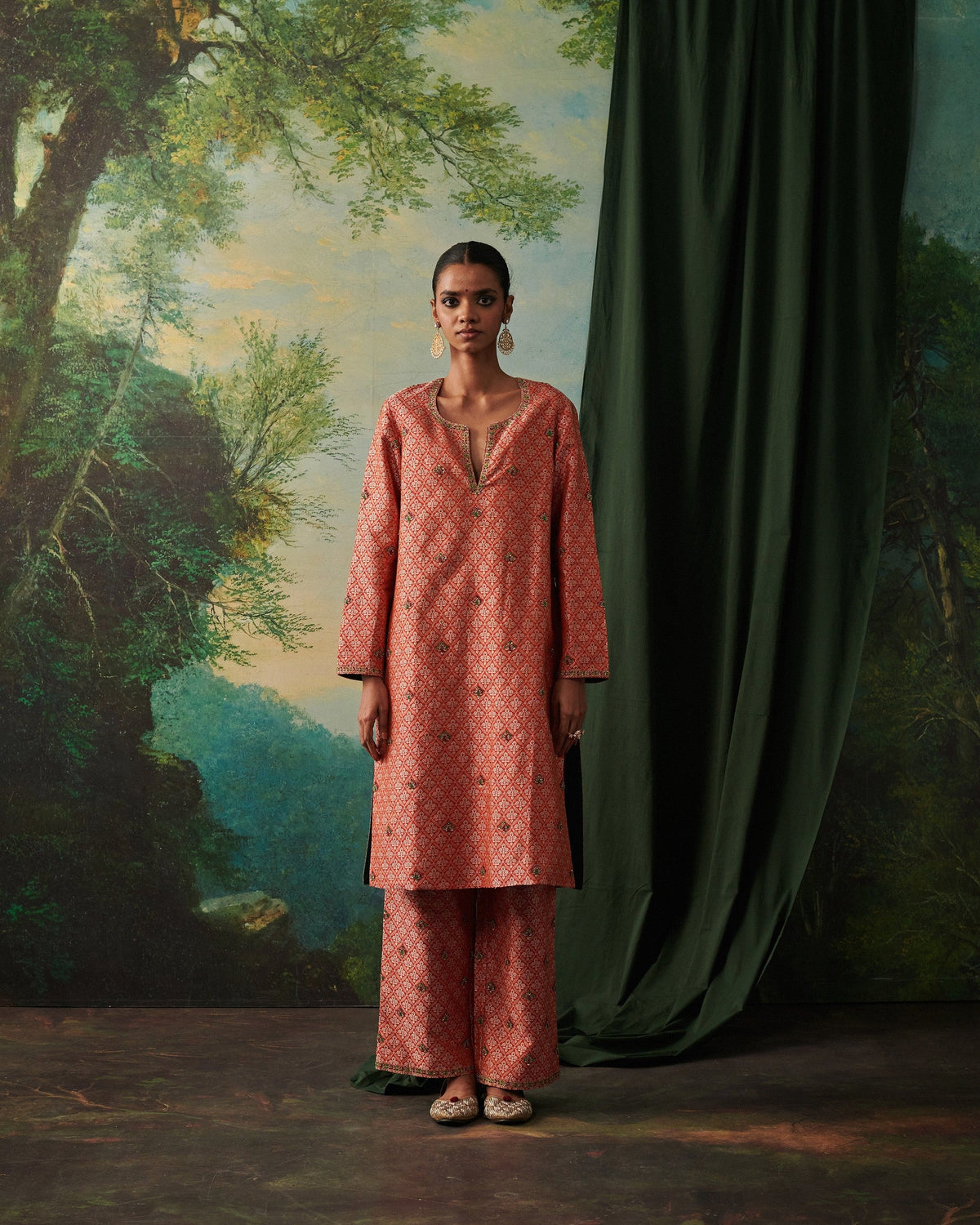
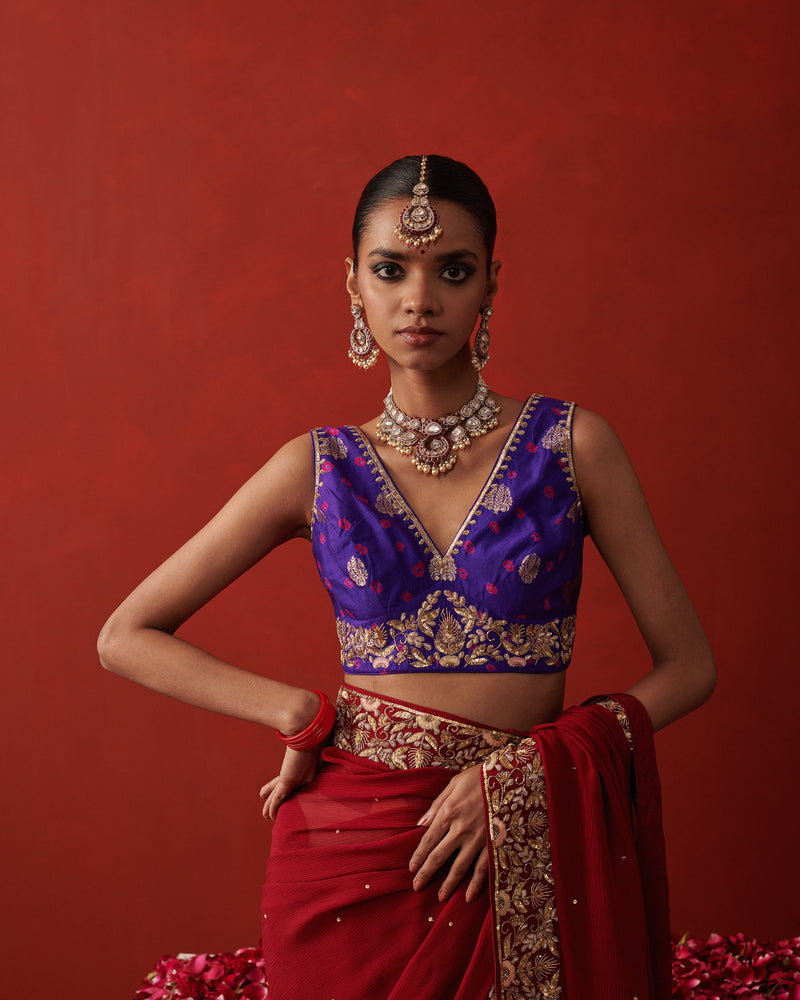
Two pieces are made in pure handwoven Banarasi silk. Because each length is woven on a traditional loom, the weave can differ slightly from the photograph, and if the original is unavailable we offer the two closest alternatives. The Alfia kurta with Ruhab pant (₹33,750) has gold floral bootis across the cloth, a relaxed silhouette and hand embroidery in sequins, cutdana and thread in green and gold along the neckline, cuffs and back yoke. The Abeer blouse (₹11,495) is bandhani Banarasi silk with a wide V-neck, hand-embroidered with paisleys and florals in sequins, cutdana and resham: one blouse that can be worn over several sarees you already own.

For a saree, the Phalgun saree with Myra blouse (₹27,500) is yellow Banarasi silk with floral motifs woven in silver thread and a rich lace border, with an ivory blouse covered in floral butis. The Rehmat lehenga with Vasl choli (₹42,500) is red Varanasi silk brocade with gold zari work all over and a broad gold border at the hem; the dupatta is not included.


Handwoven chanderi
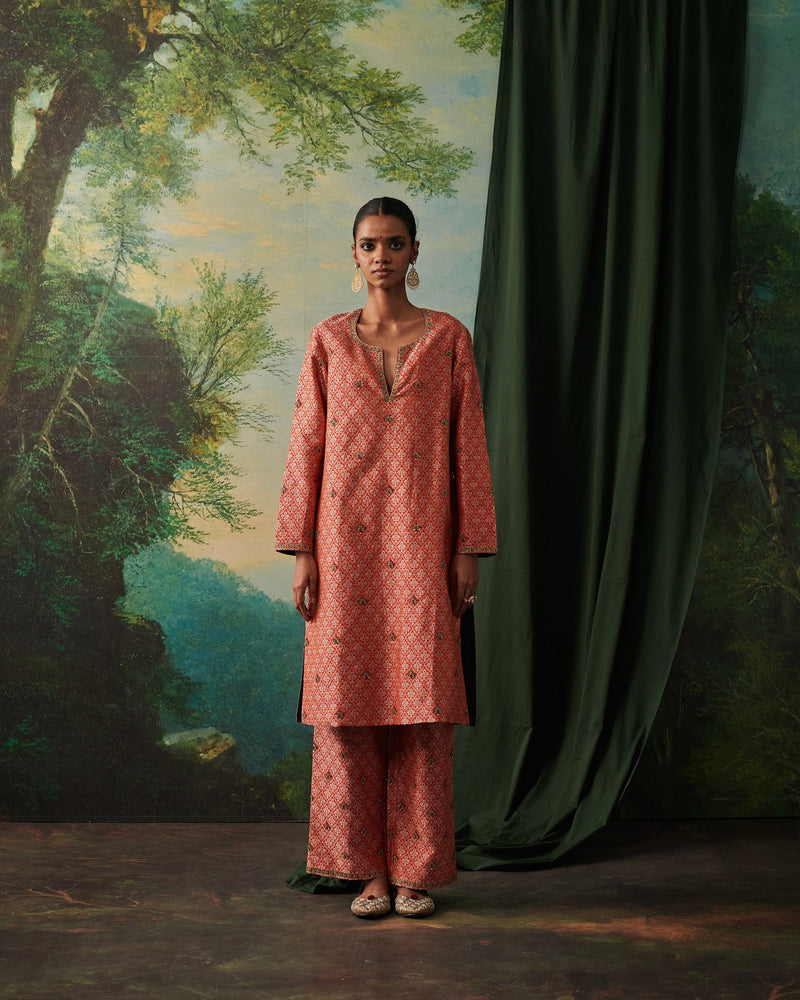
Chanderi is light, breathable and one of India's best-known handwoven fabrics; our chanderi guide explains the weave. The Naveli kurta with Ruhi pant (₹38,500) is dusty rose chanderi with floral aari, zardozi, sequin and thread work around the neckline, sleeves, back and hem. The Haniya kurta with Mithila pant (₹21,000) is magenta chanderi in a classic A-line, with gold thread, sequin and multi-colour thread work along the sleeves and hem. The Faasle top with Mogra pant (₹27,500) is an ivory silk chanderi peplum top with golden floral embroidery, over dhoti-inspired silk cotton zari pants.


For something easier, the Rangrez kurta with Aliza pant (₹18,750) is moonga silk brocade woven with gold motifs, over silk pants with a floral jaal print lifted with aari and zardozi hand embroidery. And bandhani, a resist-dye craft, appears in the Gulnaaz dupatta (₹8,500), bandhani silk in a muted brown with zardozi, sequin and cutdana paisleys at the corners. A dupatta is the most re-wearable thing we make. See more in the kurta collection.
A timing note: made to order over 4–5 weeks plus 3–7 days shipping, anything ordered today arrives around the third or fourth week of November at the earliest, which is too late for Diwali on 8 November but in time for winter weddings. Express making is sometimes possible, depending on the piece and the month, so ask on WhatsApp. Shipping is free on domestic orders above ₹30,000. Our made-to-order guide explains the process.
Made to Order, Embroidered by Hand in Jaipur
Kurta sets, sarees, lehengas, blouses and dupattas on handwoven chanderi and Banarasi, hand-embroidered by karigars in our Vaishali Nagar atelier over 4–5 weeks, with custom measurements at no extra charge. Tell us your dates on WhatsApp and we will tell you honestly what is possible. Browse everything we make.
Shop the CollectionMore brand and craft guides: best Jaipur designer labels · best Indian designer brands · sustainable bridal fashion
Frequently Asked Questions
Which are the best sustainable Indian ethnic wear brands?
It depends on the practice you care about. For handloom: Raw Mango, Anavila, Eka and Injiri. For natural dyes and hand-spun cotton: 11.11/eleven eleven and Anokhi. For upcycling: Ka-Sha's Heart to Haat line and Upcycled by Péro. For craft at scale and lower prices: Fabindia and Jaypore.
How can I check whether a saree is really handloom?
Look for the Handloom Mark, the government label for handwoven textiles run by the Textiles Committee. Newer labels have a QR code you can scan with the Handloom Mark app or check at hlm.gov.in to see the weaver and place of origin. The India Handloom Brand also endorses quality and social and environmental compliance.
Are azo dyes banned in India?
Some are. India banned the handling of 42 benzidine-based dyes in 1993 and 70 further azo dyes in 1997 under the Environment (Protection) Act, because they can release harmful amines. Not every synthetic dye is a banned azo dye, so if dyes matter to you, ask a label directly whether it uses natural dyes and on which parts of the garment.
Is made-to-order clothing more sustainable?
It removes one big source of waste: stock that is made, never sold and discounted or discarded. Made to your measurements, it should also need less alteration. It says nothing on its own about fibres or dyes, so check those separately.
Is Rashika Mittal a sustainable brand?
We would rather tell you exactly what we do. Everything is made to order, hand-embroidered by karigars in our Jaipur atelier, often on handwoven cloth we buy and embroider, with custom measurements at no extra charge. We make no organic, natural-dye or zero-waste claims and hold no sustainability certification.
Made to order in 4–5 weeks
Have an event date? We’ll tell you exactly when to order by.
We take a limited number of orders each month — secure your slot early.
WhatsApp me my order-by date + a shortlistNot sure where to start?
Tell us what you're dressing for and we'll help you choose — fabric, fit, colour, and timeline — over WhatsApp or on a video call.
Your Cart
Pieces from this story
All pieces →Not sure which piece, or need it by a date? Book a video consultation Ask us on WhatsApp


Keep reading
The journal →
Sustainable Indian Fashion: Why Handmade Is the Future
India's handmade fashion tradition is the original sustainable model. Discover why handcrafted Indian wear — made by ...
4 March 2026
Earth Day 2026: Why Handmade Fashion Is the Most Sustainable Choice
Earth Day 2026: How handmade, made-to-order fashion is more sustainable than fast fashion. Zero waste, natural materi...
10 April 2026
How to Care for Indian Fabrics: The Complete Laundry & Storage Guide
The complete guide to washing, ironing, and storing Indian fabrics — silk, organza, chiffon, chanderi, Banarasi, and ...
13 March 2026